








Israel has unveiled a bill to oversee West Bank antiquities, drawing condemnation as a violation of international law and a further escalation of its annexation of Palestinian territory.
The bill was approved for a first reading by the Israeli Knesset’s Ministerial Committee on Legislation on February 8. It would give Heritage Minister Amihai Eliyahu “sweeping authority” to appoint the governing council, designate antiquity sites, and expropriate land and artifacts across the West Bank. The legislation is set to undergo three readings in the Knesset Plenum, the chamber’s highest legislative body, and is likely to be passed later this month.
In a joint statement, the advocacy groups Peace Now and the Geneva Initiative, together with the Israeli NGO Emek Shaveh, called the bill an “extraterritorial annexation” that “poses a serious threat to the viability of a negotiated two-state solution.” The statement also warned that the legislation violates the 1954 Hague Convention and the Fourth Geneva Convention, “which prohibit an occupying power from making permanent institutional changes or exercising sovereign rights.” It added that “applying Israeli authority to Areas A and B would effectively dismantle the Oslo II Accord, which assigned civilian responsibility for antiquities to the Palestinian Authority.”
The Oslo Accords, signed in 1993 and 1995 between Israel and the Palestine Liberation Organization, divided the West Bank into three administrative areas: Areas A, B, and C. Under the accords, the Palestinian Authority manages heritage in Areas A and B, while Israel retains authority over heritage sites in Area C and oversees security in Area B. “The Oslo II framework recognized that these ancient sites are the shared heritage of both Israelis and Palestinians and stipulated the establishment of a joint Israeli-Palestinian committee for governing antiquities (Annex III, Article 2: Archaeology),” the statement reads, adding, “The committee never met, but the rationale that informed its creation is more relevant than ever.”
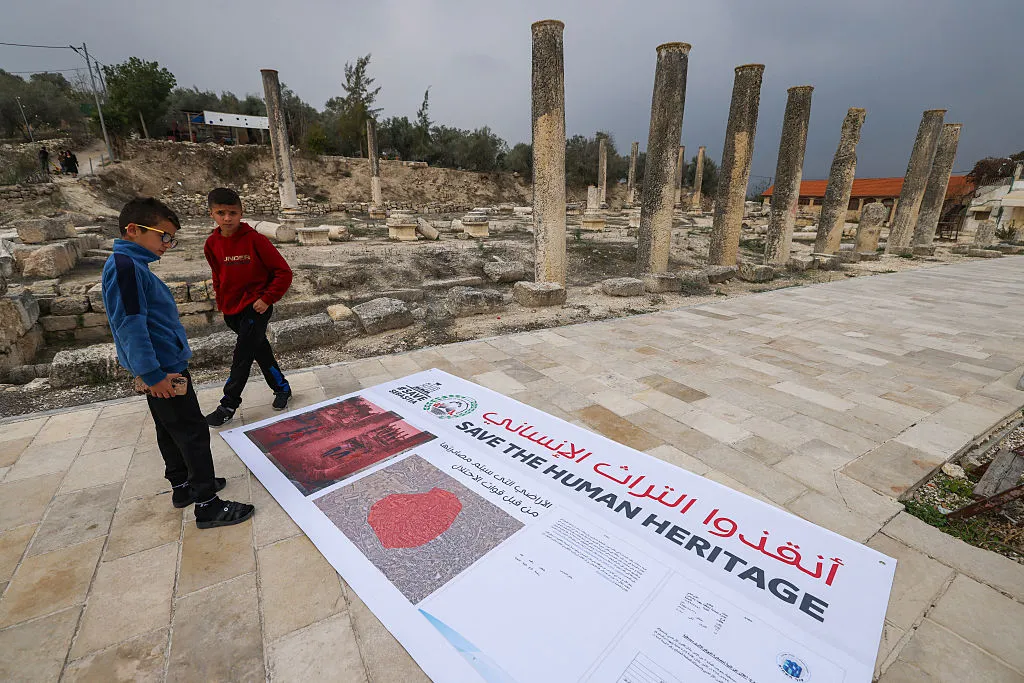
Critics view the new antiquities bill as the latest move to undermine Palestinian land ownership in the West Bank and accelerate the expansion of Jewish settlements. Last week, Israeli authorities announced plans to seize an archaeological site overlooking the West Bank town of Sebastia in Area B, which the Sebastia’s mayor, Mahmud Azem, described as an “aggression” against the roughly 3,500 Palestinians who rely on tourism to the site and nearby olive groves for their livelihoods and a “violation of the history and the heritage of Palestine.”
Sebastia, both the archaeological site and the town, has been on the tentative UNESCO World Heritage list for Palestine since 2012, recognized as a cultural crossroads spanning millennia. Its layers of history span the Iron Age, the Hellenistic and Roman periods, the Byzantine and Crusader eras, and Mamluk and Ottoman rule. This rich past has become central to the ongoing dispute over its control.
Israeli authorities have sought to re-designate the site as Israeli territory, citing biblical references and Sebastia’s role as the capital of the northern Israelite kingdom of Samaria between the 9th and 8th centuries BCE.
The argument is common among settlement movement leaders, who often refer to the West Bank by the names of the Iron Age kingdoms that once ruled there—Judaea in the south and Samaria (Shomron in Hebrew) in the north.
Under Israeli plans, the new development in Sebastia would be called Shomron National Park. Covering roughly 450 acres, it would represent the largest land seizure for an archaeological project in the West Bank since the occupation began in 1967. All settlements are considered illegal under international law.
Binyamin Har-Even, the staff officer for archaeology within the Civil Administration, told the Israeli media outlet Channel 7 after the expropriation order was declared in November that Sebastia “is one of the most important archaeological sites in Judea and Samaria. The expropriation will make it possible to protect the remains, rehabilitate the damage, and make the site accessible for future generations. We will continue to act to safeguard the assets of our national heritage.”
In rebuke, Alon Arad of Emek Shaveh, an Israeli NGO dedicated to maintaining archaeological sites “as public assets that belong to members of all communities, faiths, and peoples,” said archaeology was being “weaponized.”
“What is planned for Sebastia is really unprecedented in its scale,” Arad added, describing the plan as “very cynical” and saying it “is not about history… it is really just about land and annexation.”
Local and international outcry against the proposed Israeli legislation has grown since November.
In a statement, Mahmoud Abbas, head of the Palestinian Authority, which governs parts of the West Bank, called the new legislation “dangerous” and “an open Israeli attempt to legalize settlement expansion, land confiscation, and the demolition of Palestinian properties, even in areas under Palestinian sovereignty.”
The foreign ministers of Egypt, Jordan, the United Arab Emirates, Indonesia, Pakistan, Turkey, Saudi Arabia, and Qatar issued a joint statement saying the legislation was “accelerating attempts at its illegal annexation and the displacement of the Palestinian people.”
They warned against “the continued expansionist Israeli policies and illegal measures pursued by the Israeli government in the occupied West Bank, which fuel violence and conflict in the region.”


