







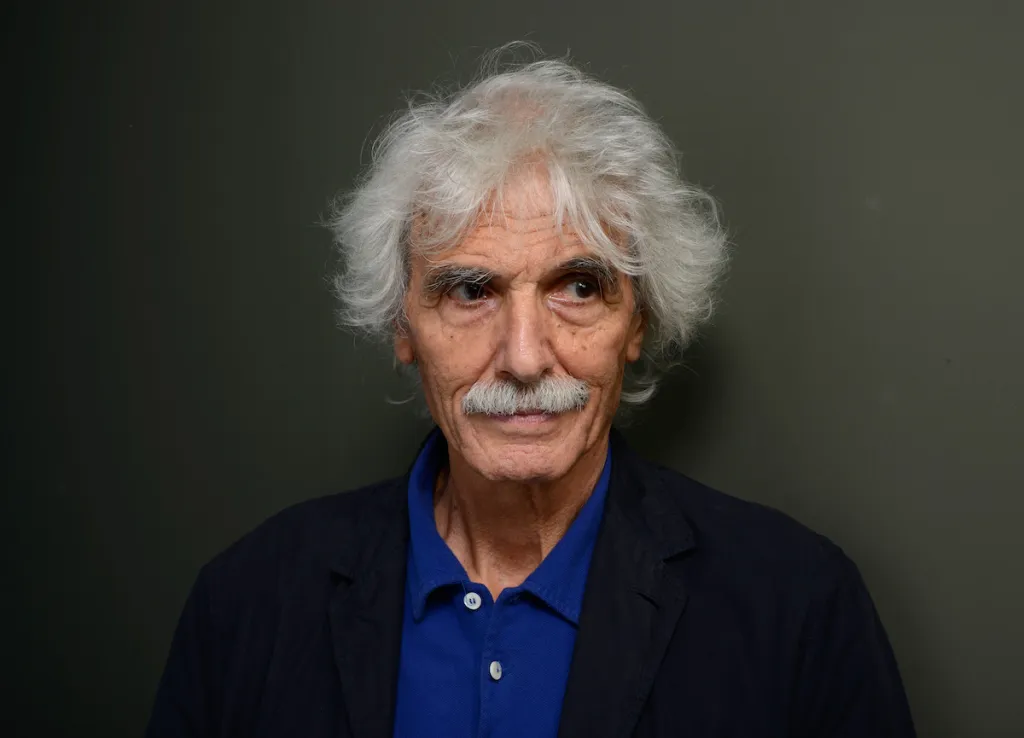
Yervant Gianikian, an Italian filmmaker whose work helped Armenia win the Venice Biennale’s top honors in 2015, has died, according to reports in the Italian press. He was 84.
Frequently working with his partner Angela Ricci Lucchi, who died in 2018, Gianikian produced experimental films that considered forms of dispossession and the lingering pain that often accompanies it. He sometimes appropriated archival footage and then repurposed it, to mull how “history ends up liberating us from the imperium of time,” as curator Marco Scotini put it in when Gianikian and Ricci Lucchi’s work appeared in Documenta 14 in 2017. Frequently, the artists altered the footage they utilized, slowing it down and changing its look in reflection of how events mutate as they are recalled and retold.
Born to Armenian parents in 1942 in Merano, Italy, Gianikian attended the Armenian College in Venice and then went on to study architecture in that same city. He met Ricci Lucchi on New Year’s Eve in 1974, setting off a relationship in life and art that continued until her death.
Together, she and Gianikian would go on to address such topics as French intervention in New Caledonia, Italian colonialism in Africa, the mass killings of Roma people during World War II, and the aftermath of the Armenian genocide.
Their work often moved beyond the screen, into the gallery space. Journey to Russia, a work presented in Documenta 14, began as a quest to make a film about the Russian avant-garde of the 1920s and ’30s in 1989. But by the time the work was shown at Documenta in 2017, the piece came to include a vast array of watercolors that complemented the images spread across six screens.
They also exhibited watercolors at the 2015 Venice Biennale’s Armenian Pavilion, where they were one of 18 participants. Alongside the video Return to Khodorciur: Armenian Diary (1986), Gianikian and Ricci Lucchi displayed hundreds of watercolors that visualized fairy tales narrated by the former artist’s father, who survived the Armenian genocide. The pavilion ended up winning the Biennale’s Golden Lion, in a gesture partially meant as a recognition of the massacre, which took place under the Ottoman Empire 100 years beforehand.
While their films frequently played at festivals across the globe, their work was also shown in an art context. Gianikian and Ricci Lucchi exhibited their work at the main exhibitions of the 2001 and 2013 editions of the Biennale, curated by Harald Szeemann and Massimiliano Gioni, respectively, and were the subject of a retrospective at Milan’s Pirelli HangarBicocca in 2012.


