






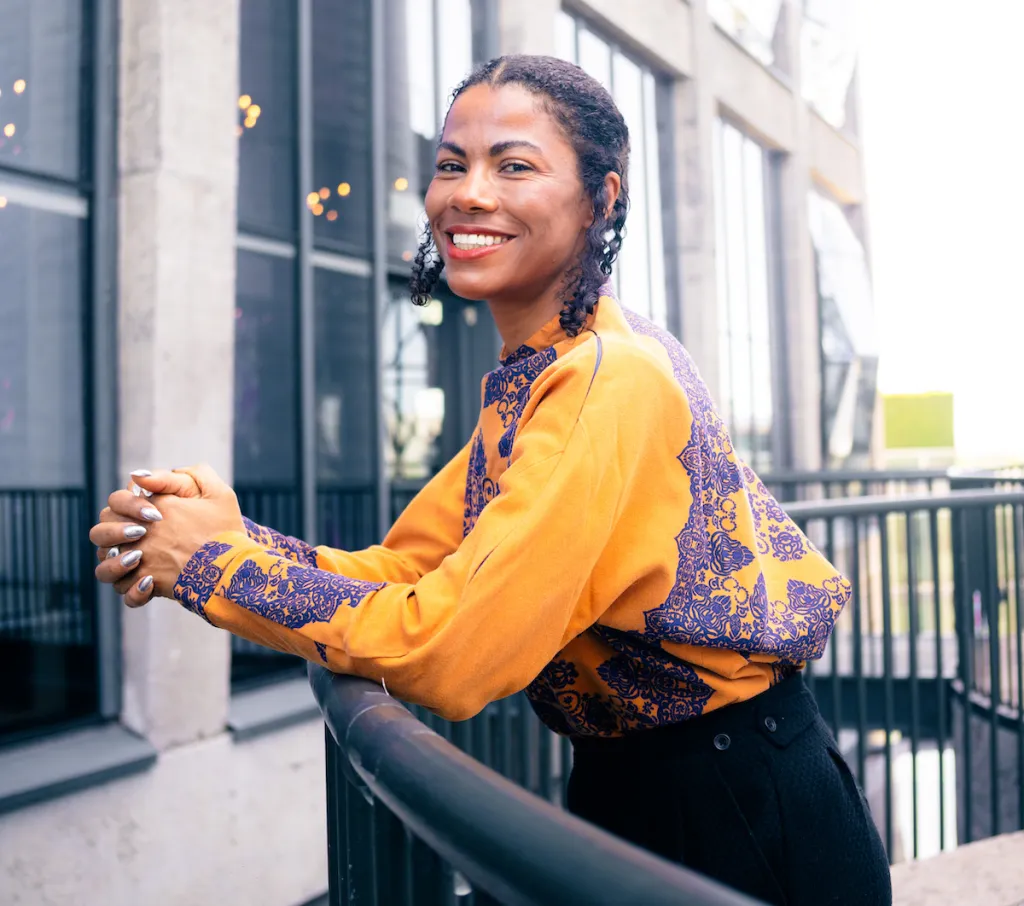
In 2023, Beata America, a curator for the Zeitz Museum of Contemporary Art Africa, made a research trip to Ghana. Accompanied by her colleague Julia Kabat, America ended up visiting the Accra studio of Zohra Opoku, a Ghanaian German artist whom Zeitz MOCAA director Koyo Kouoh “had always spoken really highly of,” as America recalled to ARTnews. Despite having never met Opoku before, America “just fell in love with her studio practice immediately,” the curator recalled.
America and the rest of the team at Zeitz MOCAA “really tried to figure out a way that we could engage with Zohra’s work more,” she said. “So when the time came to look at the exhibition schedule and look at prospective shows, her name easily came up for me for a solo exhibition.”
That show ended up becoming Opoku’s first museum survey, which opened in September at Zeitz MOCAA. Curated by America and Phokeng Setai, the show is titled “We Proceed in the Footsteps of the Sunlight” after a passage from the Egyptian Book of the Dead, an ancient funerary text guiding the soul beyond the physical world.
“I felt very privileged and honored to be in this position,” said Opoku about attending the exhibition opening, speaking via video call from Accra. The show “almost feels surreal. It almost feels like you are watching your life from the outside.” Opoku described being moved by the opportunity, especially because she has it in a space embodying the legacy of Kouoh, who died last year, before she could see her Venice Biennale realized. Kouoh’s “footprint is enormous,” said Opoku.
Zohra Opoku’s Zeitz MOCAA show.
Photo Slater Studio/Courtesy Zeitz MOCAA
On view through October 4, the exhibition is anchored by three recurring subjects: water, to signal the fluidity of practice and sanctification of daily rituals; breath, both in the context of life and death; and ground as a stabilizing force of nature, a site of comfort, rootedness, identity, and familial belonging.
“I felt like it’s perfect, moving to Ghana [from Germany] and then just becoming focused on art,” said Opoku. The relocation helped in “being connected emotionally, spiritually with the heritage of my dad. [Relocating] also helped a lot with research, travel and [having] one-on-one conversations to actually understand what my father left for me. I think what you see at Zeitz is pretty much also representing very well how I grew up as an artist in Ghana, especially.”
Often, Opoku centers the experiences of women. Her work QueenMothers (2016) is an examination of the influential roles that matriarchs play in southern Ghanaian communities and society. To explore the Akan concept of Sassa, referring to an invisible but ever-present and occasionally vengeful spirit brought about by the unresolved issues of a deceased person, Opoku spoke to several queen mothers from across the region. She went on to memorialize these queen mothers, taking photographs that show them doing a traditional Ashanti dance known as Adowa, as a way to “capture their spirit, their lively nature [and] their beautiful dresses,” said Opoku.
In addition, the artist looked to libraries at the University of Ghana in Accra and an academic at the African studies department of the Kwame Nkrumah University of Science and Technology in Kumasi. “You really wonder where all this information ends up when we don’t write it down,” she said. “For me, it was really important to learn about it and to speak about it.”


Zohra Opoku’s Zeitz MOCAA show.
Photo Slater Studio/Courtesy Zeitz MOCAA
Opoku was born in 1976 to a Ghanaian father, who was a traditional leader and a German mother in the former East Germany town of Altdöbern, and was raised by her mother and her maternal grandparents. Opoku first visited Ghana in 2003, relocating some eight years later to the country, where she always felt at home when she visited to connect in all aspects with her heritage, as she has previously put it. There, she began to focus more fully on her art practice.
Inspired by her cultural heritage, Opoku explores identity, belonging, and memory through textiles, photography, screenprints, installations, and sculptures. But of all the mediums she has utilized, she spoke most about textiles, which she said had “fascinated” her from a very young age. As a kid, she observed how her grandmother handled sheets and tablecloths “diligently,” she shared. She noticed how textiles blew on a clothesline in the family’s garden. As the wind dried these textiles, Opoku thought they became sculpture. Then they became delicate all over again when ironed. Opoku’s family members also practiced embroidery, crocheting, and knitting, but she was interested in sewing. “I think from the very beginning, I handled textile like it was second nature,” she said.
Trained in fashion design and photography in the German city of Hamburg, Opoku often screenprints photographs onto pre-dyed natural fabric, then embroiders onto her materials and even adds collaged imagery. Her gallerist Mariane Ibrahim called her a “woven storyteller who is conceptually involved with the idea of creating stories and patches of stories in a sort of a continuum,” adding that the artist’s work is “extremely personal.” Ibrahim, whose award-winning 2017 Armory Show booth featured work by Opoku, praised the artist as a “shapeshifter.”
Zohra Opoku, O lord of offering…, 2023.
Aurélien Mole/Courtesy Mariane Ibrahim
The Zeitz MOCAA show highlights how Opoku also moves freely between small- and large-scale ways of working. “The scale in which Zohra works is huge. [The] dynamism in her practice. It evolves constantly,” said America, the Zeitz MOCAA curator. “It’s one of the things we’re actually focusing on in this exhibition as a survey, is to look at this 10-year period, how her practice has evolved, shapeshifted, and [has] gotten to different levels.”
Opoku praised the curators for an “incredible job,” adding “my personal recommendation for everyone who goes into the exhibition is to really make time to read the work description. It changes the entire experience of walking through. It’s beautifully written.”


