







The Rietberg Museum in Zurich, which dates to the early 1950s, owes its origins to a collection largely amassed in the 1920s and 30s by German-Swiss banker Eduard von der Heydt, who regarded his objects as art rather than anthropological specimens or colonial souvenirs. Nevertheless, among his holdings were pieces originating in the Kingdom of Benin, now in present-day Nigeria, whose remarkable sculptural heritage was looted and then dispersed after its capital, Benin City, was raided by British forces in 1897.
Now, the Museum Rietberg will join its fellow European institutions—among them Berlin’s Ethnologisches Museum and Holland’s Wereldmuseum Leiden—in restoring ownership of several of these works to Nigeria. Today, the city of Zurich, which owns the Rietberg, is announcing that 11 objects in its permanent collection are being transferred to the Republic of Nigeria, represented by the National Commission for Museums and Monuments.
Two of the objects are of particular significance, says Rietberg director Annette Bhagwati.
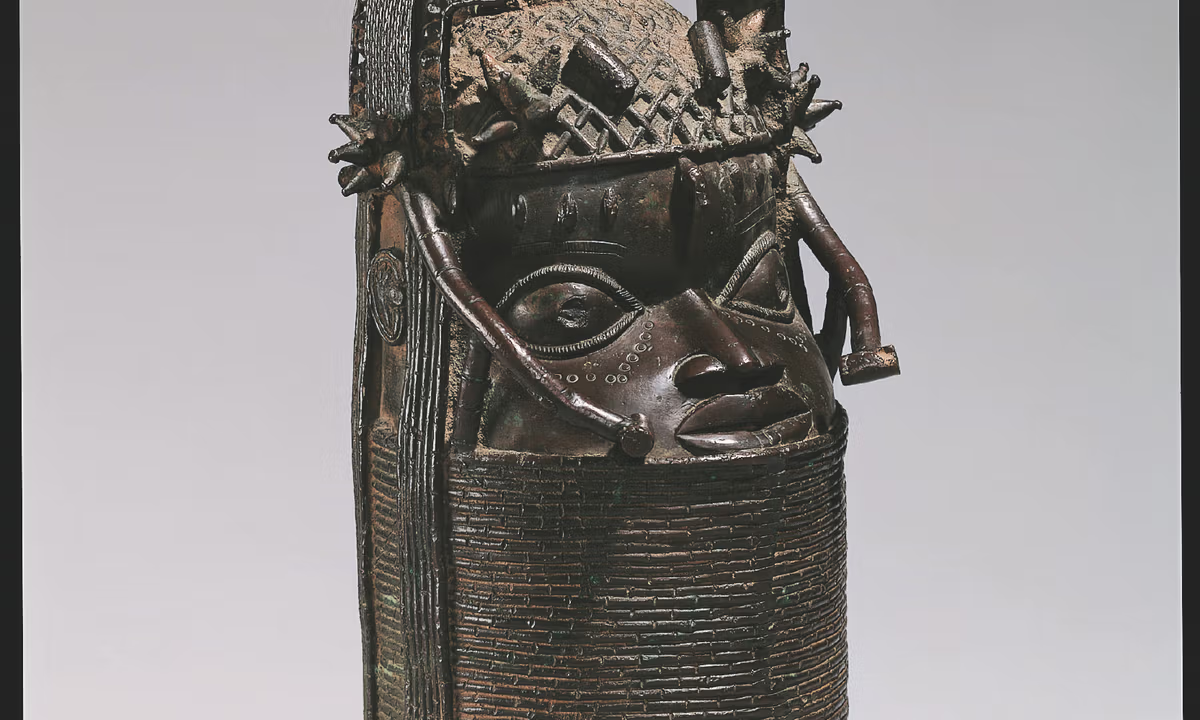
A commemorative bronze head, from around 1850, is a representation of the ancestor of a chief and would have been placed in the king’s ancestral shrine. Looted in 1897, it later passed into van der Heydt’s collection sometime before 1927. An 18th-century ivory tusk, also located on an ancestral shrine in the Royal Palace in Benin City, was mounted on a bronze memorial head and told the story of an Oba, or chief, from the 17th or 18th century. Its wayward path from Benin City to Zurich took it through a number of British collectors and a Sotheby’s London sale in 1962, before finally reaching the Rietberg, via a Zurich dealer, in 1993. These two works, which are “ritual objects of great importance”, says Bhagwati, will be sent back to Nigeria, likely this summer. But the other nine objects, in spite of their changed ownership, are staying put.
“The Nigerian side was very interested in the idea that the history and the artistry of Benin would still be told in Switzerland,” Bhagwati tells The Art Newspaper.
Another object looted in 1897, whose ownership will change but whose location will stay the same, is a pendant bronze mask dating as far back as the 17th century. Also found in Benin City’s sacked Royal Palace, it didn’t arrive at the Rietberg until 2011. After an auction in 1902, it was sold to German and American collectors, before returning to Europe after a Dutch dealer acquired it in 2009. Now it will stay on in Zurich as a permanent loan.
The transfer of these objects is an outgrowth of the Benin Initiative Switzerland (BIS), launched in 2021 under the leadership of the Museum Rietberg. The BIS sought to identify the connection of dozens of Benin objects in Swiss museums to the looting of 1897. The initiative concluded that 55 objects were probably connected in some way to the events of 1897.


