








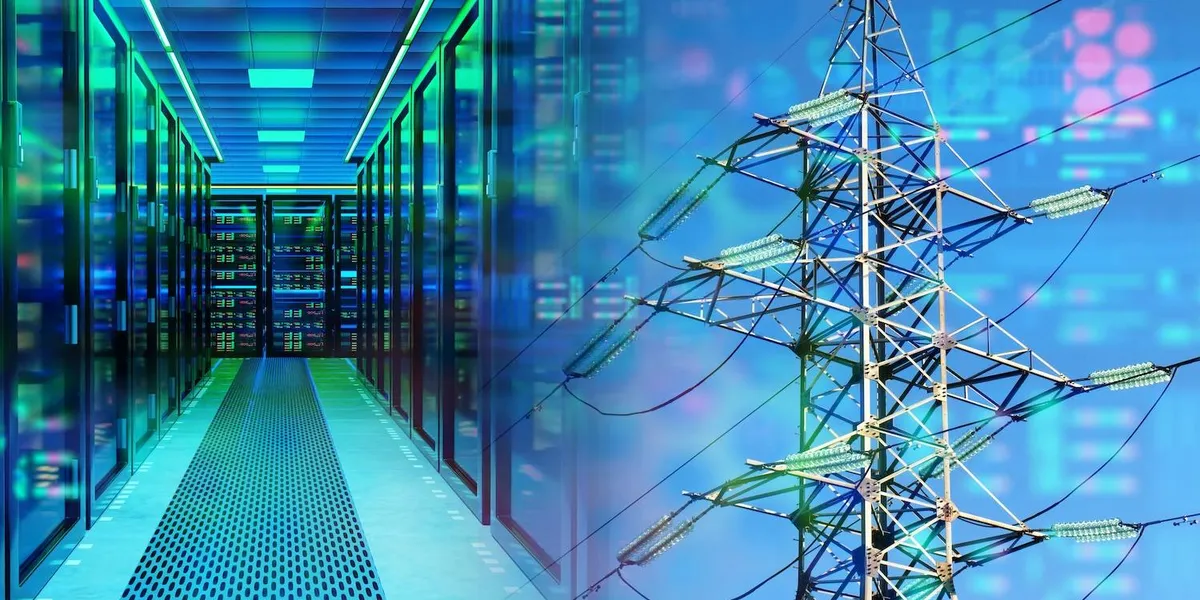
AI’s biggest constraint may have little to do with technology. The real challenge is building enough physical infrastructure to power its expansion.
That’s the view of Bruce Kahn, PhD, senior portfolio manager at Shelton Capital Management and a lecturer at Columbia University, who spoke with the Investing News Network about where he sees the strongest investment opportunities in the AI boom.
From grid capacity and corporate power deals to federal policy, Kahn pointed to a common thread throughout the conversation: AI may be advancing at unprecedented speed, but its growth ultimately depends on the physical infrastructure needed to support it.
The reality of AI revenue
Kahn believes a meaningful share of the new data center capacity being built right now may end up serving crypto operations rather than AI workloads.
He argued that the cryptocurrency industry represents a more tangible source of compute demand, because it has immediate, proven revenue behind it. “We have yet to see any real revenue generation from (AI),” he said.
That skepticism lines up with the numbers from this earnings season S&P 500 (INDEXSP:.INX) profits jumped 52.6 percent in the second quarter, the biggest year-over-year gain since 2021, but a meaningful share of that wasn’t operating profit.
Alphabet (NASDAQ:GOOGL) posted a roughly US$98 billion gain tied to its stake in SpaceX (NASDAQ:SPXC), Amazon (NASDAQ:AMZN) a similar US$53 billion gain tied in large part to its stake in Anthropic.
Without those one-time gains, earnings growth was still a strong 33.8 percent, but much of what’s left is concentrated in the companies selling into the AI buildout, like chipmakers, rather than proof that end users are paying enough to justify it.
The spending is also outrunning even genuine revenue. Meta’s (NASDAQ:META) results show US$31.1 billion in quarterly capital expenditures left the company with just US$784 million in free cash flow, even though it does have real, working AI revenue to point to, like its Advantage+ ad tools, now running at a US$75 billion annual pace.
And the spending shows no sign of slowing; Alphabet raised its 2026 CAPEX guidance to US$195 – US$205 billion and Meta to US$130 – US$145 billion. Microsoft (NASDAQ:MSFT), which dropped the US$37 billion AI revenue run-rate figure it touted in April without explanation, told investors to expect capital spending to keep growing into next year during its latest earnings call.
Additionally, a large share of Microsoft’s headline backlog growth traces to a single customer, OpenAI, which by most accounts is dependent on continued outside fundraising to make good on those commitments, meaning a large portion of the AI buildout’s demand is tied to companies promising to pay with money it hasn’t fully raised.
Feeding into that is a broader pattern analysts have flagged across the industry: NVIDIA (NASDAQ:NVDA) has taken stakes in companies like OpenAI and CoreWeave that then use that capital, directly or indirectly, to buy Nvidia chips, a circular structure that some analysts have called out as inflating the appearance of demand without necessarily reflecting revenue from actual end users.
Whatever is driving the demand, Kahn was unambiguous that the mismatch between capital deployment and physical grid buildout is a current risk, not a future one. “We’re already at the bottleneck,” he said. “The hyperscalers and the data center demand, the compute demand, is already well beyond what we can power and hydrate or cool.”
He expects frontier AI model providers will raise subscription prices to ration scarce compute and bandwidth, and users may see system performance degrade as constraints bite. He also suggested the bottleneck itself is part of why AI companies are moving to go public now, timing their IPOs to capture value while compute scarcity supports high valuations.
The reality of infrastructure
On hyperscalers’ efforts to sidestep the grid entirely through off-grid solutions such as leased jet turbines and small-scale on-site solar, Kahn sees these as short-term stopgaps, not a lasting fix. Regulatory pushback is unlikely to force hyperscalers off self-generation, he said, but self-generation also won’t scale far enough on its own.
The long-term answer, in his view, is a return to large, centralized power, which he expects to be “more nuclear than renewables” at the scale AI and broader electrification will require.
Asked whether AI demand is acting as a catalyst for private capital flowing into nuclear and clean energy, Kahn said electrification broadly is the driver; it’s not AI alone.
However, he flagged a large pool of private credit “dry powder” that fund managers need to deploy quickly, with thin covenants, as a separate “more pernicious” dynamic than simply hype.
As the best opportunities get funded, he said, that capital increasingly moves into second- and third-tier projects, raising risk. Fund managers, having largely exhausted institutional demand, are now pushing evergreen alternative-investment products into wealth management channels.
The power buildout and the private-credit overhang are two trends that arose independently and simply happened to collide at the same moment.
“These two things, I don’t think were planned, but the timing is interesting,” he said. AI and data centers have become a convenient landing spot for capital that needed somewhere to go, a “de facto receptacle,” rather than a specifically well-underwritten opportunity.
Demand vs. reality
The idea that a single AI-driven megatrend is really several independent stories that happened to land on top of each other is also how Kahn frames demand numbers.
Earlier this month, Wood Mackenzie estimated that only around 28 percent of the roughly 1,066 gigawatts of US data center power currently in interconnection queues will actually get built, citing “phantom” projects and speculative capacity requests. Presented with that figure, Kahn pushed back slightly – “split the difference and call it 50 percent” – but agreed the broader point holds: a meaningful share of announced capacity won’t materialize, and even legitimate projects may take longer than markets expect.
What doesn’t change, in his view, is the underlying build-out of power itself.
“The power is going to get built,” Kahn said.
Whichever story actually pays off, whether it be AI, crypto or broader electrification, the physical demand for power doesn’t go away.
It’s a point Kahn returned to when asked directly whether chip-level efficiency gains, such as Nvidia’s Blackwell-to-Vera Rubin architecture, AMD’s low-precision math formats or Google’s custom TPUs, buy enough time for grid infrastructure to catch up. His answer was flat: no. “The demand for power is so much greater than the next-level efficient chip,” he said.
Asked about community resistance to new data centers, Kahn didn’t dismiss it.
“It’s not a side story. It has become the story,” he said, attributing much of the backlash to fear over water and energy costs and jobs. But he said he doesn’t think the pushback is moving equity valuations, and it won’t change the longer-term trajectory toward more digitization and more power demand, even as it delays or kills individual projects.
The real trade: Picks, shovels and wires
That’s also the logic behind how Kahn invests. He said he avoids trading hyperscaler valuations or making calls on macro variables like FX and interest rates, calling that kind of positioning “guesswork.” His approach is to find physical, structural supply-and-demand trends that hold regardless of which AI company wins, which data center gets finished or whether the AI revenue story ever fully materializes.
That means grid equipment, materials and infrastructure, what’s been called the “picks and shovels” of the buildout.
He used digital water metering as an example. “I know a water utility has to go from analog to digital, so they need digital water metering systems. That is without question… whether the US dollar–Japan yen trade upends the long end of the curve or not doesn’t really affect the need for water metering equipment, and they’re going to buy it.”
On where growth is actually concentrating, Kahn was careful to frame this as information for evaluating equipment suppliers selling into those markets rather than a case for investing directly in data center real estate in those regions.
He pointed to ERCOT (Texas) and PJM as the dominant hubs, because their permitting and interconnection systems remain far ahead of other regions.
At the time of the interview, ERCOT was roughly two and a half weeks into a state-ordered freeze on new data center interconnections. Gov. Greg Abbott had directed a full audit of the 474 gigawatts of pending requests, with ERCOT not expecting to complete it until December.
That freeze might suggest ERCOT is more overwhelmed than ahead, or it might be read as a symptom of exactly the advantage Kahn described: so many projects rushed toward the fastest-moving grid that it had to pause and catch up.
On specific sectors, Kahn pointed to geothermal, both conventional and advanced, as genuinely promising, noting that conventional geothermal already works at scale today despite technical challenges like heat degradation in a given resource.
More unexpectedly, he said he remains constructive on wind power, arguing that political efforts to block major wind projects are, in his reading, a signal that the projects are economically significant rather than evidence they should be abandoned.
He extended similar logic to carbon capture and storage: large multinational companies operate on 20-to-30-year investment horizons, he said, and are prepared to litigate through moratoria rather than abandon already-contracted projects.
The bottom line
Strip away the AI narrative, in Kahn’s view, and what’s left is a set of separate, ordinary stories that happen to have converged at the same moment, around the same physical infrastructure.
His portfolio is built to be indifferent to which of those individual stories turns out to be right: not the hyperscalers racing to secure power, but the industrial and utility-side businesses that get built out either way.
Don’t forget to follow us @INN_Technology for real-time news updates!
Securities Disclosure: I, Meagen Seatter, hold no direct investment interest in any company mentioned in this article.
Read the full article here


