







The race to build AI data centers is colliding with an older, slower power grid- tension that was on full display in a recent panel on data centers and AI power at the 2026 Fastmarkets Global Lithium, Battery and Critical Materials Conference in Las Vegas.
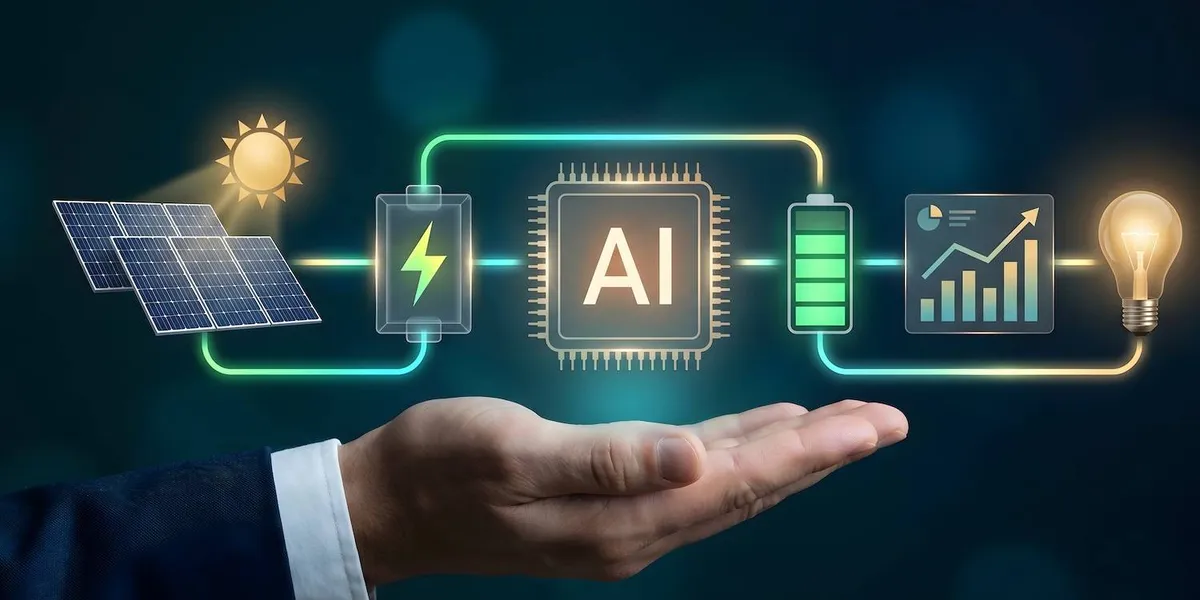
Industry experts described a future in which AI campuses function less like passive electricity users and more like vertically integrated energy companies in their own right.
AI supercomputers consume energy at an unprecedented scale, and GPU hardware iterates on rapid two- to three-year product cycles. Utility substations, high-voltage transformers and power lines, by contrast, move on decade-long timelines. That widening mismatch is becoming a genuine bottleneck for the world’s biggest tech companies.
To keep pace, the data center industry is undergoing a radical transformation. Power technology and energy storage are no longer ancillary infrastructure — they’re becoming the central engineering challenge of the AI era.
The power crisis: Why the grid can’t keep up
Traditional data centers used to run at predictable power densities, roughly 14 kilowatts per rack. The advent of AI hardware has pushed per-rack requirements to 130–140 kW. Today, next-generation facilities are targeting 250 kW per rack, with future designs aiming for 400 to 600 kW, and eventually over a megawatt.
Now, the queue to connect a new large-scale facility to the transmission grid averages five years or more. At the same time, AI training runs create rapid, extreme power swings.
Ben Lowe, a partner at multinational strategy consulting firm Roland Berger, described AI workloads as “frequency regulation on steroids,” causing sudden, high-magnitude volatility that threatens grid stability and local power quality.
Faced with a choice between waiting for grid access or taking control of their own power, AI operators are increasingly choosing the latter by designing campus‑scale microgrids, self‑contained systems that combine on‑site generation, multi‑hour storage and sophisticated controls to run AI factories independently or semi‑independently of the bulk grid.
Lowe suggested that up to half of all new data centers built by the 2030s could attempt to operate off-grid or near-off-grid.
It is, he added, “an incredibly difficult engineering challenge,” but the alternative is waiting in transmission queues that may never clear at the scale AI operators want.
To handle the volatility and sheer speed of power swings, data centers are completely redesigning how electricity moves inside the building.
For decades, facilities relied on traditional Alternating Current (AC) distribution systems paired with diesel generators and backup units built to provide just a few minutes of emergency power.
That legacy setup is being replaced by high-voltage Direct Current (DC) architectures with 800‑volt architectures emerging as the preferred target to eliminate multiple inefficient conversion steps between the power source and the server, while replacing traditional transformers with solid-state alternatives that route power with microsecond precision.
Crucially, this new architecture changes the role of the battery.
Instead of relying solely on massive central backup generators, engineers are placing small battery packs directly inside server racks or beside them as side-cars. These in-rack batteries act as immediate shock absorbers, instantly smoothing out microsecond power surges from heavy GPU workloads before those spikes can trip the main system.
That evolution makes batteries central. In Lowe’s view, storage is “perfectly suited” to handling both sides of the interface.
From an analyst’s perspective, Fastmarket’s Walter Zhang described a sector moving from cell innovation to system and ecosystem design. In the early 2020s, the focus was on ever‑larger cells as the energy storage systems market entered a “fast forward stage.” Now, he said, “people are paying more attention to the system design,” with efficiency, reliability, commissioning and deployment process taking precedence.
Where backup power once meant minutes of runtime, Zhang said customers are now talking about four‑ to six‑hour and even eight‑hour systems. ESS is no longer just a buffer; it is what “supports the operation of the AI data center,” stabilizing power as policies in places like China push renewables to supply AI campuses directly.
All of this plays out against hard constraints: multi‑year interconnection queues, transformer shortages, land and permitting hurdles and, in some jurisdictions, outright moratoria on data centers and storage projects.
The supply chain bottleneck: Scaling up to campus-level storage
While small in-rack batteries protect individual servers from instant spikes, running an off-grid microgrid requires massive, campus-scale energy storage systems capable of powering the facility for four to eight hours at a time.
This creates a new supply chain bottleneck. Brand-new, utility-scale battery cells face multi-year manufacturing backlogs, leaving data center operators with microgrids they cannot fully power.
To bypass factory wait times and get online fast, developers are turning to an unexpected workaround by repurposing retired EV batteries. When an EV battery loses a fraction of its total range, it is routinely replaced, even though it retains up to 80 percent of its usable energy, more than enough capacity for stationary storage.
Claire McConnell, VP of energy storage development at Redwood Materials, used the panel to draw a straight line between EV end‑of‑life packs and AI factory power. Instead of sending batteries straight to recycling, Redwood repurposes them into large‑scale energy storage systems.
At the core is a technology stack built around a “pack manager”, effectively a universal interface that allows the company to connect packs with different chemistries, form factors and capacities from multiple OEMs into “one unified energy storage system.”
Because this approach taps into an existing supply of unused batteries, projects can move from initial order to fully commissioned power in as little as four months.
For AI data centers, McConnell sees batteries doing multiple jobs simultaneously: accelerating interconnection via front‑of‑the‑meter systems, supporting behind‑the‑meter microgrids until grid power arrives, handling transient mitigation where storage interfaces with gas and providing traditional backup.
Crucially, she expects lower‑cost repurposed batteries to make multi‑hour durations economically viable, enabling “value stacking” across use cases in a single asset.
Redwood already processes around 20 GWh annually of lithium‑ion batteries, the equivalent of 250,000 EVs, and positions itself as the largest recycler in the North American market. That also makes it, she said, the largest new source of domestic lithium in decades, the first commercial‑scale nickel operation in the US in a decade, and the largest domestic source of cobalt.
The execution reality: Day two operations and thermal safety
Deploying massive microgrids and second-life batteries solves the speed problem, but it introduces a complex operational reality.
Getting a complex microgrid that combines natural gas turbines, intermittent solar, battery arrays and erratic AI computing loads commissioned is hard. Operating it daily with nearly 100 percent uptime reliability is even harder.
That’s where Anirudh Mulukutla, co-founder and CTO of Phaseshift, argues software and analytics become the real constraint. He maintains success hinges on software and analytics that consolidate multi-asset operations, rather than just adding more data. “One of the internal KPIs we have is how many screens do we eliminate in the customer remote operations center.”
Additionally, concentrating thousands of second-life high-energy lithium-ion battery packs on a single campus creates significant thermal runaway risks. Redwood recently passed UL 9540A fire testing, she said, by re‑racking EV packs in open‑air configurations and spacing them to limit thermal propagation. “If any single pack experiences a thermal event, it will not propagate to its neighbors,” she said.
The new compute
The boundary between computing power and electric power has dissolved. In the AI era, building a tech company means becoming an energy company.
The net result is a sector in which AI demand, power architecture and storage technology are intertwined.
The operators who win the AI race will be the ones who successfully navigate the physical realities of grid queues, high-voltage engineering and multi-megawatt microgrids.
Don’t forget to follow us @INN_Technology for real-time news updates!
Securities Disclosure: I, Meagen Seatter, hold no direct investment interest in any company mentioned in this article.
Read the full article here


