







France’s legendary wine regions enjoyed a beautifully warm July last year, but there was an unexpected shadow for organic grapegrowers. On July 15, 2025, the national health and safety agency ANSES, (Agence nationale de sécurité sanitaire), withdrew market authorization for 19 copper-based fungicides that farmers use to combat downy mildew. The products can no longer be bought or sold as of Jan. 15, 2026. After that, farmers have one year to use existing stocks.
Industry insiders describe this as a genuine shock to the organic wine sector. It leaves organic winemakers confronting an existential question: How do you protect vines from downy mildew when your primary defense has been eliminated?
“Copper is a natural element, naturally occurring in nature,” said Gérard Bertrand, a leading vigneron in southern France and advocate of organic farming. “To get to toxic levels, you have to use much larger quantities. It’s a lot of noise for nothing.”
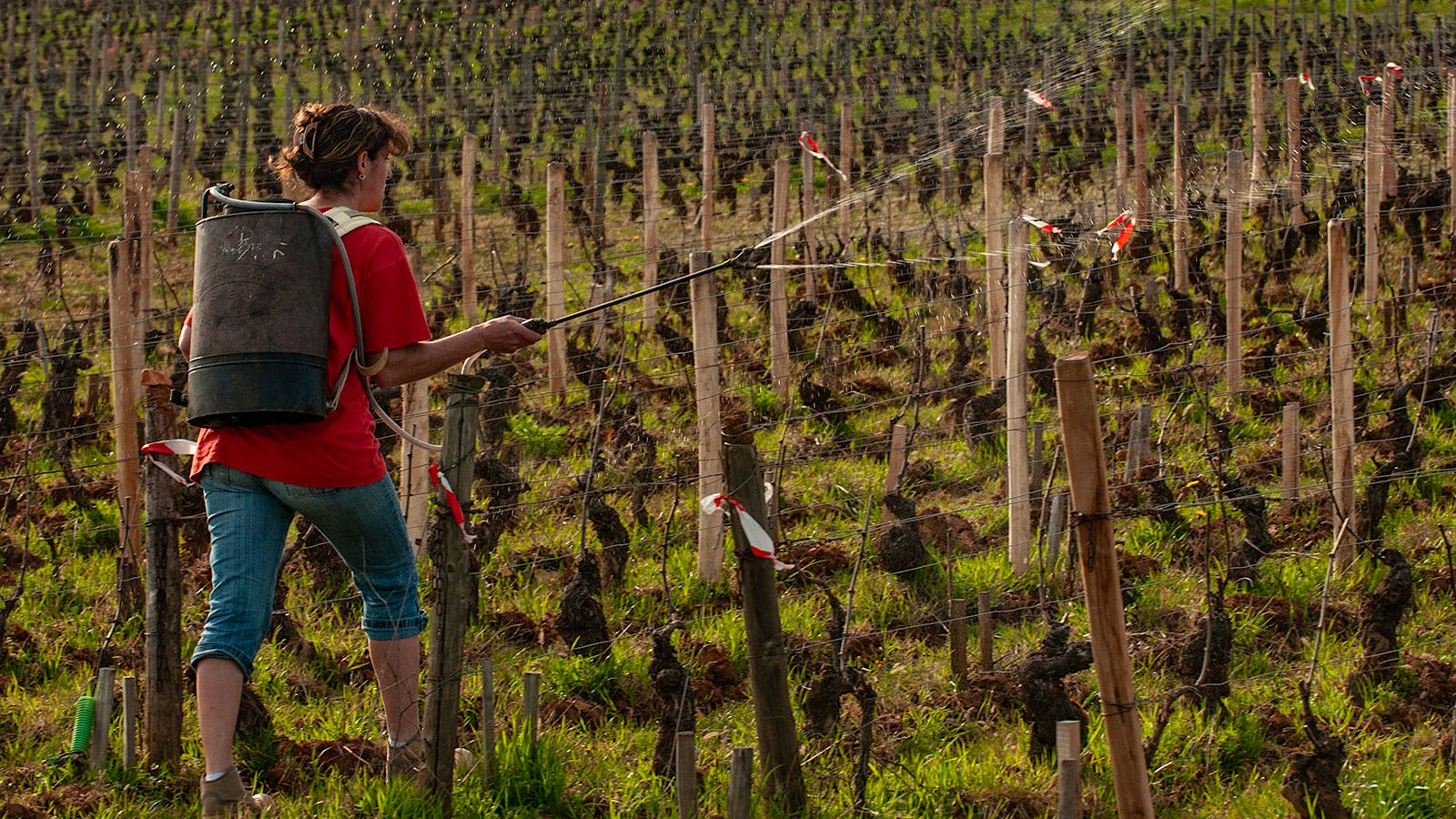
Why are grapegrowers spraying copper onto vineyards? Copper mixed with other materials has served as a key tool for viticulture since 1885, when it was utilized to stave off an epidemic of downy mildew in France, which had arrived in the country as an invasive species. Copper is a naturally occurring element and is approved worldwide for organic agriculture. Critically, there is no equivalent for organic farming. The other options are forbidden synthetic fungicides.
[article-img-container][src=2026-01/ns_sprayed-pinot-noir-011226_1600.jpg] [credit= (Jon Wyand)] [alt= French Pinot Noir vine sprayed with copper.] [end: article-img-container]
Copper, while it does protect vines from fungal disease, is a persistent metal that accumulates irreversibly in the top few inches of vineyard soils. In large quantities it disrupts essential microbial communities and earthworm populations that define healthy terroir. It can also contaminate the waterways that flow through wine regions. There are also mounting concerns about its impact on vignerons and vineyard workers themselves. Repeated exposure during mixing, spraying and handling treated vines poses documented risks of skin irritation, respiratory issues and long-term health consequences for agricultural workers.
French farmers are cognizant of the dangers of excessive use. Current European regulations permit farmers to spray no more than 28 kilograms of copper per hectare (about 2.4 acres) every seven years, averaging 4 kg/ha annually. Yet data from the ITAB Institute (Technical Institute for Organic Agriculture and Food) shows that French organic growers used an average of just 3.72 kg/ha in 2024, a year that included heavy rains in many regions. That suggests winegrowers are voluntarily operating well below regulatory limits.
“It feels like a personal attack against organic farming practices,” said Alexis de Benoist of Domaine Alexis de Benoist in Burgundy’s Mâcon-Cruzille. “We are already using less copper than the authorized annual dosage. [Eliminating it] makes the vines much more fragile and susceptible to mildew.”
ANSES officials justified the withdrawal by arguing that copper spray manufacturers had not provided sufficient worker safety data. But officials in other winegrowing nations in the European Union disagree. The EU extended copper use authorization until mid-2029.
In Alsace, vigneron Julien Klein questioned why France is imposing stricter standards than the EU. “Copper is not the problem. It’s not as toxic as some products still authorized.”
Who Will This Impact?
If you enjoy wines from French regions known for damp weather, the restrictions will have an impact. Mildew pressure defines viticultural survival in places like Alsace, Champagne, Burgundy and Bordeaux.
“Our tool box for fighting downy mildew in the vineyards is greatly diminished now—2024 was a very wet year,” said Pierre-Baptiste Jestin, director of operations for Champagne Leclerc-Briant. “If we hadn’t been able to use all forms of copper to mitigate the effects in organic vineyards here in Champagne, the losses would have been dramatically higher.”
Regarding a way forward, Jestin remains optimistic, hoping that scientific research can devise alternatives to copper. He noted phytotherapy—plant derived remedies such as nettle teas, used by some alongside copper—remains a highly valuable solution in the preventive control of downy mildew. He suggested that perhaps organic viticulture organizations should coordinate to fund research for alternatives to copper that are both effective and natural.
Ironically, officials’ attempts to make farming healthier could lead to less organic vineyards and more chemical fungicides. Industry estimates suggest that 20 percent of organic vineyard land could lose certification due to inability to control mildew without adequate copper options. François Garcia from Hérault’s agricultural chamber described copper as “indispensable” in organic farming. Trade body SudVinBio cautioned that producers may abandon organic practices altogether.
Valentin Mery of Demeter, the biodynamic certification pioneering organization, noted, additionally, that, “There’s hardly any [government] support for farmers seeking to convert to organic. There’s a bit for the conversion process, but afterwards, to maintain organic practices and status, there’s very little, if any, financial support. There are perhaps some tax benefits, but that’s about it.”
What Lies Ahead
Two copper products remain authorized, but they carry stringent restrictions, which may make them less practical. Without viable alternatives to copper, how does organic viticulture survive in regions where Bordeaux’s Atlantic humidity, Burgundy’s continental rainfall, Cognac’s and Champagne’s persistent dampness all create conditions where mildew protection determines vineyard sustainability?
The answer will shape not merely French wine’s future, but the trajectory of organic agriculture across Europe.
Stay on top of important wine stories with Wine Spectator’s free Breaking News Alerts.


