








Against the backdrop of British Prime Ministers Keir Starmer’s resignation and London’s hottest-ever June day, a Sotheby’s double-header evening sale on Wednesday offered a rare note of reassurance. A total of 24 museum-quality works from modernist heavyweights hit the auction block from the collection of billionaire investor Joe Lewis, featuring works by Pablo Picasso, Claude Monet, and Francis Bacon. A modern and contemporary auction followed, containing lots that read like a roll call of resilient blue-chip artists this side of 1860: Alberto Giacometti, Mark Rothko, Egon Schiele, Georg Baselitz, Roy Lichtenstein, David Hockney, to name a few.
“Masterpieces from the Lewis Collection,” as the first sale was titled, realized £296 million ($390 million), setting a record for a single-owner collection sale in London. The “Modern & Contemporary Evening Auction” achieved £97.1 million ($128.1 million). Combined, they brought in a total of £393.4 million ($520.7 million) on Wednesday night, or the “highest total ever achieved in a single night at auction in Europe,” according to Sotheby’s. Over 70 percent of works sold achieved prices in excess of their high estimates. The night’s second half, 85 percent of which sold by lot, marked a 55 percent increase on the equivalent sale last June of £62.5 million ($82.3 million).
There’s a lot of money sloshing around the top-end of the art market right now, as the past two marquee New York auction seasons have proven. The market is trying to recover, but elite collectors seemingly want only trophy works; raging global conflicts, economic uncertainty, and political turmoil have whittled demand down to the safest names. Wet paint auctions feel like a distant memory, with frivolous, speculative art buying, especially from 2020 to 2022, now being passé. Risk-off investing is in, and the houses have been choreographing their sales accordingly.
But “safe” doesn’t simply mean famous. Collectors are competing for works with scarcity, exceptional provenance, and a clear place in art history. Part of that demand is coming from Asia. Sotheby’s reported that Asian collectors bid on half of the Lewis collection lots, scooping up more than a third of the works on offer.
Auctioneer Oliver Barker, the house’s chairman of Europe, was first to helm the rostrum. Kicking off the Lewis collection, Gustave Caillebotte’s Portrait de Paul Hugot (1978) saw more than 30 bids, ultimately selling for £10.2 million ($13.5 million), double its high estimate. “This will set the tone for what will be a record sale here tonight,” Jussi Pylkkänen, Christie’s former global president who runs the London-based Pylkkänen Art advisory, texted via WhatsApp as the hammer came down.
A ripple of applause from Sotheby’s packed New Bond Street salesroom followed the sale of Lot 2, René Magritte’s La Belle Promenade (1965), after it went for a shade over £16 million ($21.1 million). Its high estimate was only £4 million ($5.3 million). Next, Picasso’s Buste de Femme (1938) sold north of its £18 million ($23.7 million) high estimate for £23.8 million ($31.4 million). Henri Matisse’s 1935 canvas Lydia (Étude pour ‘Portrait au Manteau Bleu’) was then snapped up for £3.75 million ($4.9 million), almost double its high estimate. My phone pinged: “This is a cleverly managed start comprising three modernist market darlings, and a stellar work by Caillebotte,” Pylkkänen added.
Half an hour before the sale kicked off, I called David Schrader, Sotheby’s former private sales rainmaker who recently joined forces with Pace Gallery and Emmanuel Di Donna to launch a new secondary market dealership. “The material in the Lewis sale is fresh, there are some really great things, and the consensus seems to be that the estimates are reasonable…. and more conservative than the May sales,” he told me from New York. Despite Pace Di Donna Schrader (PDS) having a booth at Art Basel in Switzerland last week, Schrader didn’t hang around this side of the Atlantic for the sale. Some of his fellow New Yorkers did jet in, though, including Bill Acquavella of Acquavella Galleries.
Amedeo Modigliani’s Nu assis au collier (1917–18) sold for £48 million ($63.5 million).
Courtesy Sotheby's
The Lewis Collection, amassed by British businessman Joe Lewis and his daughter Vivienne (who was sitting in the front as Sotheby’s), was always going to be salivated over by buyers, whatever the market conditions. Sotheby’s offered four works from the collection in March, spearheaded by a 1972 self-portrait by Francis Bacon, and all four sold well. However, the collection’s sale does reflect current demand, in that it was top notch and built on historically important works with strong provenance.
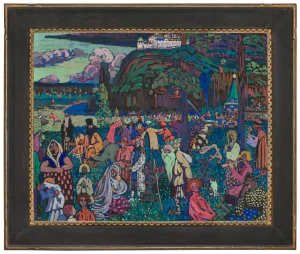
Bidding slowed after the first few lots. Edgar Degas’s Petite Danseuse de Quatorze Ans (1922) sold bang on high estimate for £25 million ($33.1 million). Kazimir Malevich’s Head of a Peasant (1911) sold well for over £3 million ($4 million), topping the high estimate of £2 million ($2.6 million), while Schiele’s Danaë (1909) sold for a few thousand shy of its high estimate of £18 million ($23.6 million).
Lucian Freud’s iconic painting of Sue Tilley sold mid-estimate for £29.3 million ($38.5 million), before Lot 13, Amedeo Modigliani’s Nu Assis au Collier (1917–18) was bought for £48.2 million ($63.5 million), making it the top lot of the night. Its high estimate wasn’t listed in the catalog, but a Sotheby’s spokesperson said it was “in excess of £45 million” ($59 million). There were no serious fireworks for the rest of the sale, though Modigliani’s Homme à la Pipe (Le Notaire de Nice) (1918-19) sold for £23.3 million ($30.7 million).
Earlier, Gustav Klimt’s Portrait of Gertrud Loew (1902), Lot 16, had injected some late nitro into the sale, selling to an Asian collector for £36.2 million ($47.6 million), against its £30 million ($39.5 million) high estimate.
Helena Newman, Sotheby’s chairman of both Europe and Impressionist and modern art, took to the rostrum for the second part of the sale. The pace of bidding was less frantic than the start of the Lewis sale, but Lot 5, Marlow Moss’s 1953 geometric composition White, Yellow and Black set a record for the artist, selling for £1.2 million ($1.5 million), more or less double its high estimate. Next came an untitled Rothko work on paper from 1959, which sold a little above estimate for £9 million ($11.9 million).


Claude Monet’s Nymphéas (1907) sold for £40.8 million ($54 million).
Courtesy Sotheby's
And then it was time for the auction’s headliner, Monet’s Nymphéas (1907). Bidding started at £25 million. “If you look at the Monet Nymphéas, that’s certainly priced to sell. It’s not overblown,” said Elizabeth Gorayeb, Sotheby’s former senior vice president of impressionist and modern art and the current executive director of New York’s Wildenstein Plattner Institute (WPI), which is at work on updating Monet’s catalogue raisonné. “Given how much it sold for the last time it was up, and given how much people are paying for works by Monet, I think the estimate is quite reasonable.”
It ended up going for £40.8 million ($54 million), right above its high estimate. That figure is about $2 million less than what it last sold, $56.5 million, in 2022 at Christie’s as part of the Anne H. Bass Collection, according to ARTDAI. (Adjusted for inflation, however, $56.5 million would be around $64.7 million in 2026, per the US Bureau of Labor Statistics Inflation Calculator.) Despite this, the result made it the most valuable Impressionist work sold at auction in Europe in over a decade.
“What a thrill to have brought a masterpiece of this caliber to London, and to see it pursued so passionately by collectors from around the world, a testament to the enduring desire for masterpieces of Impressionist and modern art,” Newman said.
Monet’s other work in the sale, Camille Assise sur la Plage à Trouville (1870), came from the same consignor. The portrait is the only one from a series of the artist’s first wife left in private hands; one is owned by the National Gallery in London. Gorayeb said it was being offered at auction for the first time “in years and years and years,” after having been “sort of dismissed in its early days as a study.” She described it as “an exceptional work,” noting that “you can see the sand that was encrusted in it because Monet painted it from the beach.”
Unfortunately for the house, it passed at around £5 million, despite having last sold for $12.1 million at Christie’s New York in 2018 as part of the Peggy and David Rockefeller, per ARTDAI. “The little Monet was just not flashy enough,” Gorayeb texted afterward.
By the time Alex Branchyk, Sotheby’s chairman and head of modern and contemporary art, took over from Newman, the crowd in the room had thinned out. The sale felt like it petered out somewhat. The biggest sum achieved in the latter half of the sale was for Banksy’s 2011 Love Is In The Air (life size), which sold for £6.4 million ($8.5 million) Perhaps it was the relentless heat; the mercury was flirting with 28º Celsius (82ºF) at 9:30 p.m.
“It’s been thrilling to see the works we’ve enjoyed and cherished draw such crowds during the view,” Vivienne Lewis said after the sale of the family collection. “You know, I wasn’t sure how I’d feel about letting them go, but—slightly to my surprise—even before the sale began, I felt good about it. We’ve always known we were only ever custodians of these works, and in that time we’ve tried to do our best by them, enjoying them ourselves and ensuring that, wherever possible, they were also seen and enjoyed by others. So now it feels less like letting go and more about sending them out into the world, into new homes where they can be cherished and enjoyed all over again.”


