





Could Leonardo da Vinci, alongside imagery of visitors strolling through art exhibitions, become the face of future euro banknotes?
In a first, Europeans can now help decide how they want to pay for their Belgian chocolate and French cheese: with bills printed in designs depicting either “European culture” or “Rivers and birds,” announced the European Central Bank (ECB) today. Not too shabby. The bank has revealed 10 shortlisted finalists of an international competition for the eurozone’s new banknote designs, and invited the public to share their two cents about it in a survey here, open until September 21, 2026. This is the first time the euro will get a full makeover since it was issued in 2002.
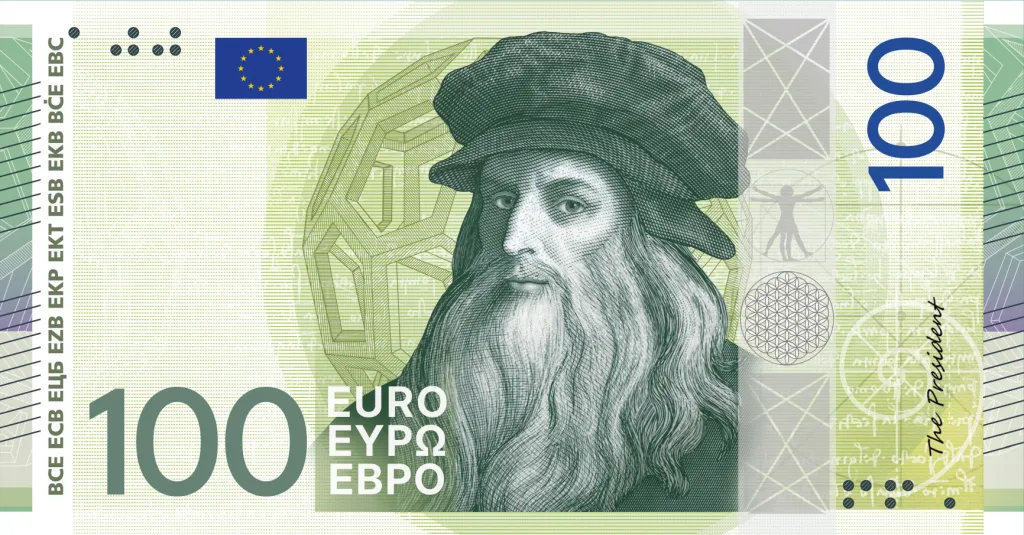
Among the design proposals, the arts and culture category features figures such as opera star Maria Callas on the 5-euro bill, Ludwig van Beethoven on 10-euro notes, and Leonardo on the 100-euro bill. On the reverse side of the latter note, designers have proposed various scenes of visitors admiring art exhibitions. Alternatively, the “Rivers and birds” topic depicts European birds and river landscapes, while the flip side shows imagery of modern European Union institutions.


This image is part of design proposal E, created by Myrsini Vardopoulou, and has been shortlisted by the ECB as a potential design for the third euro banknote series. An independent jury selected it as part of a design contest run by the ECB from Summer 2025 to Summer 2026, during which designers across the EU were invited to create design proposals for the themes “European Culture” or “Rivers and birds”.
Copyright: European Central Bank 2026
In the past, euro notes avoided references to any single country’s culture, but many of these latest designs aim to tell stories about the continent. “Euro banknotes are more than a means of payment — they are one of the most tangible expressions of Europe,” said Christine Lagarde, President of the ECB. “Through designs that combine beauty and meaning, they will reinforce our shared identity.”
Public survey results will be weighed alongside another, separate EU poll conducted by an independent research company. Near the end of the year, the EU Governing Council will make its final selection based on a combination of public input from the surveys, the opinion of an independent jury, and a technical assessment. Next, it will be a few more years before the new bills go into production, with improved features for security as well as visually impaired people.


