








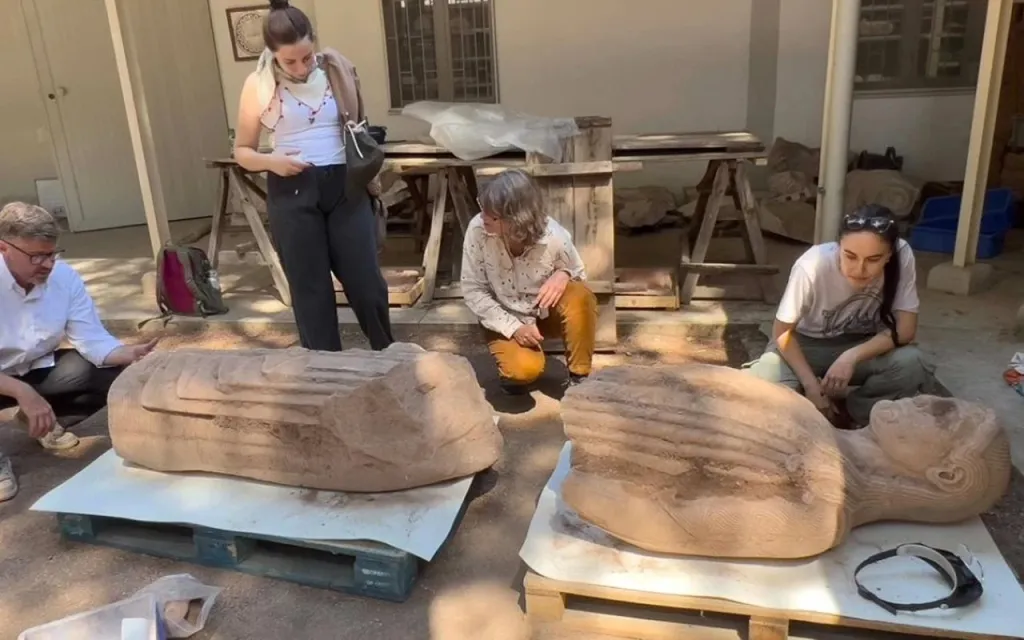
A seven-foot-tall marble statue from the 5th century BCE has emerged from under what used to be a Roman roadway in the ancient city of Sardis, in western Turkey, reports Heritage Daily. A UNESCO World Heritage Site in the Salihli district of Manisa Province, the city served at the time as the capital of the western satrapy of the Achaemenid Persian empire and of the kingdom of Lydia.
According to Turkey’s Minister of Culture and Tourism, Mehmet Nuri Ersoy, who posted about the discovery on Facebook, the sculpture, dated between 470 and 450 BCE, is one of the rare surviving examples of monumental marble statuary from the period. After conservation work is complete, the statue will go on view at Turkey’s Manisa Museum. The dig is under the administration of the General Directorate of Cultural Heritage and Museums.
Discovered in two large parts, the sculpture is missing its feet and some other fragments. During the Roman period, it had been repurposed and placed under paving material—which, ironically, allowed for its facial features and other details to be well preserved.
Experts say that the sculpture is stylistically hybrid, with an upright stance and long hair that were current in the 6th century BCE and a treatment of the face and hands that reflects trends in the first half of the 5th century BCE.
The figure wears a thick himation (an ancient Greek cloak or wrap) and a chiton (a rectangular tunic) over a distinctive horizontally striped garment. Experts point out that there are no known examples of this sort of clothing in comparable sculptures from Anatolia or mainland Greece, so the garb reflects a local tradition distinct to the ancient kingdom of Lydia.
A seven-foot-tall marble sculpture from the ancient city of Sardis.
Ministry of Culture and Tourism, Turkey
The figure holds what may be a quince in its right hand, possibly an offering to a deity. From this feature, archaeologists hope to learn more about ritual practices and religious beliefs in the city.
Sardis became famous for its wealth under King Croesus, points out Greek Reporter, which notes that the artwork may provide new insight into cultural exchange between the Greek, Lydian, and Persian worlds.


