





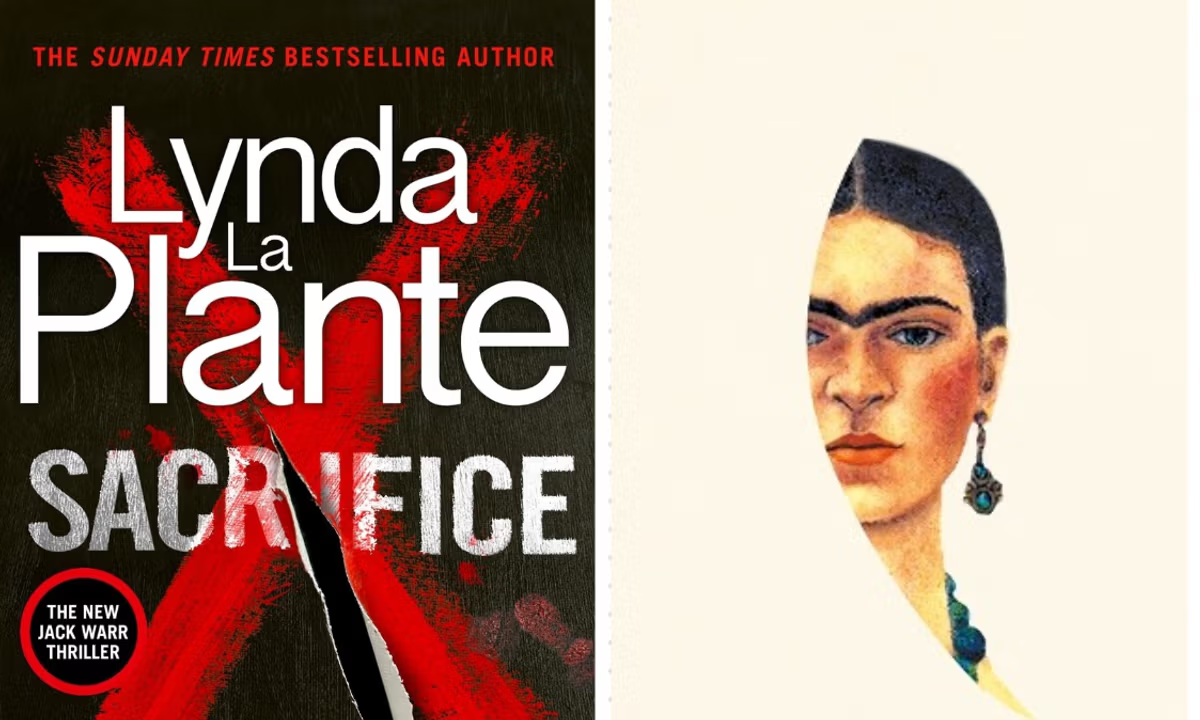
These two thrillers, The End of the Vodka and Sacrifice, are based on paintings, but they are very different beasts: the first weaves a tale based on real people and events; the second is purely fictional.
The End of the Vodka’s title reprises the last words of the beautiful socialite and bit-part actress Dorothy Hale to her former lover, the artist Isamu Noguchi. Shortly afterwards she took her own life by leaping from a Manhattan skyscraper.
Her friend, the renowned writer and diplomat Clare Boothe Luce, commissioned Frida Kahlo to paint a memorial portrait for $400 (those were the days!). The book moves between Kahlo’s thought processes while making the famed picture, El Suicidio de Dorothy Hale (1939), and a long, imagined conversation between Luce and the Duchess of Windsor (aka Wallis Simpson) in the Ritz Hotel in Paris in 1940. It turns out, according to the fictional ending, that far greater forces were at work, as the world descended into war.
What is factual is that Luce was sickened by the painting, which was not the classic portrait she expected. The work shows the details of Hale’s death three times: as a tiny figure on the balcony, falling to her death, and lying on the bloodied pavement. Below is inscribed: “In New York City on the 21st of October 1938, at 6:00 in the morning, Dorothy Hale committed suicide by throwing herself from a very high window in the Hampshire House. In her memory […], this retablo was executed by Frida Kahlo.” At Luce’s request, Noguchi painted out the part of the inscription that read: “painted at the request of Clare Boothe Luce, for the mother of Dorothy.” So horrified was Luce that she hid the painting for a time, before it was finally donated anonymously to the Phoenix Art Museum.
What did Wallis Simpson and Luce discuss? What drove Hale to despair? This is where the author departs from the real-life tragedy and creates a conversation and subsequent events, placing his characters at the centre of an intrigue that went far beyond the making of a portrait.
There is a contrast between the two voices: that of Kahlo herself, plus various newspaper reports and brief messages, and the invented conversation between Luce and Simpson. The author evokes very nicely the easily bored, entitled duchess: Luce desperately needs to retain her attention while recounting the life of Hale, all because she has been blackmailed into asking the Duchess about her dealings with Hitler—a question
that could potentially change the course of history.
Does the book work? There is ample literature about Luce, Kahlo and the events described, most of which appear in the book: the only “thriller” part comes towards the end, when the novel suddenly veers into a high-stakes kidnapping. For this reviewer, it falls between two stools—neither a conventional crime mystery nor a factual recounting of actual events—but certainly a page turner.
Shady dealings
As for Sacrifice, this is a straightforward thriller by Lynda La Plante, feted screenwriter and author and winner of the UK’s Diamond Dagger award for her lifetime contribution to the crime and mystery genre.
It is apparently the last of the series featuring the detective Jack Warr, and this time he becomes embroiled in a story about a painting by Jean-Michel Basquiat.
The book opens promisingly: “Detective Sergeant Jack Warr’s dream of heading up a new Art Fraud Squad was now on the point of becoming a reality…” And off he goes, despite being allowed only two recruits and a two-room office. His superintendent is dubious about Warr’s operation, and it soon appears that its very survival depends on his exposing a possible forgery: a multi-million-dollar Basquiat.
His first contact, art dealer Ester Langton, was found murdered, but she had already sold the Basquiat to a gullible art dealer, and by now Warr suspects it was the work of the talented art forger Adam Border. But he has simply disappeared off the face of the earth.
Working on a tip off, Warr sets off to search for the faker in Sicily, and—spoiler alert!—finally runs him to ground in a decaying villa where he discovers he had indeed forged the painting, along with many others, as well as committing other crimes. But it being Sicily, he is also entangled with the Mafia, before a showdown with dramatic consequences—for everyone.
From the technical aspects of forensic investigations to depictions of the shady go-betweens in the art market, the background to the book is convincing. It is excitingly paced and Warr is an arresting character, torn between wanting to uphold the law and something dark lurking in his own past. La Plante has certainly penned another blockbuster to add to the five previous books about Warr, which to date have sold more than 1.1 million copies.
• Oscar de Muriel, The End of the Vodka, Extraordinary Books, 336pp, £16.99/$24.95, published 25 June; Lynda La Plante, Sacrifice, Zaffre, 400pp, £22/$21.99, published 12 March
• Georgina Adam is art market editor-at-large at The Art Newspaper


