






Last week, pop star Olivia Rodrigo’s new album you seem pretty sad for a girl so in love made its eagerly anticipated debut. The 23-year-old singer’s third album is widely read as chronicling the rise and fall of her romance with actor Louis Partridge across 13 standard tracks.
Last week, Rodrigo’s album caught the art world’s attention when the singer revealed she had commissioned artist Chloe Wise to create original cover art for the album. The limited-edition collectible vinyl features Wise’s oil painting Carve our names (2026), which shows Rodrigo clad in a pink babydoll dress and menacingly holding a switchblade in her hand.
The collaboration is just one of the album’s art world crossovers. In fact, art historical references are dotted throughout the album’s visuals if you take a closer look, from suggestions of Edgar Degas’s dancers and Édouard Manet’s Le Déjeuner sur l’herbe in the music video for “stupid song” to allusions to Frida Kahlo in “the cure.”
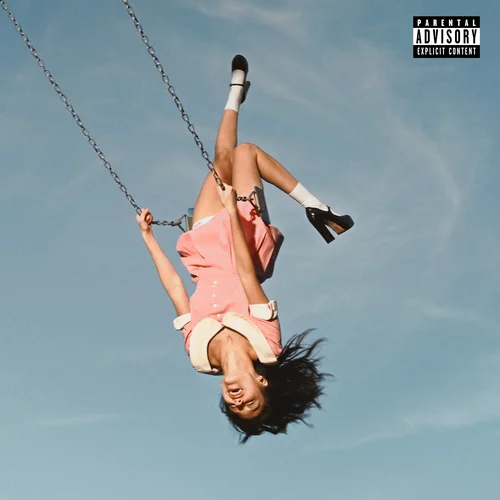
Fans were quick to point out the album’s particular fascination with French aristocratic frivolity. The album’s standard cover, shot by hipster-era icon Ryan McGinley, shows Rodrigo sailing high into the air on a playground swing, wearing the same pink babydoll dress and black platform Mary Janes.
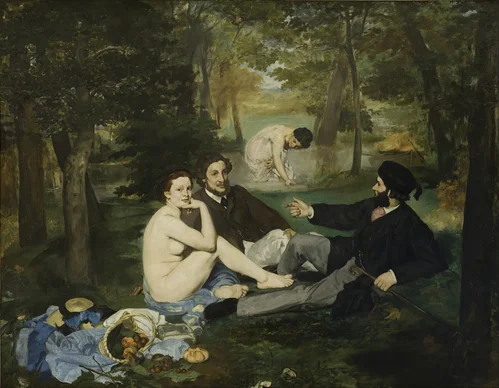

Luncheon on the Grass (Le Déjeuner sur l'herbe), 1863
Édouard Manet
Musée d'Orsay
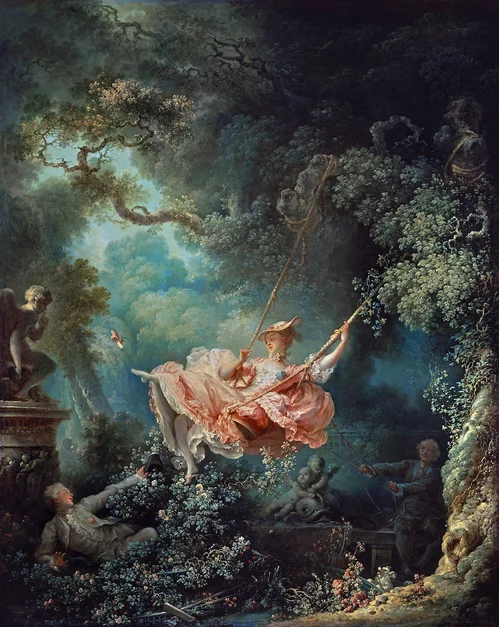
With its flirty insouciance, the image offers an obvious parallel to the famed Rococo painting The Swing (1767–68) by Jean-Honoré Fragonard. That playful painting shows a young woman in magnifcent pink ruffled gown being propelled on a swing by one man. A second glance reveals that the seemingly innocent image is anything but. The woman’s paramour is hiding in the bushes near the swing, looking up her petticoats. She casts one slipper into the air as she swings upwards. She is, one might notice, seated upon a small cushion.

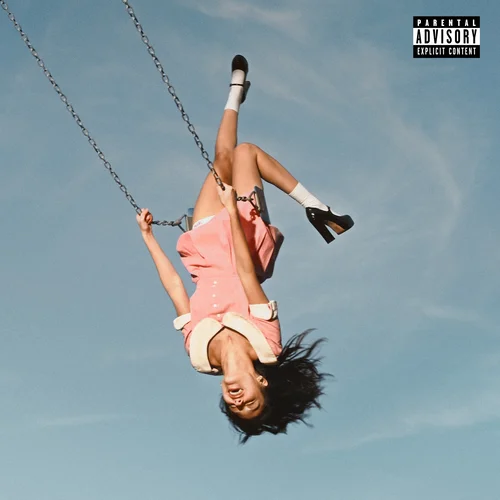

In an interview with late-night host Jimmy Kimmel, Rodrigo said the photograph, which shows the singer nearly entirely upside down, took over two hours to capture. She also shared that she was seated on a small cushion for the duration of the shoot.
Superfans of the pop star were quick to notice that Rodrigo’s ex-boyfriend, Louis Partridge, recently posted a photograph of The Swing, on view at the Wallace Collection in London, on social media. Given that the painting is considered famous for its sexual innuendo and suggestion of erotic intrigue, the Instagram post fueled new speculation about the end of the couple’s relationship.
The Swing is not the only reference to French courtly life, either. The music video for Rodrigo’s song “drop dead” was filmed in the opulent Château de Versailles, the royal palace of the French monarchy. Directed by Petra Collins, the filmmaker and photographer known for her dreamy girlish aesthetic from the 2010s, the music video pictures Rodrigo in chunky baby blue headphones and a Chloé ensemble of a dusty blue babydoll top, ecru bloomers, and white knee-high socks.
In “drop dead” Rodrigo sings, “You’re lookin’ like an angel on the walls of Versailles.” While we can’t be sure which angel Rodrigo means exactly (Baroque putti can be found on frescoes throughout the palace), visitors to Versailles are on the case.
Filming in Versailles is a rare occasion and Rodrigo likened the experience of the nine-hour overnight shoot to the 2006 film Night at the Museum. The music video certainly has cinematic inspirations, most obviously Sofia Coppola’s hugely influential film Marie Antoinette, starring Kirsten Dunst. The 2006 film, which was also shot in the halls of Versailles, imagined the luxurious layabout lifestyles of the French court set to contemporary music, not ulike Rodrigo’s.
Other landmark films earn nods, too. One unforgettable sequence shows Rodrigo dashing and dancing through Versailles’s halls. The scene is a reference to French auteur Jean-Luc Godard’s 1964 Bande à part. In the film’s most famous scene the three central protagonists gleefully run through the Louvre. That memorable scene was also recreated in Bernardo Bertolucci’s steamy 2003 film The Dreamers.
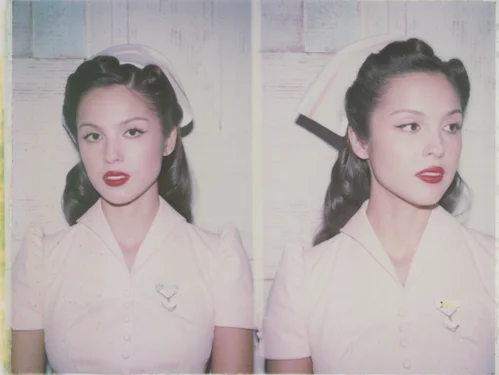

Not all Rodrigo’s art allusions are locked in the 18th century, however. In the music video for “the cure,” Rodrigo plays a nurse looking to cure ailing hearts. Throughout the course of the video, however, the nurse herself begins to unravel and red strings spool out of her fingertips. Harper’s Bazaar noted the painting’s similarity to Frida Kahlo’s harrowing self-portrait Henry Ford Hospital (1932), which pictures the Mexican artist in a hospital bed, her red veins unfurling from her naked body to objects around her.
Kahlo returned to similar imagery of veins in her striking painting The Two Fridas (1939), which shows the artist twice—once in colonial Spanish dress and once in Indigenous Mexican attire—both connected by red veins.
While Rodrigo’s album laments the disappointments of her relationship with Partridge, Kahlo famously painted The Two Fridas in the aftermath of her divorce from her husband, Mexican muralist Diego Rivera, after his devastating affair with Kahlo’s sister Christina (Rivera and Kahlo would later remarry). It was a time of heartbreak but also success for the artist who traveled to Paris for an exhibition of her work organized by Surrealist André Breton that same year. It was also at this point that the French government purchased her self-portrait titled The Frame (1939), ultimately making her the first 20th-century Mexican artist to have a work enter The Louvre. The Two Fridas became emblem of Kahlo’s fractured identity, a theme Rodrigo grapples with throughout her new album.


