





Oleksandr Dubovyk, who turns 95 on 1 August, is unique among Ukrainian artists. He is both a patriarch of Ukrainian contemporary art and, paradoxically, an emerging artist.
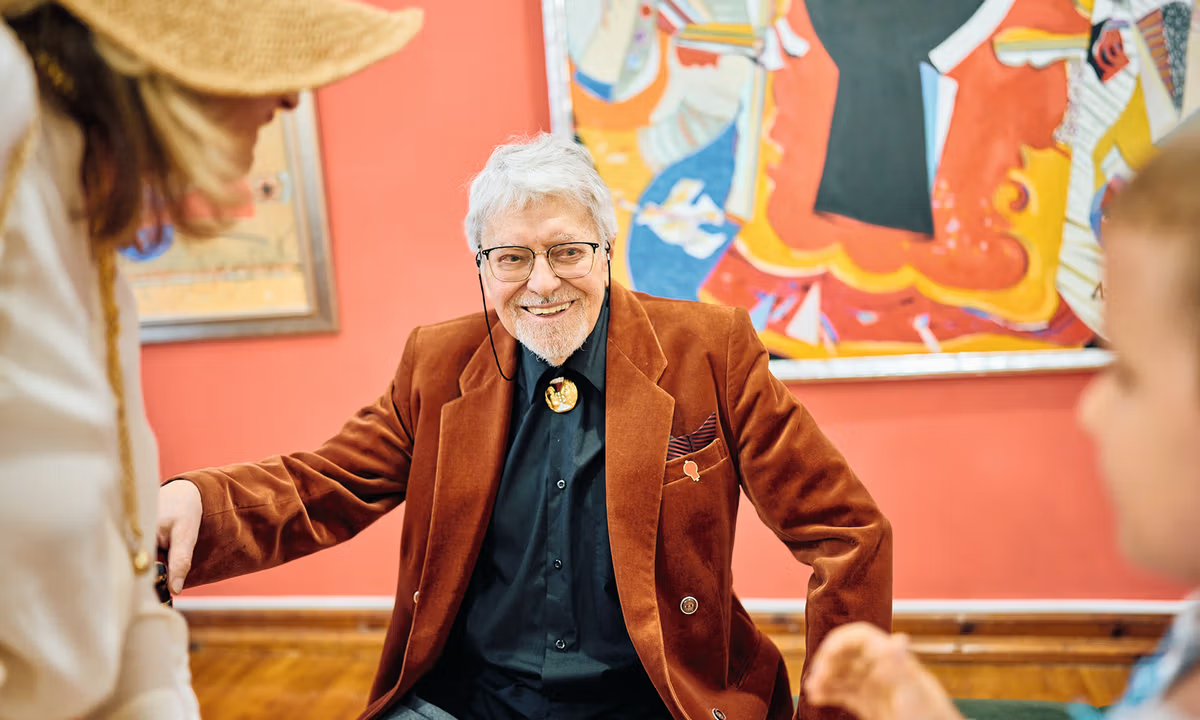
Ukrainian history’s tragic twists and turns, intertwined with his own life, have put him in that unusual position. Remarkably youthful, dressed in black with wavy silver hair, fashionable glasses and a ready smile, he spoke by video with The Art Newspaper earlier this year among his works displayed at the Dom Master Klass Cultural Centre in Kyiv.
Dubovyk was born in Kyiv when the Soviet dictator Joseph Stalin was attempting to destroy Ukraine in the 1930s and has lived through every tragedy and artistic movement of Ukrainian history since then. His father, a poet, was executed in 1941.
Dubovyk, also spelled Alexander Dubovik, moved from Realist art in the 1960s to abstract symbols, becoming a non-conformist artist cut off from the benefits of official recognition but also not bound by its restrictions. His 1963 painting Nuclear Physicists, showing scientists deep in dispute at a reactor, is Expressionist in nature despite its Soviet theme.
After Ukraine became independent in 1991 following the collapse of the Soviet Union, Dubovyk’s works featured on postage stamps. In a testament to his range, he created stained-glass windows for the Protestant New Apostolic Church in Kyiv and wall paintings for Chapelle Notre Dame des Anges near Nice in France. But the chaos of that period, which culminated in Russia’s illegal annexation of Crimea in 2014 and invasion of eastern Ukraine, resulted in him not getting his full due in terms of major exhibitions.
Defending Ukraine’s cultural identity
Dubovyk stayed in Ukraine through the 2022 full-scale invasion, which began when he was 90. “Our wild neighbour [Russia] wanted to destroy our nation,” he says. “We did not submit.”
The first large-scale retrospective of Dubovyk’s work opened at the end of June at the Ukrainian House exhibition hall on Kyiv’s central Khreshchatyk Street, a venue recently damaged by a Russian strike. Labyrinths of Meanings (until 2 August) is organised by Stedley Art Foundation, a major collector of his work. The curator, Kateryna Tsyhykalo, has just completed a second book about the artist. An exhibition of Dubovyk’s work, White Bouquet A Labyrinth of Symbolism, was also on show at the Oxford Festival of the Arts in July.
Oleksandr Dubovyk’s Vivat August (1991) National Art Museum of Ukraine, Kyiv, Ukraine
Since the invasion, Dubovyk’s White Bouquet symbol, rooted in his close study of philosophy, has become a template for defending and rebuilding Ukrainian cultural identity on an indestructible metaphysical level. The symbol has been the inspiration for the annual Bouquet Kyiv Stage festival, founded in 2018, which takes place in August at St Sophia National Reserve in Kyiv.
“It has nothing to do with flowers or bouquets,” Dubovyk says. “The bouquet is a quantum idea, about art as a whole belonging to humanity and not to governments, nations or styles.”
But Dubovyk, who has recorded philosophical tracts in the form of notebooks for decades, says the symbol is about more than art. “It is about everything. This division on all levels must be eliminated because it is dangerous. Whether we want it to or not, we are coming to another understanding of the world in which we are united as humankind.”
Bouquet Kyiv Stage is sponsored by Dom Master Klass, the cultural organisation co-founded by Evgeni Utkin, a Ukrainian tech entrepreneur involved in defence technology. He describes Dubovyk’s White Bouquet as a counterpart to Kazimir Malevich’s Black Square, an understanding of art “as a precursor of what happened in society”.
From nothing we jumped into another world from which all these drones appeared, all these new technologies, from regular business people who had never held a Kalashnikov
Oleksandr Dubovyk
“The bouquet is a mega-symbol,” Utkin says, describing it as a metaphor for Ukraine’s response to Russia’s assault. “The Russian army is ten times bigger. It has tanks, rockets and nuclear weapons. Then there is us, fully disarmed. We couldn’t have responded symmetrically. We were armed with this bouquet. It showed us our strength. From nothing we jumped into another world from which all these drones appeared, all these new technologies, from regular business people who had never held a Kalashnikov.”
A practice formed by war
Yuliya Bukus, a project coordinator at Dom Master Klass, describes how Dubovyk created his series The Phantoms at the beginning of the 2022 invasion. “In the first days, it was nearly impossible for him to reach his studio in the Obolon district of Kyiv due to the threat of occupation, so he began working at home. This situation shaped both the format and technique: he used coloured paper, markers and gouache,” she says. “The creation of these works was constantly accompanied by the sounds of sirens and explosions, fierce battles and a profound sense of anticipation. To date, he has created around 100 works and continues to develop the series as we live through these turbulent times.”
Dubovyk spoke to The Art Newspaper in front of his 2015 painting The Encounter with Nothingness, depicting an abstract figure’s encounter with a spewing orb. “This is the most interesting mystery,” he says. “You know when someone is outside the door and you don’t know if it’s ominous. In art you always have this: someone is always behind the door.”
He adds: “Human life is hope, it is constant expectation of the unknown. This is the main mystery of life. How do you exist in this condition when someone is lurking behind your back. Life is given to you. You understand it is the only thing of value.”


