





Sotheby’s will stage a series of sales, starting in October, of over 900 works spanning antiquity to 20th century and including fine art and design, from an unnamed collector, with the total estimated at more than $60 million.
The collection, which Sotheby’s is calling “Magnum Opus,” includes artworks by masters like Canaletto, Edgar Degas, Max Ernst, Francesco Guardi, Jean-Honoré Fragonard, Luis Meléndez, Pablo Picasso, and Jacob van Ruisdael.
Four New York sales, between October 21 and October 23, will bring some 600 works from the haul to auction. The rest will appear at various sales at Sotheby’s New York and Paris, spanning some 25 of the house’s categories, from contemporary art to books and manuscripts, from jewelry and prints and photographs to design, stretching into 2027.
“Every work, in every category, bears the mark of a collector who approached each acquisition with the same exacting standards and the same fundamental belief that objects of quality speak across time,” said Sotheby’s global head of major collections Catherine Foster Ellison in press materials.
A Mughal Pietra Dura inlaid marble footrest, ca. 1700, along with a selection of gold boxes, on a Russian Neoclassical ormolu Guéridon, late 18th century, pictured in situ.
Sotheby's.
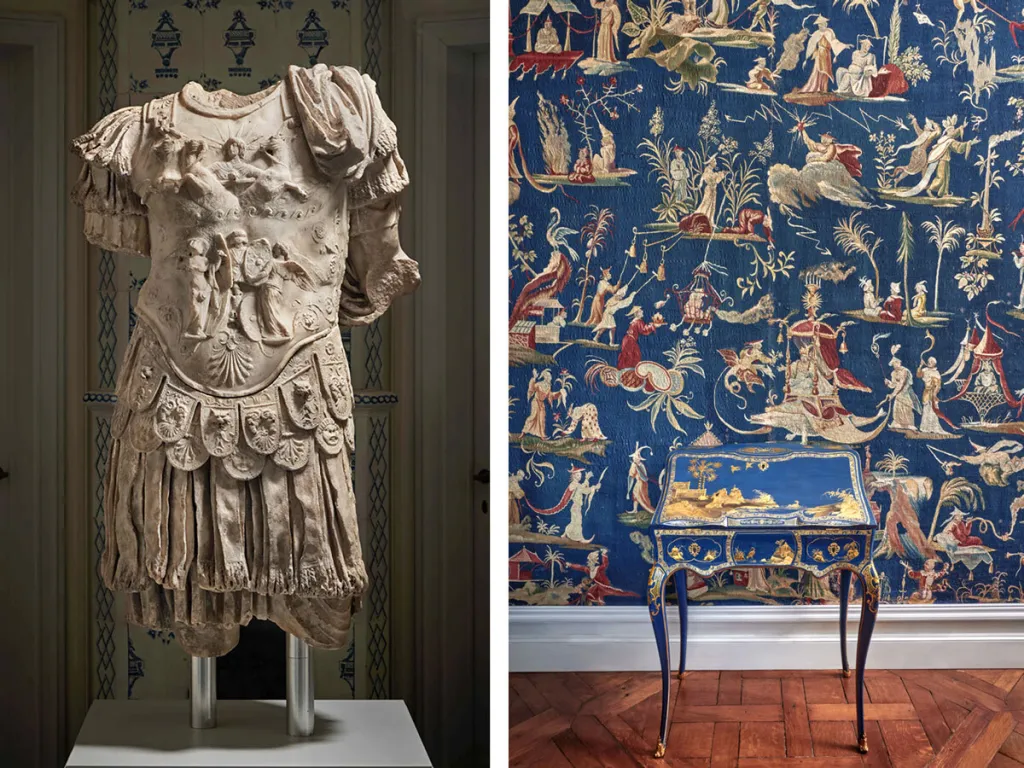
Leading the sale is a treasure of ancient art, a marble torso of a Roman emperor from the Julio-Claudian period (first half of the 1st century CE), estimated at $8 million–$12 million. Also on offer is an Augustan marble portrait head of a girl (27 BCE–14 CE) for $2.5 million–$2.5 million.
Other leading artwork selections are a Canaletto for $6 million–$8 million, a Degas pastel for $5 million–$7 million, a Luis Meléndez for $4 million–$6 million, a Ruisdael for $2.5 million–$3.5 million, a Picasso for $1 million–$2 million, a Guardi for $1 million–$1.5 million, and an Ernst at the same price.
“From Degas’ extraordinary command of color and form to Picasso’s mastery of sculptural medium and narrative—from early in a career that was never less than singular—each work finds an artist at a moment of genuine consequence,” Scott Niichel, the house’s vice chairman for Impressionist and modern art, said in a statement.


A Louis XV ormolu-mounted blue and gilt vernis Martin bureau en pente in front of a rare pair of Brussels Chinoiserie tapestries, pictured in situ.
Sotheby's.
Design objects include the Bernheimer Safavid “Vase” carpet fragment from southeast Persia (early 17th century), estimated at $350,000–$500,000; an Isfahan carpet from Central Persia (mid-17th century) for $400,000–$600,000; the von Hirsch garden carpet from northwest Persia (17th century), estimated at $200,000–$300,000; and an Iznik cintamani pottery tile from Ottoman Turkey (ca. 1580) for $120,000–$180,000.
“Rugs and carpets are key components of the finest private and institutional collections of Islamic art,” said Benedict Carter, senior director and head of the Islamic and Indian art department, calling the Bernheimer and Von Hirsch fragments “two of the great world carpets.”
If you’ve got a hankering for furniture, the house also has you covered, with, for example, a pair of Louis XVI giltwood Marquieses attributed to Georges Jacob (ca. 1785), priced at $200,000–$300,000. Like tapestries? Note the rare pair of Brussels Chinoiserie examples, estimated at $500,000–$700,000. Into ceramics? Note the Sèvres wine bottle coolers made for Marie-Antoinette in 1784 and estimated at $30,000–$40,000.
A preview exhibition goes on view at Sotheby’s London from June 27–July 1, while the Julio-Claudian emperor’s torso is in the spotlight at Sotheby’s New York from June 27–July 6.
All four floors of the auctioneer’s Madison Avenue headquarters will be devoted to an exhibition of the collection from October 17–22.
Here are some highlights from the sales.


