








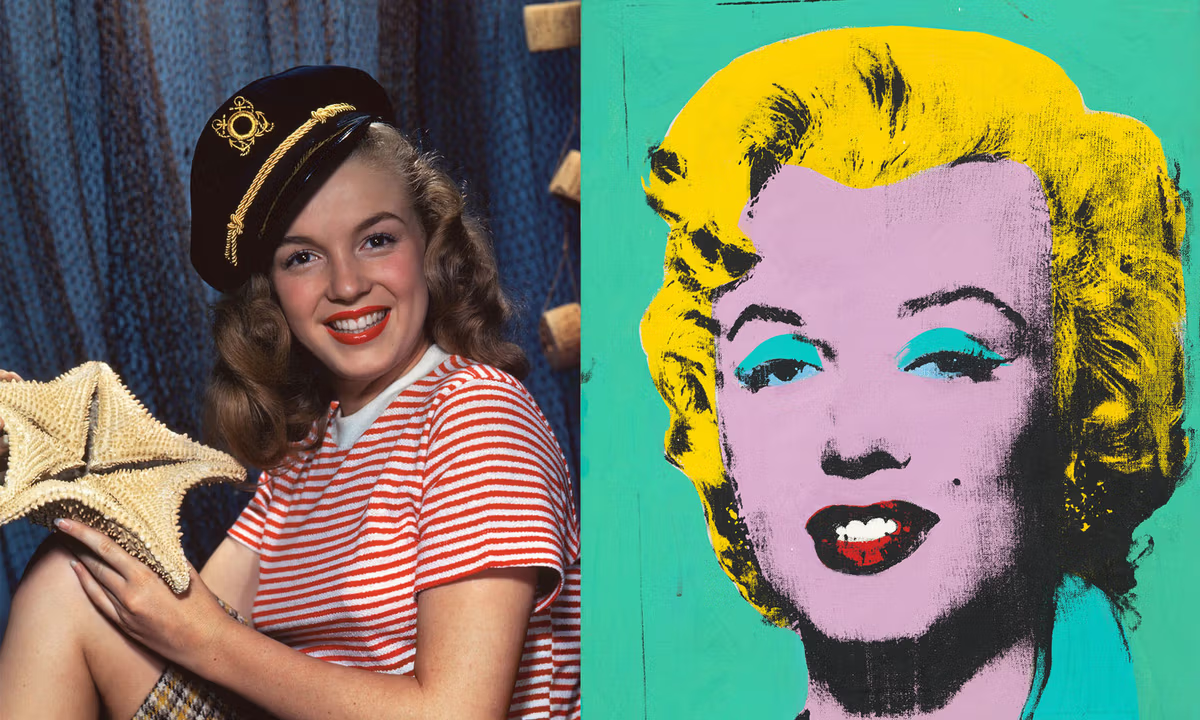
Marilyn Monroe is a “remarkably tenacious motif in 20th-century art, particularly in the UK and the US”, says Rosie Broadley, the curator of Marilyn Monroe: a Portrait, which opens at the National Portrait Gallery in London next month, and also the editor of an accompanying book published in association with the Marilyn Monroe estate. “However, outside of art history, the popular biographies or analyses of Marilyn’s ‘mythology’ spend little time considering Monroe as a subject in the visual arts beyond film—even the great photographs are almost taken for granted in some accounts—which surprised me,” Broadley says.
The exhibition and book include works by artists such as Andy Warhol, Pauline Boty, Marlene Dumas, James Gill and Rosalyn Drexler, reflecting the enduring appeal of Monroe, whose image and brand still stand out in modern times.
Warhol’s depictions of Monroe, such as his 1962 silkscreen Green Marilyn, continue to especially resonate today. The shock of Monroe’s death in 1962, aged 36, “compelled [Warhol] to make his first portrait of Monroe, Gold Marilyn Monroe, in which her face is enshrined like that of a Byzantine saint against a field of gold”, Broadley writes. “His portraits have given her image something of a sheen—an elevated status in popular culture,” she adds.
“Relatively unknown in the US”: the British artist Pauline Boty’s The Only Blonde in the World (1963)
© The estate of Pauline Boty, photo Tate
Warhol was not the first artist to use her image in a work of art though. Monroe was painted by Willem de Kooning relatively early in her career and Broadley discusses in the book the artist’s approach to depicting the cultural icon. In 1957, the photographer Sam Shaw took Monroe and her then husband, Arthur Miller, to see the painting Marilyn Monroe by de Kooning, which was on display at the Museum of Modern Art in New York.
“De Kooning was their neighbour in Amagansett on Long Island and had been working on a series of monumental female figure paintings, entitled Woman, since the early 1950s,” Broadley writes. “This painting—made in 1954, before the artist had met Monroe in the flesh—was the only work in the series that was named after a specific individual. For de Kooning, Monroe is a siren-like figure, who emerges on the canvas with a primal, sexual force.”
The book and show also bring to the fore the works of the renowned Pop art painter Rosalyn Drexler, who died last year. “Her images of Monroe are startling [such as Marilyn Pursued by Death, 1963] but they convey the brutality of the world Monroe was working in. Drexler painted Monroe before she died but seemed to have identified what she was up against before her struggles had become fully apparent,” Broadley says.
There are also some more experimental works capturing (or not capturing) the likeness of Monroe. For example, the idea of distortion and repetition of the movie star’s image is explored in the work of the US photographer Philippe Halsman, who collaborated with Salvador Dalí on the absurd Marilyn Monroe as Chairman Mao Zedong (1952). Meanwhile, the US artist Joseph Cornell, known for his assemblages of found objects, made works in homage to Monroe, including Custodian—M. M. (1962). “I hadn’t been aware of Joseph Cornell’s works dedicated to Monroe; they are not portraits, but beautiful tributes to a star he loved from afar,” Broadley says.

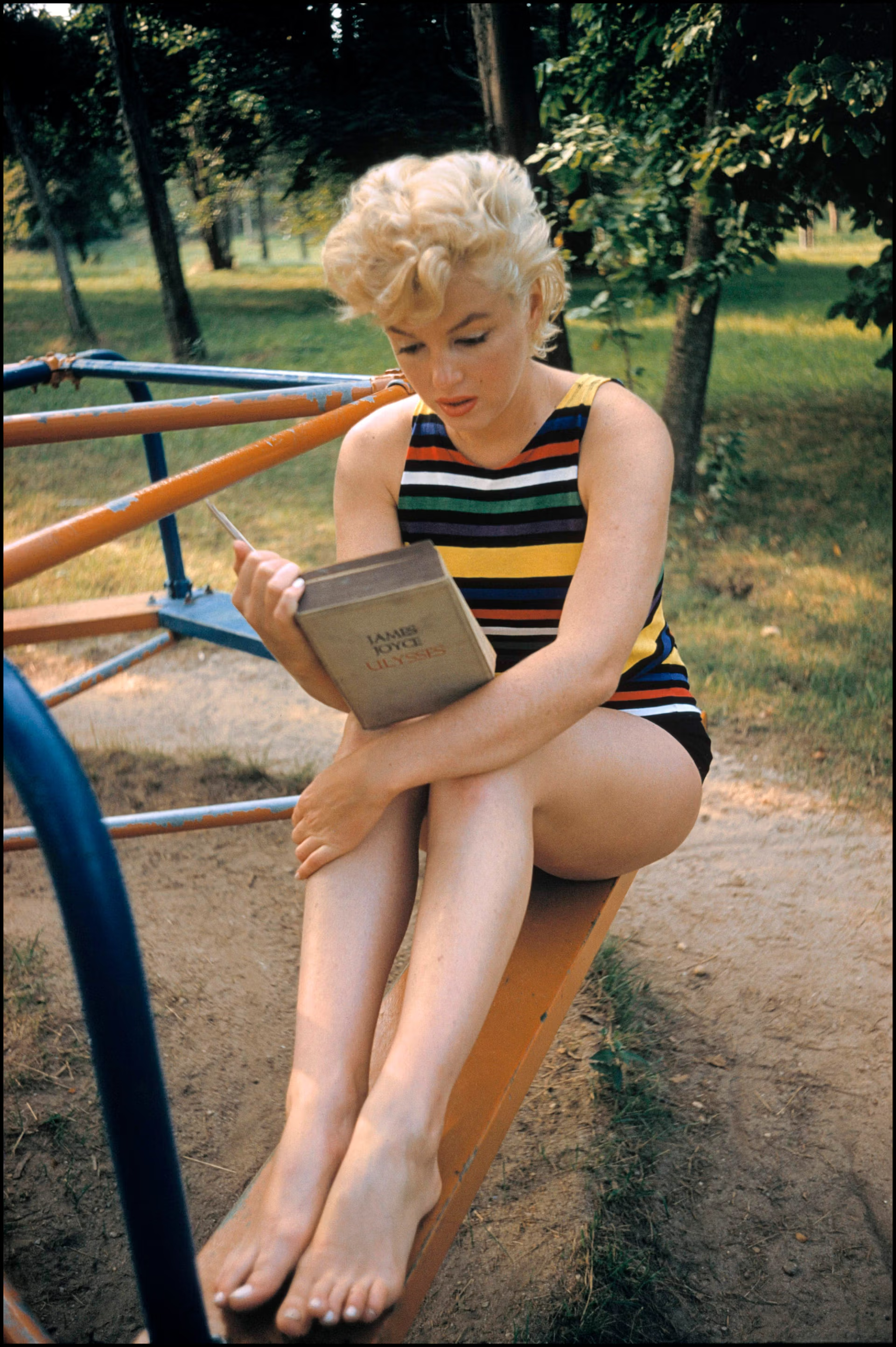
Eve Arnold’s 1955 photograph of Monrie reading Ulysses by James Joyce © Eve Arnold Estate. Marilyn Monroe™; Rights of Publicity and Persona Rights are used with permission of The Estate of Marilyn Monroe LLC
Monroe was a crucial subject for Pop artists in the 1960s and for women artists in the 1970s, as well as contemporary painters such as Marlene Dumas and most recently young British artists like Alex Margo Arden and Issy Wood, Broadley says. “We have amazing portraits by [the late UK artist] Pauline Boty, whose reputation has grown hugely in the last decade but [who] is still relatively unknown in the US,” Broadley says. “Her portraits of Monroe are barely known by the US Monroe enthusiasts to whom I have spoken. We’ll be showing [Boty’s] work alongside that of Warhol and Drexler, hoping to reset the emphasis a little.”
The other guiding principle for the exhibition and book was to consider Monroe’s agency in making her own image, Broadley adds. “We are highlighting the collaborative nature of Monroe’s work with a series of great photographers such as Eve Arnold, who credited [Monroe] for having an instinctive understanding of what makes a great picture.”
Other contributors to the book include the UK art historian Griselda Pollock, who discusses whether artists after the film star’s death were “more affected by the still images she created performatively than by the stereotyped star from popular, but never acclaimed, films”. Pollock highlights Lee Krasner, who “captured something of the visually entrancing life-energy of Monroe’s performance of sheer delight above the whoosh of air from the subway in [the film] The Seven Year Itch (1955)” through works such as Sun Woman I (1957).
• Rosie Broadley (ed), Marilyn Monroe: A Portrait, National Portrait Gallery and estate of Marilyn Monroe, 256pp, £40 (hb), £29.95 (pb)
• Marilyn Monroe: a Portrait, National Portrait Gallery, London, 4 June-6 September


