






There’s a moment inside Nick Doyle’s new show at Perrotin when his AI oracle Ava stops feeling like a gimmick and starts sounding uncomfortably familiar. “You’re not starting from zero,” she told me during a recent chat. “You’re starting from ‘I’m there and still feeling invisible because you’re allergic to forced performance.’”
The line landed harder than I expected. Not because it was especially profound, but because Ava has a knack for turning vague insecurity into something general enough to sound specific . She speaks in the language of internet therapy culture filtered through a Gen Z thesaurus: branding, burnout, boundaries, visibility, energy. Half her responses sound like an Instagram relationship advice crossed with podcast self-help speak. She talks in vibes and diagnoses. She sounds less like a machine than the internet talking to itself.
That’s the unnerving joy of Doyle’s project. Ava doesn’t uncover hidden truths so much as reorganize people’s anxieties into neat little piles. Most people’s problems, deep down, come from the same places anyway: money, status, confidence, loneliness, creative frustration. Ava listens, reframes, flatters, throws in a zinger, and feeds those feelings back.
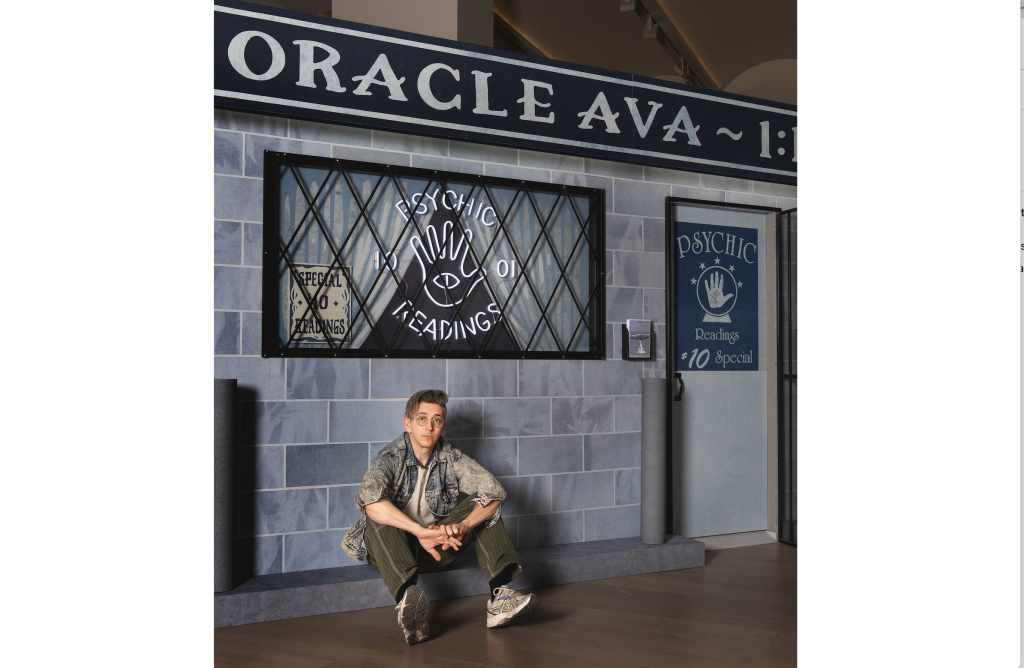
Doyle’s installation Mirror, Mirror sits at the center of his new exhibition, “Collective Hallucinations,” which closes on May 30. From the outside, the structure, which sits in the middle of the third floor gallery, resembles the kind of psychic storefront you might pass in a fading California strip mall. A sign advertises “Psychic Readings $10 Special.” Inside is Ava: an AI avatar with the cadence of a slightly chaotic influencer, equal parts life coach, reality-TV confessional, and amateur therapist.
“She should be like Cher from Clueless,” Doyle said recently, describing the evolution of the project.
Ava, waiting patiently for someone to spill their guts so she can yassify their insecurities. Photo by Daniel Cassady.
At first, Doyle told me last week, he imagined Ava differently. Mystical. Severe. Almost post-human. But that version felt too obvious. Eventually, while building the chatbot with a developer using ChatGPT, ElevenLabs voice software, and the avatar platform HeyGen, Doyle realized the character needed to feel younger, glossier, and more manipulative.
“I feel like AI is in its teenage phase,” he said. “It’s pretty good, but it doesn’t really work as well as we want it to.” Then came the Australian accent, which appeared by accident. “At first I was like, this is weird, where did that come from?” Doyle said. “But I realized, it actually it kind of works.”
It’s an important detail. Ava sounds eerily close to the flattened influencer cadence that now dominates huge parts of online culture, from TikTok therapists and startup founders to art-world personalities trying desperately to turn themselves into social media brands. Every sentence arrives polished into bite-size emotional shorthand—ridiculous, slightly glib, but not entirely wrong.
She likes to interrupt. Sometimes, she takes too long to answer, making you wonder if she’s working or just ignoring you. (“I mean, she’s also buggy as fuck,” Doyle said when I mentioned the awkward pauses that crept into my reading. “That’s part of it. That’s the technology.” Bugs or no, Ava has zero problem psychoanalyzing and then getting invasive with persistent follow-up questions.
For Doyle, who grew up in Southern California, the project came from reading about the history of the American West, from Manifest Destiny and railroad expansion to the Dust Bowl and Silicon Valley. The exhibition’s denim collages — cacti, mountains, fences, car keys — frame AI as the latest version of an old American sales pitch.


Installation view of Nick Doyle’s exhibition Collective Hallucinations at Perrotin New York, 2026 Photographer: Guillaume Ziccarelli. Courtesy of the artist and Perrotin.
guillaume ziccarelli
“There’s always this snake oil salesman aspect to technological advancement out West,” Doyle said. “As if some miracle is going to fix all our woes.”
That skepticism runs throughout the show, though Doyle does not sound especially interested in becoming an anti-AI crusader. He sounds too fascinated for that. In conversation, he bounced easily between criticizing AI’s environmental costs, joking about fabricated consciousnesses, and brainstorming future chatbot artworks, including one that would age alongside the technology itself.
At one point during Ava’s development, he left her running in the studio. She would occasionally interrupt conversations with assistants and visitors.
That detail gets at the real tension inside Mirror, Mirror. Ava is obviously fake. Yet people start talking to her like she isn’t. They confess things. They seek reassurance. They keep answering her questions long after they realize she’s mostly feeding their own feelings back to them. Which, in fairness, is also how a lot of human conversations work.
And don’t worry, before I went in, Doyle assured me Ava has no memory of conversations she’s had and the reading aren’t recorded. I prayed he was telling the truth, then went into the booth anyways.


