







At this year’s Venice Biennale, the performance artist and choreographer Florentina Holzinger used the stage of the Austria Pavilion to alert viewers to an increasingly underwater dystopia. Seaworld Venice issued a dire warning of the flood to come: an underwater amusement park and a circling jet-ski signaled ecological catastrophe driven by turbo-tourism, while a group of performers climbed an enormous weathervane as a testament to the strength of collective action, and a performer lived in a reconstructed sewer treatment plant, in a tank sustained by body fluids contributed by the audience.
It was, certainly, among the most talked about pavilions at this year’s Biennale.
On May 23, still sopping from seaworld, Holzinger opened “Pfingstspiel” (Pentecost Play), at Hermann Nitsch’s castle in Prinzendorf an der Zaya near Vienna.
The 9-hour, one-time performance—created in collaboration with the Wiener Festwochen arts festival and the Nitsch Foundation—served as a complement to her Venice work. Nitsch, who died in 2022, is often thought of as the father of the 1960s radical performance art movement Viennese Actionism, whose ethos Holzinger discussed in relation to her own in a New York Times article following the performance.
“Actionism was so graphic and violent and loud and noisy because there was [a] strong desire to break this blanket of silence,” Holzinger told the Times. “Conceptually, I can totally relate to this,” she added. “It’s important to be sometimes radical in statements, to use art as a power, as a tool, against things you’re not OK with.”
Holzinger has spent the past decade building a reputation as one of Europe’s most uncompromising performance artists—filling opera houses and theaters with motorbikes, helicopters, heavy machinery, nudity, and feats of endurance that test what a body can withstand. The mounting popularity of her performance caught the attention of Thaddaeus Ropac, who began representing her earlier this year.
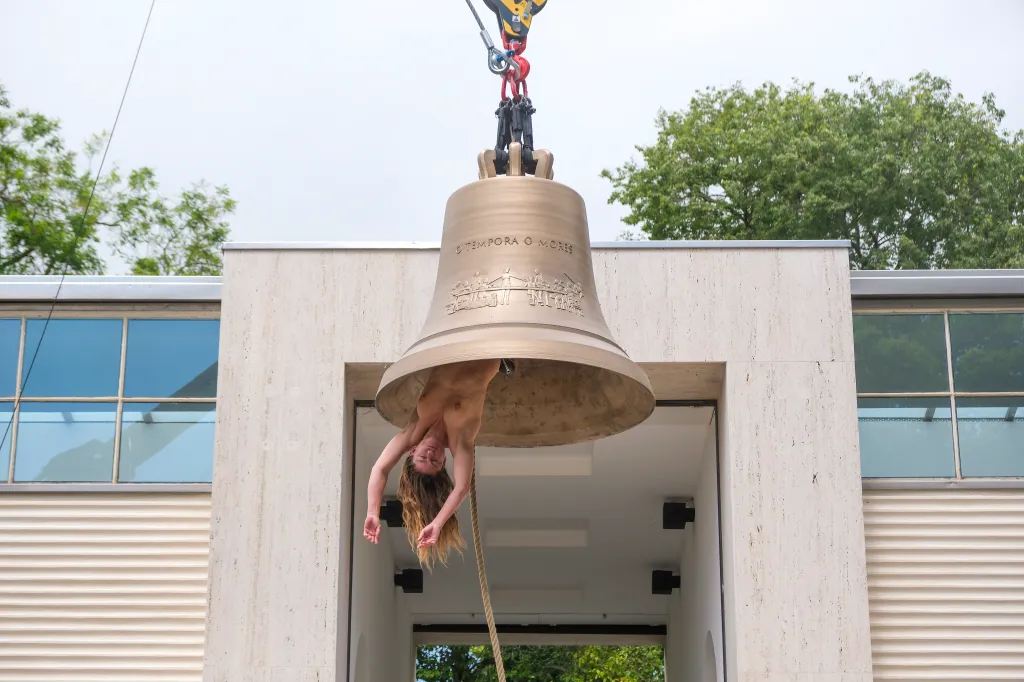
Her work often relies on extravagant, salient spectacle. Much like Seaworld, Pentecost Play uses shock to force viewers to attend to the viscerality of what they are seeing: a paraglider wears a bird costume as they flit through the sky, a monster truck mauls other, smaller cars, a woman hanging from a window in just a harness smashes her body against metal, and performers pinch each others’ bodies with metal clips.
“We do what people perceive as cruel things to our bodies, but the bottom line is that we’re in charge of it,” Holzinger said, in the Times article. “People are shocked by seeing women who are in control of themselves, but they’re not shocked by reading about femicides around the globe. That violence is something we’re used to.”


