






An excavation in Moharam Bek, a neighborhood in central Alexandria, has uncovered a trove of archaeological findings dating from the Greek, Roman, and Byzantine periods. The news was announced by Egypt’s Ministry of Tourism and Antiquities earlier this month and reported by Greek City Times.
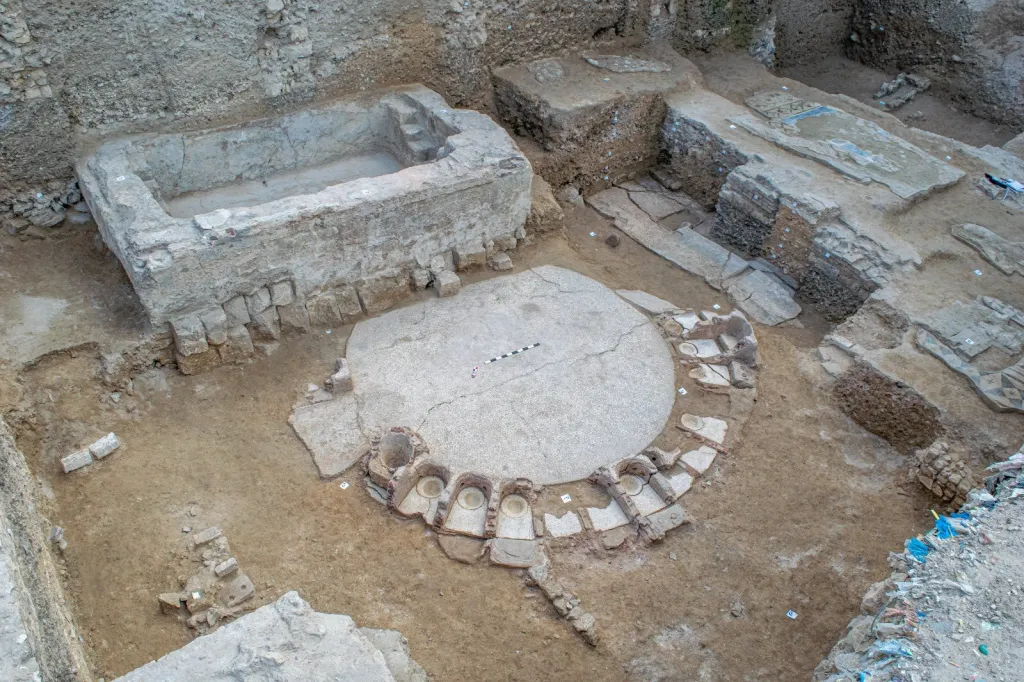
The items range from Greek and Roman statues to smaller objects like coins, lamps, and ceramic vessels. Also uncovered were architectural structures like a public bathhouse, decorative mosaics from a Roman villa, and high-tech water systems.
Mohamed Abdel Badi, of the Supreme Council of Antiquities (SCA), said in a statement that the site provides “a comprehensive model of the development of residential and service architecture in ancient Alexandria.” The earliest objects, from the Ptolemaic period (305-30 BCE), include the circular public bath, called a tholi, and intricate mosaic flooring belong to an adjacent Roman residential villa.
Among the Greco-Roman statues uncovered are depictions of deities like Bacchus (god of wine), Asclepius (god of medicine), and Minerva (god of wisdom).
Hisham El-Leithy, secretary general of the SCA, noted that these latest findings further prove Alexandria’s importance as an urban center known for architectural advancements and a high standard of living, and that they will help researchers better understand the ancient city’s layout. “This continuity,” El-Leithy noted, referring to the discovery of artifacts from periods covering some 400 year, “offers valuable evidence of how urban life adapted over time.”
Archaeologists have been excavating areas in Moharam Bek for several months, and the work is ongoing. They plan to show some of what they have uncovered at the Graeco-Roman Museum in Alexandria.


