








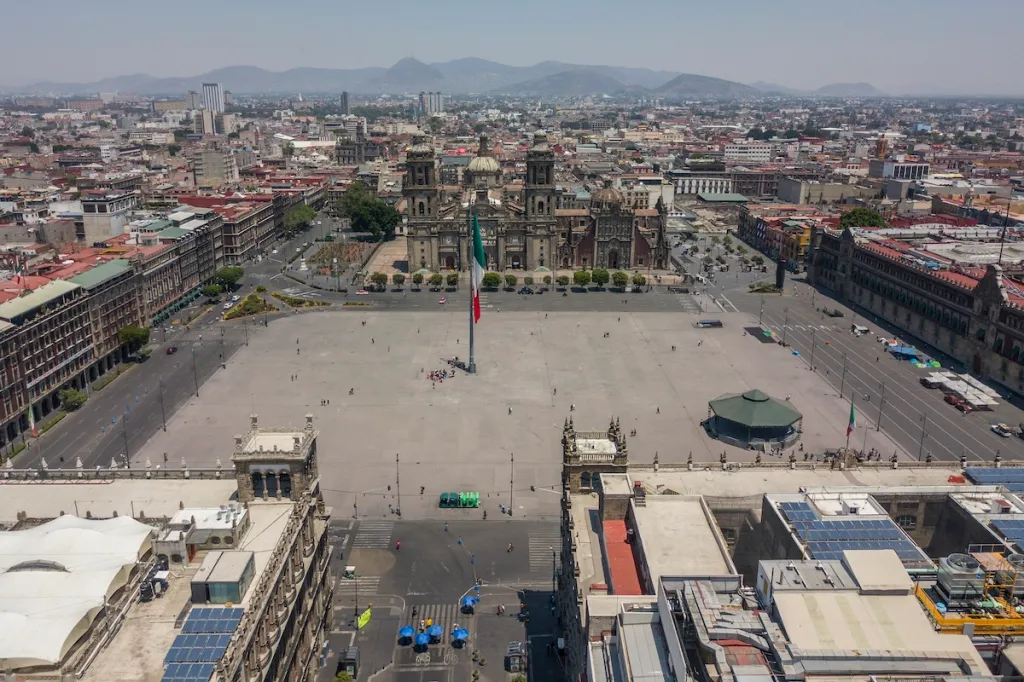
Researchers from Mexico’s National Institute of Anthropology and History (INAH) finished a holistic survey of an area beneath Mexico City’s Centro Historico that long ago served as the home of the sacred precinct of the Aztec capital Tenochtitlan.
As reported by Heritage Daily, the project undertaken as part of INAH’s Urban Archaeology Program to identify buried pre-Hispanic structures beneath the city’s streets is “expected to improve the protection of archaeological remains during future infrastructure and construction projects.”
Instead of excavation, the archaeologists studied changes in ground elevation, street gradients, building inclinations, and structural cracks to deduce where walls and foundations might have once been located before the sacred precinct was buried after the Spanish conquest in the 16th century.
Raúl Barrera Rodríguez, the director of the Urban Archaeology Program, said, “In earlier investigations, excavations carried out beside structural cracks revealed the edges of pre-Hispanic foundations. By documenting these fractures and variations in ground level, it becomes possible to propose the layout of the buildings that once formed the sacred precinct.”
The survey was conducted with topographic measuring equipment capable of making precise calculations in the scale of millimeters, and was described by Claudia Curiel de Icaza, the Secretary of Culture of Mexico, “an unprecedented investigation that will contribute to a fuller picture of the surviving traces of Tenochtitlan below the modern capital and will help to maintain the city’s archaeological heritage for the long term.”


