






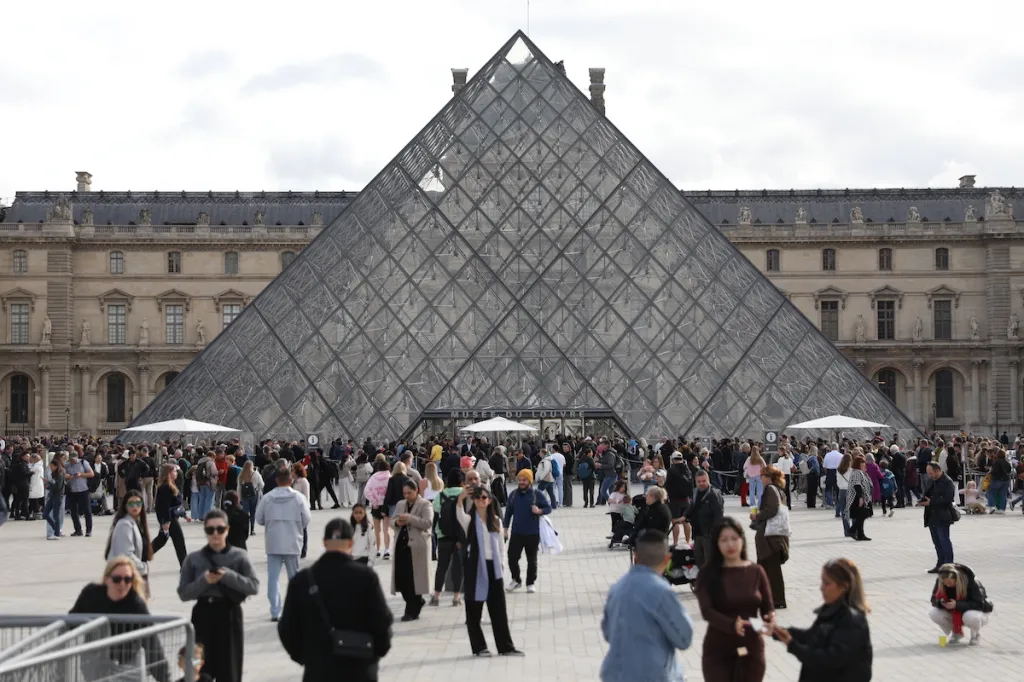
Originally delayed earlier this year, reportedly amid staff unrest, and later postponed until after the French municipal elections, the jury tasked with selecting the architects for the Louvre Museum renovation is now set to convene in mid-May, Le Figaro reports. Its members will assess five shortlisted architectural proposals, formally launching the $778 million renovation plan spearheaded by French President Emmanuel Macron.
Quoting sources close to the project, the French newspaper reports that jury members are scheduled to meet on May 13, addressing speculation that the initiative could be shelved amid staff shortages and urgent infrastructure needs—all unfolding against a backdrop of leadership upheaval in the aftermath of the Louvre’s high-profile jewel theft. Reportedly compounding the uncertainty, the shortlisted architectural firms were given a tight deadline to finalize their proposals in late January, only to be told that the jury set to hear their presentations had been postponed indefinitely.
To their presumed relief, it now appears that the architect who will lead the major modernization of the Louvre Museum—including the creation of new galleries and a new lobby—will be named imminently.
Last week, the museum’s newly ascendant president, Christophe Leribault, and Culture Minister Catherine Pégard reportedly visited the Préfecture de Paris et d’Île-de-France (the region’s administrative hub), where the architects’ scale models are currently on view for evaluation. What form the winning design will ultimately take remains to be seen. Catherine Pégard has indicated that “certain aspects of the plan would be reworked or adjusted, while others would be reinforced.” Meanwhile, Emmanuel Macron has championed a “New Louvre” slated for completion by 2031, though the feasibility of that timeline has been questioned.
The 21-person jury is chaired by Marc Guillaume, prefect of Paris, and comprises French civil servants, including the mayor of Paris and the French Director-General for Heritage; architects such as Anne Démians, Bernard Desmoulin, and Lina Ghotmeh; as well as leading museum professionals including Neil MacGregor and Sam Keller in Basel. The five architecture firms selected by the jury are Amanda Levete Architects, architecturestudio, Dubuisson Architecture, Sou Fujimoto, and STUDIOS Architecture.
The project, announced by Emmanuel Macron in January 2025, aims to ease overcrowding at the Louvre Museum, which welcomes some 9 million visitors annually. In addition to a new entrance, the plan calls for upgrades to aging infrastructure and—most controversially—the construction of a new 33,000-square-foot exhibition space for the Mona Lisa. It was revealed in January that the museum’s 2026 budget set aside $116 million for preliminary studies tied to the renovation and $17.5 million for technical maintenance, including just $2.1 million for the safety of its artworks.
That same month, some 350 staff members at the Louvre Museum, representing three unions, staged a walkout in protest, arguing that the institution should prioritize long-overdue technical upgrades and building upkeep over plans to relocate the Mona Lisa to a standalone gallery.
The strikes followed a period of internal upheaval at the French museum. In January 2025, a memo from Laurence des Cars to the French cultural minister was leaked, detailing extensive structural damage, water leaks, and overcrowding at the Louvre Museum. The following October, thieves stole $102 million in crown jewels in a headline-grabbing heist that ultimately prompted Des Cars’s resignation.


