







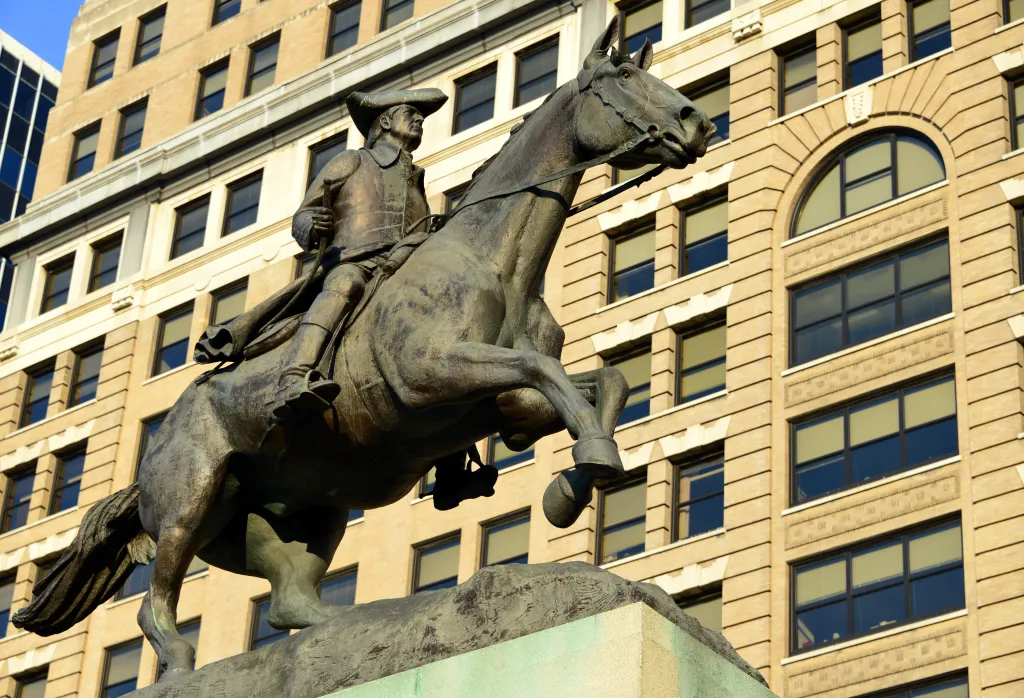
Last Friday, the Trump administration erected 13 statues on Freedom Plaza in downtown Washington D.C.—including an equestrian monument dedicated to the Revolutionary War figure and slave owner Caesar Rodney that was removed from view in Wilmington, Delaware amidst the Black Lives Matter movement in June, 2020.
The statue depicts Rodney’s famed 1776 ride from battle in Dover, Delaware to Philadelphia, where he cast the decisive vote for the country’s Independence. Rodney died in 1784, at his home on the Byfield plantation, where he owned 200 slaves.
Surrounding the statue are 12 soldiers, who “represent the collective sacrifice of those who served during the Revolutionary War, reflecting the broad range of individuals who contributed to the nation’s founding,” according to a written statement spokesperson from the Department of the Interior.
The spokesperson continued, “as we approach America’s 250th anniversary, the Trump administration has been committed to celebrating and acknowledging the full breadth of our nation’s history.”
In 2020, shortly after Rodney’s statue was removed, Trump issued a proclamation celebrating the founding father’s 292nd birthday, arguing the removal of Rodney’s statue was the result of “an extreme anti-American historical revisionism” led by “critical race theorists on college campuses, cancel culture adherents in corporate boardrooms, and flag-burning mobs on city streets.”
Earlier this year, the Trump administration announced the installation of a statue of Christopher Columbus, a replica of a monument that protesters in Baltimore tore down following the murder of George Floyd in 2020. Fragments of the original were later recovered and refashioned to form the sculpture now standing on the north side of the Eisenhower Executive Office Building.
The reinstallation of decommissioned monuments comes as Trump seeks to exert increased control over the Smithsonian Institute, which, in an order called “Restoring Truth and Sanity to American History,” he claims is espousing a version of history that “deepens societal divides and fosters a sense of national shame.”


