







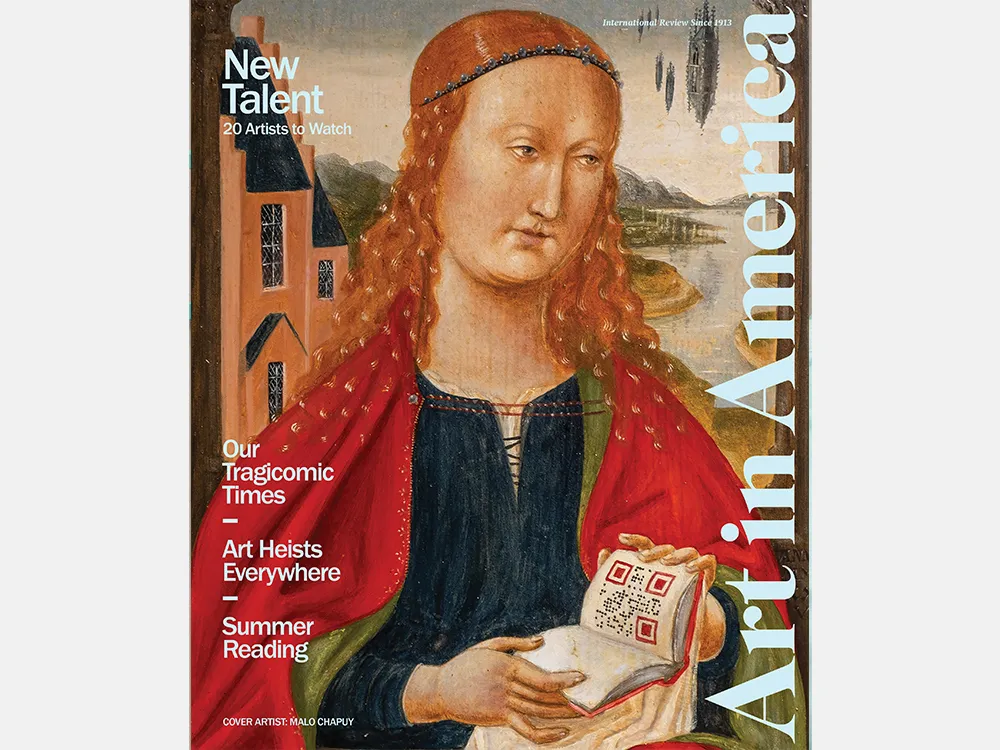
There has been much discussion over the past decade or so about the role of the artist during our tumultuous political times. Looking at the latest crop of Art in America’s “New Talent” artists, I can’t help but think that one of artists’ primary functions during such times is to remind us that few things in this world are truly immutable, and instead that the world is in constant flux and things are perhaps as likely to get better over time as they are to get worse. This is a way of talking about hope.
The concept of mutability shows up over and over in these pages. In Elizabeth Glaessner’s paintings, human beings seem to be in the process of transforming into animals, or hybrids. Both Isaiah Davis and Jenny Calivas are interested in changing a hard material into a softer one—in Davis’s case, steel, and in Calivas’s, the medium of photography. The meaning of Juliana Halpert’s photographs shifts depending on how you want to see them: as simple memorialization or as documentation of a site of wrongdoing. The drawings that make up Joeun Kim Aatchim’s pieces mean one thing on their own, and something different when layered atop one another. In Kiah Celeste’s sculptures, compact discs become the facets of a shimmering snake, and a bowling ball is transformed into a giant’s gleaming pearl. Terran Last Gun turns the writing on historical accounting ledgers into abstraction, just one part of a complex geometry.
Recently, the New Yorker critic Hilton Als complained that some younger artists in the Whitney Biennial are recapitulating the work of their forebears with insufficient attention to the process of influence, that they are “makers who have little if any relationship to what they’re putting out there, aside from its being a product in service of a career.” I find this to be too harsh a judgment; but in any case, there is no such thing to be found in the work of the artists in these pages. If anything, they are keenly aware of what came before them. As Koyoltzintli said of the musical instruments she fashions from clay, “I feel like I am in constant conversation with the past and we are discussing what we’re going to do with the future.”
View of Alexa West’s performance Jawbreaker Part 1 & 2, 2025, at Pageant, New York.
Photo Kayhl Cooper
FEATURES
New Talent
Twenty exciting artists to watch, as chosen by the editors of Art in America.
Our Tragicomic Times
We no longer know when to laugh or cry at our world or at our art.
by Eugenie Brinkema
All Systems Go
How systems art became the defining movement of the 21st century—and what we should do about it.
by Emily Watlington
The Art of the Steal
Why we can’t get enough juicy art heist stories.
by Jackson Arn


Theo Eshetu: Till Death Us Do Part, 1986.
Courtesy Theo Eshetu
DEPARTMENTS
Datebook
A highly discerning list of things to experience over the next three months.
by the Editors of A.i.A.
Hard Truths
A museum worker ponders senior citizens as social-media ambassadors, and a gallery worker worries about ominous connections.
by Chen & Lampert
Sightlines
Playwright Nilo Cruz tells us what he likes.
Battle Royale
Frick Collection vs. Morgan Library—two New York Gilded Age museums go head-to-head.
by the Editors of A.i.A.
Inquiry
Theo Eshetu talks about finding new and unfamiliar forms for film.
by Emmanuel Iduma
Revelations
A writer singles out Asad Raza’s Absorption.
by Claudia Rankine
Syllabus
Our summer reading list is filled with art-themed novels.
by Emily Watlington
Appreciation
A tribute to Henrike Naumann, who stared down a divided Germany’s past while eyeing our troubled present.
by Kyle Dancewicz
Issues & Commentary
It’s worth taking time to mourn the disappearing generation of staff art critics as we try to build new models.
by Catherine Wagley
Spotlight
Olga Fröbe-Kapteyn, a painter, collector, and collaborator of Carl Jung, mined the archive and her subconscious.
by Eliza Goodspasture
Book Review
A reading of Trevor Paglen’s How to See Like a Machine: Images After AI.
by Louis Bury
Cover Artist
Malo Chapuy talks about his artwork on the cover of A.i.A.

Elsa Schiaparelli and Salvador Dalí: Skeleton Dress, 1938.
Photo Emil Larsson/ Salvador Dal , Fundaci Gala-Salvador Dal /DACS, 2025/Courtesy Victoria and Albert Museum, London
REVIEWS
United States
United States Diary
by Greg Allen
London
“Schiaparelli: Fashion Becomes Art”
by Eliza Goodpasture
New York
“Noguchi’s New York”
by Terry Nguyen
Whitney Biennial
by Emily Watlington
Philadelphia
“The Shakers”
by Kelly Presutti
Salem
“Edmonia Lewis: Said in Stone”
by Tyehimba Jess


