






Artist Betye Saar, whose assemblages transformed ephemera and heirlooms into meditations on Black history, racism, memory, and spirituality, died in her sleep on July 26 in Los Angeles, four days before her 100th birthday. Her death was confirmed by Roberts Projects, the Los Angeles gallery that represented her for close to two decades.
“Betye Saar was one of the greatest artists of our time, and it has been an immense honor to work with her for nearly 20 years,” Julie Roberts, co-founder of Roberts Projects, said in a statement. “Her singular vision transformed the course of contemporary art, and her legacy will continue to inspire generations of artists, scholars, and audiences around the world.”
Born Betye Irene Brown in Los Angeles in 1926, Saar was the eldest of three children of Jefferson Maze Brown and Beatrice Lillian Parson. Her father died when she was about five, and her mother moved the family to Pasadena to live with a maternal aunt, Hattie Parson Keys, whose belongings later inspired a series of assemblages made in her honor. Saar spent summers at her paternal grandparents’ home in the Watts neighborhood in L.A., watching artist Simon Rodia construct his monumental architectural sculpture Watts Towers by hand, inspiring Saar’s passion for using found and repurposed materials.
Saar studied design at UCLA and worked for years as an interior decorator, at one point running a studio called Brown and Tann with fellow designer Curtis Tann. In 1952, she married ceramicist Richard Saar; the couple settled in Laurel Canyon, Hollywood Hills, and had three daughters, Lezley, Alison, and Tracye, before divorcing in the late 1960s. Saar remained in the Laurel Canyon house for the rest of her life.
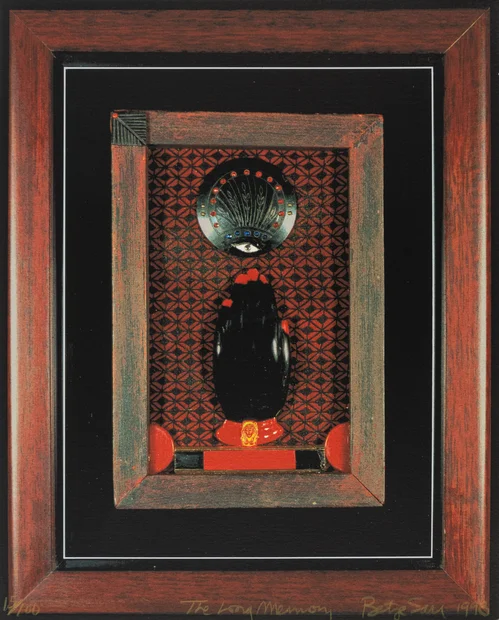

The Long Memory, 1998
Betye Saar
CLAMP
Her turn toward fine art came almost by chance. Enrolled at Cal State Long Beach to pursue a teaching credential, Saar wandered into the printmaking studio and immediately changed course. “The move into fine art, it was liberating,” she later told the Los Angeles Times. “It gave me freedom to experiment.” Her early prints carried mystical and occult overtones, drawn from books on alchemy and palmistry, and she began framing them in old window frames scavenged from junk shops.
A 1967 exhibition of Joseph Cornell’s boxed assemblages at the Pasadena Art Museum pushed Saar toward three dimensions. In 1969, she completed Black Girl’s Window, built around a salvaged window frame layering autobiographical imagery, astrology, and racial identity. Trips to Chicago’s Field Museum, where she immersed herself in African art, and to Haiti in the early 1970s, where she explored voodoo and folk magic, further shaped her visual language.
Saar’s best-known work, The Liberation of Aunt Jemima (1972), transformed a stereotypical “mammy” figurine—armed with a rifle and grenade—into what she described as a warrior against servitude. First shown at the Rainbow Sign, a Black cultural center in Berkeley, California, near the headquarters of the Black Panthers, the piece connected Saar to the Black Arts Movement and led to a solo exhibition at the Whitney Museum of American Art in 1975. Activist Angela Davis later credited it with helping to spur the Black women’s movement. “I wanted to empower her,” Saar said in a 2015 interview. “I wanted to make her a warrior.” The original assemblage now belongs to the Berkeley Art Museum and Pacific Film Archive.
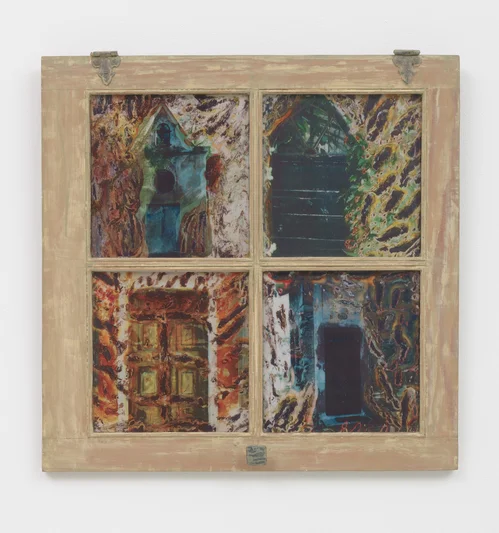

4 Doors in a Window (Bellagio, Italy – 1994), 2004
Betye Saar
Roberts Projects
Over the following decades, Saar continued mining flea markets, yard sales, and family heirlooms, producing works including Records for Hattie (1975), Mojotech (1987), and the altarpiece Wings of Morning (1992), alongside installations like House of Fortune (1988). Scholar Kellie Jones, who curated the 2011 exhibition “Now Dig This! Art and Black Los Angeles 1960–1980” at the Hammer Museum, said in a TK that Saar’s reach extended well beyond the U.S.: “She has works with Mexican milagros, she has titles in Spanish, she at certain points has Asian influence and Haitian influence… She was a person in the world.” Her practice inspired a generation of artists, including her daughter, the artist Alison Saar. Saar’s work is held in the collections of more than 80 institutions worldwide, and she had solo exhibitions at the Museum of Modern Art in New York, the Fondazione Prada in Milan, as well as the Los Angeles County Museum of Art and the California African American Museum. “I’ve always done what I did and never felt I was competing with what was going on,” she told the Los Angeles Times of her career.
She continued working into her late 90s, including a commissioned installation at the Huntington Library’s gardens, made at 96 and now on view as “Betye Saar: Drifting Toward Twilight” through November 2027. “Even in death those things can be really beautiful,” she said of the installation in an accompanying documentary. Two other shows remain on view during her centennial year: “Let’s Get It On: The Wearable Art of Betye Saar” at Roberts Projects, in Los Angeles, through August 22, and “Betye Saar’s Black Dolls” at the New York Historical Society, through October 4. Her works are currently included in “Tarot! Renaissance Symbols, Modern Visions” at the Morgan Library & Museum.
Saar is survived by her daughters, Lezley Saar, Alison Saar, and Tracye Saar-Cavanaugh, as well as six grandchildren, including the artist Maddy Inez, and a pet tortoise named Rojo. Her artistic legacy is now overseen by the Betye Saar Legacy Group, a coalition of scholars and curators the artist assembled in 2025 with Roberts Projects. A biography by Zoé Whitley, co-curator of “Soul of a Nation: Art in the Age of Black Power,” is expected in 2027.


