





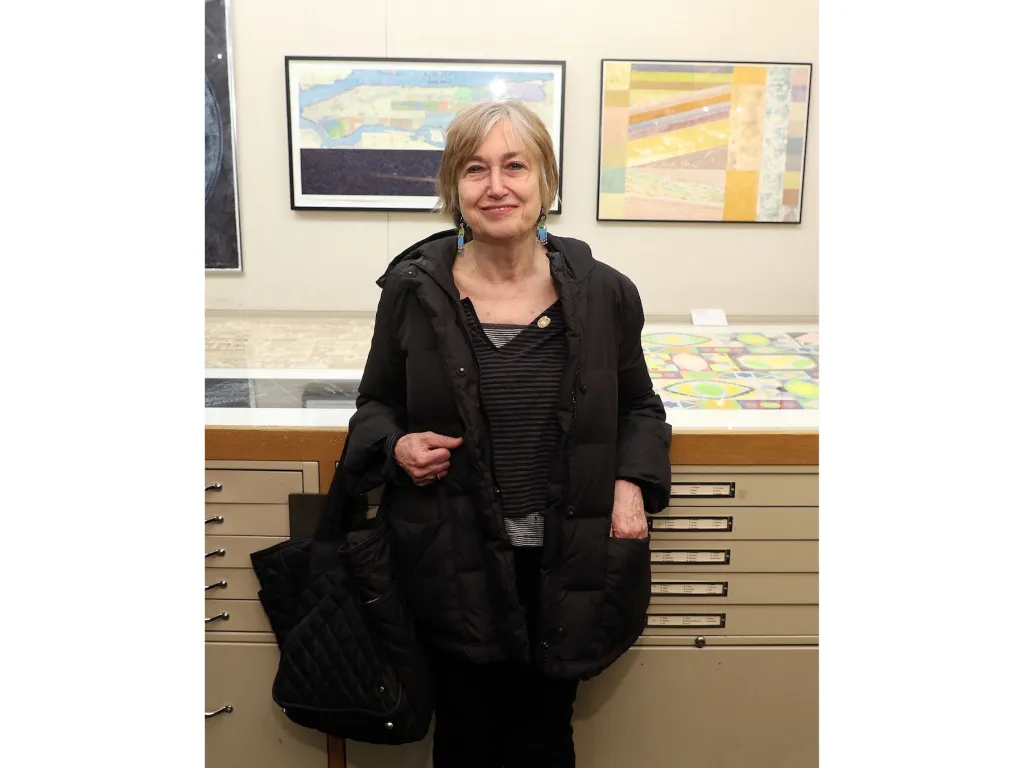
Joyce Kozloff, the renowned Pattern and Decoration artist and founder of the feminist magazine Heresies (1977–93), has revealed herself to be a founding member of the feminist action group Guerrilla Girls. She made the disclosure in an interview published July 22 in Art Journal Open.
The Guerrilla Girls collective was formed in 1984 in response to the exhibition “International Survey of Painting and Sculpture” at the Museum of Modern Art in New York, which included the work of 169 artists, fewer than 10 percent of whom were women. Using the tagline “the conscious of the art world,” the Guerrilla Girls’s anonymous members embarked on a poster campaign targeting institutions and figures in the art world whom they felt were responsible for the exclusion of women and non-white artists from mainstream exhibitions and publications.
“We decided to call ourselves the Guerrilla Girls, wear fishnet hose and short skirts, call out the worst misogynists in the art world, appear publicly in masks, like avengers,” Kozloff told her interviewers, curators Helena Reckett and Maura Reilly. “A new member had misunderstood our name, brought a gorilla mask to a meeting, and voila! We all had aliases, the names of dead women artists: I was Liubov Popova.”
Kozloff continued, “Remaining anonymous was an important Guerrilla Girls decision. People thought this was to avoid art world reprisals. For me, that was never the reason. I argued for anonymity because I didn’t want attention to be on us as individuals, I wanted it to remain on the issues.”
In the same interview, Kozloff disclosed that she was one of the creators of what is perhaps the Guerrilla Girls’s most famous poster: The Advantages of Being a Woman Artist (1988). Among the 13 “advantages” it lists are: “Working without the pressure of success,” “Not having to be in shows with men,” “Having the opportunity to choose between career and motherhood,” and “Knowing your career might pick up after you’re eighty.”
The idea for the poster came to Kozloff while she was a participant at the 1985–86 Kohler Arts/Industry Residency program in Wisconsin and sharing a house with three other artists in residence, all of whom were men. “They were married, college ceramics professors,” she recalled. “Each had brought an undergrad woman student along, their girlfriends, who also did their housework, cooking and were unpaid studio assistants at the factory. When I got back, I wrote a rough draft, ‘The Disadvantages of Being a Woman Artist.’ Until then, our posters always had verifiable statistics, so this was a stretch. But then, our clever members turned it around to ‘Advantages,’ and it worked!”
Asked why she opted to come forward at this moment, Kozloff told Ocula magazine, “I’d had a pact with another Girl that whoever died first, the survivor would bring her out. But I suddenly realized that if I were dead, I couldn’t tell the story my way. More and more, I see life as Rashomon, we all remember it differently, and so we all have different stories to tell.”
Kozloff, who left the group in 1991, added that she believes that the other surviving founding Guerrilla Girls will continue to withhold their identities. But of her own decision to unmask, she said “I spoke to them before I did, and they gave me permission.”


