








At the New Art Dealers Alliance’s (Nada) New York fair (until 17 May), many stands are overflowing with works that investigate themes of culture and belonging through multimedia pieces with a heavy emphasis on textiles. The artists Keith Lafuente (showing with SoMad), Polina Osipova (showing with JO-HS) and Griselda Rosas (showing with Luis De Jesus Los Angeles) all use textiles to examine histories of inequality.
Rosas, a multidisciplinary artist who grew up in Tijuana and settled in San Diego, returned to textiles during the pandemic. “She started working at the kitchen table at home using what she had: her sewing machine,” Luis De Jesus says. “She uses thread like paint.”
That process marked a return to a mode of survival long practised among the women in her family. Rosas painted on paper and then used her sewing machine to embroider on top, drawing from imagery taken from Mexican codices depicting life during colonial first contact. (The works at Nada range from $5,000 to $20,000.)
On JO-HS’s stand, Osipova likewise employs textiles to excavate history, printing family photos onto fabric to create wall-hanging, sculptural works. The creation of this fabric, originally from the Chuvash region, is a way of exploring the culture that existed in the region before it was Russianised.
For Lafuente, the use of textiles is a way of commenting on labour inequalities in the era of globalisation. Lafuente used scraps from the cutting-room floor of the designer Oscar de la Renta to create the patchwork design that Filipinos use to make rags. This features on Lafuente’s kinetic sculpture Waiter (Kain Na!) (2025), which references the Filipino service industry—the Philippines’ largest export—and is priced at $16,000.
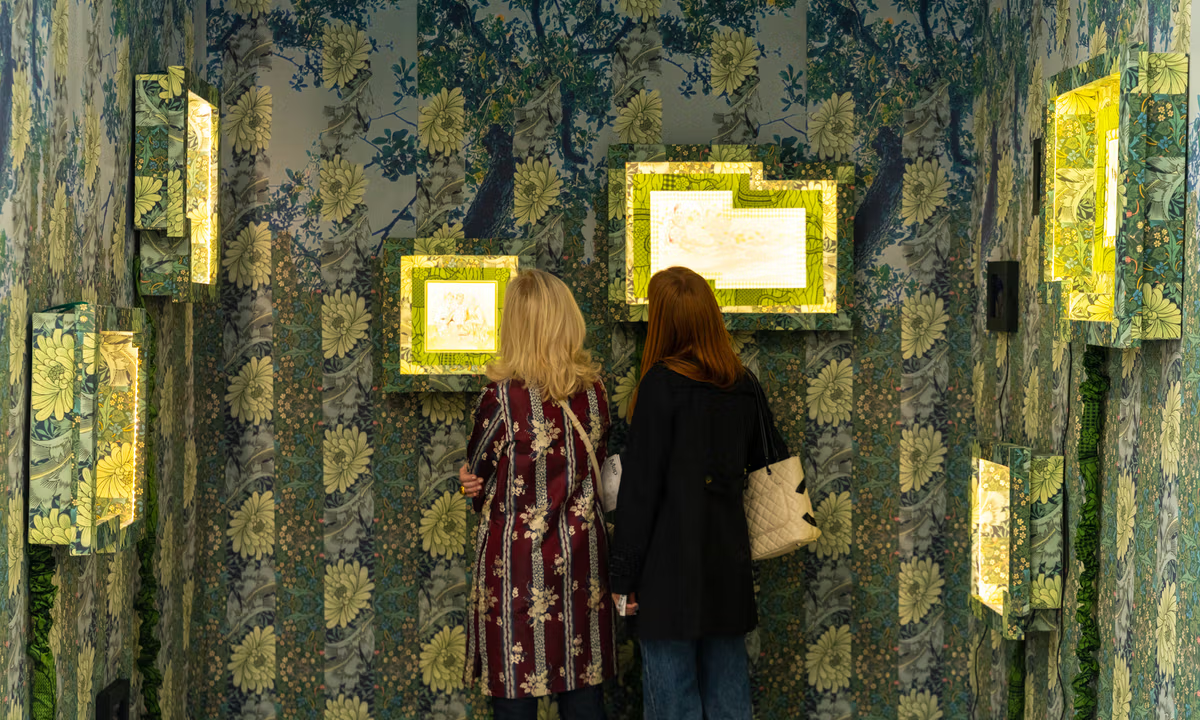
Elsewhere, artists use textiles to illustrate personal histories. On Voltz Clarke Gallery’s stand, Ruth Owens tells a story of belonging and migration in a series of paintings set in lightboxes made of different patterned textiles, ranging from $4,500 to $6,500. Born in what was then West Germany, Owens was raised by her German grandmother for her first four years while her parents moved around due to her father’s military job. When the family was set to be reunited and settle down in the US state of Georgia, Owens’s grandmother abducted her; the scene is painted in a work titled Kidnapped on a Sunny Day (2024).
The billowing green fabric wrapped around the stand represents threads of Owens’s ancestry and cultural traditions referencing the environment, including Nigerian batik, and a William Morris-inspired vegetal motif. “I’m drawn to fabric because its materiality—its softness—translates into affect and a softer way of relating,” Owens says.


