







The Ultimate Fighting ring had not yet been erected on the White House lawn. The National Mall had not yet been repaved into an IndyCar race track for the Freedom 250. But the entertainment programming of America 250, the semiquincentennial celebration of the birth of a nation, was nevertheless well underway.
Banners three stories tall with Donald Trump’s menacing portrait were being stretched accross federal office buildings around the Mall, including the Department of Justice. A similarly glowering headshot of Charlie Kirk, the right-wing polemicist and college dropout who encouraged America’s online youth to harass teachers out of their jobs and who, though shot at a school, technically didn’t die in a school shooting, appeared on the facade of the Department of Education.
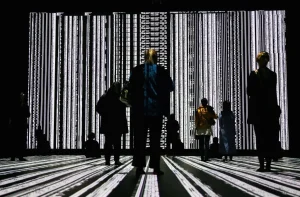
Though little noted at the time, beginning last New Year’s Eve, A250 announced the semiquincentennial theme of celebrating the great white men who first made America great with a nightly video projection onto the Washington Monument. The computer-animated, 24-minute history of the USA begins with an underwater POV, bobbing above the surface of the ocean as two ships sail away. This could be taken as the view of someone escaping enslavement by jumping overboard during the Middle Passage, until an unseen narrator praises Christopher Columbus’s discovery of the New World. Soon, a bird’s-eye view follows a low-res Paul Revere riding through the streets of Boston like a free-to-play mobile phone app.
In this telling, the rest of the United States’ story is about real estate. Freedom having been won from England, the video skips most of a century as it hurdles from the Louisiana Purchase and the California gold rush to the Empire State Building. Lewis and Clark appear in a pan across a painting from the Wikipedia page of their unmentioned Hidatsa guide, Sacagawea—the only woman, the only Indigenous person, the only non-white person in the video. America’s history ends with the World Trade Center (the new one), and a giant animated birthday candle, accompanied by a military band playing John Philip Sousa marches. The video repeated every 30 minutes for a week.
Projected on an obelisk, this narrowest of histories prefigured the commemorative distortions to follow. In February, it was reported that the National Park Service will exhibit a decommissioned equestrian monument of a slaveholding signatory of the Declaration of Independence. That statue, of Delaware delegate Caesar Rodney, had been removed from its original site in Wilmington after the anti-racist demonstrations of 2020. It will be installed on Pennsylvania Avenue, in a plaza dedicated to Martin Luther King, Jr.
Behind the retrenchment of official programming is an events company founded by the producers of Trump’s rallies, including the rally-turned-insurrection on January 6. In March of this year, it was revealed that, in 2025, the contractors for the nonpartisan A250 Commission had been fired and replaced by this MAGA team. So far, they have received no-bid federal contracts totaling over $26 million.
Paul Revere, Jr.: Sons of Liberty Bowl, 1768; in “America at 250” at the Museum of Fine Arts Boston.
Courtesy Museum of Fine Arts Boston
IN OTHER WORDS: as America marks the literal anniversary of the OG “No Kings” manifesto, the official spectacles now aim to consolidate Donald Trump’s authoritarian rule and advance a white supremacist agenda by whitewashing the country’s history. But it’s a big country, and even amid the racist violence and mayhem, even with legacy institutions wavering, museums can be anchors to the independent national and local commemorations. And they are indeed stepping into the gap to tell America’s fuller, more complicated history of colonialism, displacement, slavery, immigration, liberation, and self-government.
But no museum shows are coming to save us. Back in 2017, when the Trump Muslim travel ban was announced, The Museum of Modern Art quickly organized a solidarity show of works by artists from affected countries. In the wake of the 2020 protests of anti-Black police violence, museums put themselves forward as hosts for their communities’ racial reckonings and difficult discourses. But in the current climate of censorship and funding threats, museums have largely pulled back from the political front lines. With rare exceptions, the America 250 exhibitions and programs of US museums reflect plans set around 2024, rather than in response to the urgency or precarity of the moment.
For museums in the original 13 colonies especially, this means quietly carrying on with efforts to reconsider and diversify historically white-centered art collections and re-presenting the results as an America 250 glow-up. In Philadelphia, where the Declaration was signed, it means collecting stories of local billionaires that can finally be told. The Philadelphia Museum of Art and the Pennsylvania Academy of the Fine Arts are collaborating on a joint show titled “A Nation of Artists.” The 1,000-work rehang of their American Art collections incorporates 120 rarely seen works from the Middleton family, who own the Philadelphia Phillies baseball team. Philadelphia is also hosting the MLB All-Star Game.
In New York, the American Folk Art Museum’s collection show “Folk Nation: Crafting Patriotism in the United States”promises to link “vernacular art and the construction of an American sense of self,” showing work by a diverse array of artists across time. But it also explores the interrelation of American identity and the 20th-century development of “folk” art as a collecting category, which is itself inextricable from the museum’s founding and mission. Meanwhile upstate, at the Rockwell Museum in Corning, America 250 is also Rockwell 50: The museum, now a Smithsonian affiliate, opened in 1976. Alongside the department store scions’ collection of American art, the Rockwell showed “Native Now: Contemporary Indigenous Art at The Rockwell Museum,” the museum’s 25-year project to collect works by contemporary Indigenous artists. The Rockwell is also the third stop on a multiyear tour for “Gateways: African American Art from the Key Collection,” an exhibition of 88 works spanning 150 years assembled by longtime museum and arts educator Eric Key.
Whether it is the city’s revolutionary history or its present as a progressive bastion, the museum’s forward view of mission or the objects at its center, the Museum of Fine Arts, Boston’s “America at 250” exhibition, opening in June, seems exceptionally relevant right now. The MFA is reinstalling the 18th-century galleries in the Art of the Americas wing to integrate art from Native and non-native artists across the Americas—North, Central, South, and the Caribbean—in order to explore “how artists have contributed to, or in some cases resisted, ideas of nationhood and identity.” Gilbert Stuart’s unfinished 1796 portrait of George Washington will be contrasted with Mohawk artist Alan Michelson’s 2018 depiction of Washington’s Indian moniker, Hanödaga:yas (Town Destroyer).
Elsewhere in the show, David Drake’s inscribed clay vessel (1857) will be shown along with Paul Revere’s Sons of Liberty Bowl (1768), which the MFA has previously called America’s “[third] most cherished historical treasure after the Declaration of Independence and the Constitution,” and now also describes as “an early example of American protest art.” The Revere bowl was hidden for decades by the descendants of the secret resistors whose names are engraved on its surface. On April 18, 2025, the 250th anniversary of the lighting of the “two if by sea” lamps in the Old North Church, historian Heather Cox Richardson recounted the many small, unsung acts of resistance to tyranny that didn’t become as famous as Revere’s midnight ride. To this list, the museum adds Drake, who was enslaved in South Carolina and who “exemplifies literacy as an act of resistance.” In October 2025, the MFA returned two vessels to Drake’s descendants, then bought one back, the first instance of museum restitution for an artist’s enslaved labor.


Titus Kaphar: Shadows of Liberty, 2016; in “Pictures More Famous than the Truth” at the Virginia Museum of Fine Arts.
Courtesy Yale University Art Gallery, New Haven
The Virginia Museum of Fine Arts in Richmond is reflecting on America 250 by pairing a contemporary artist with collection works from just one historical artist. In “Titus Kaphar and Junius Brutus Stearns: Pictures More Famous than the Truth,” Kaphar’s deconstructed depictions of George Washington contrast with five Stearns paintings that were instrumental in mythologizing Washington in the mid-19th century. While undergoing a renovation, VMFA on the Road has put a 14-work exhibition in an Artmobile. “Virginia as America: Navigating Life, Liberty, and the Pursuit of Happiness” will tour the state through mid-October, delivering “an alternative lens by which to understand our past” to rural residents who watch Fox News, highlighting the relevance of the country’s founding principles “for realizing a ‘more perfect union’” to people who dream of the Confederacy.
A similar traveling project is underway at the National Gallery in Washington, albeit on a slightly different scale. While many galleries in the West Building are renovated, the NGA’s partnership program, “Across the Nation,” has sent major—and not always American—works to 10 museums from Alaska to Utah to Connecticut. Partners have received works by Hans Memling, Rembrandt, van Dyck, Matisse, Cézanne, Degas, Georgia O’Keeffe, Alma Thomas, Mark Rothko, and so on.
On view at the NGA in D.C. instead: “Dear America: Artists Explore the American Experience,” a one-gallery show of drawings, prints, and photographs; and “American Icon: The US Flag in Art,” a 30-work “spotlight show” about the single safest subject in town. Though the NGA previously offered a more provocative pairing, showing contemporary works by Kerry James Marshall alongside John Singleton Copley’s Watson and the Shark (1788), their American Galleries A250 reinstallation, centered on sculpture, risks going unnoticed altogether. Three objects—a sculpture each by Hiram Powers and Bessie Potter Vonnoh and a candelabrum by Andrew Ellicott Warner—will be added to the galleries. If it were fully instead of only partially gilded, the silver candelabrum (1817) would probably have been requisitioned for the White House by now.
The NGA’s most resonant contribution is West to East, an online 10-part series of essays and videos in which contemporary artists discuss the communities and places they call home, from South Central to the Diné Nation, from Lake George to Iowa to the Rio Grande. If anything should be projected onto the Washington Monument, it’s this. The facade of the East Building would also work.

Robert Frank: Trolley—New Orleans, 1955; in “Dear America: Artists Explore the American Experience” at the National Gallery of Art.
Courtesy National Gallery of Art, Washington, D.C./©June Leaf and Robert Frank Foundation
To celebrate the bicentennial in 1976, the National Endowment for the Arts created a photo survey grant program to produce “a new portrait of the nation, during a pivotal chapter in its history.” Over six years, more than 70 photo surveys in regions all over the country resulted in thousands of photos, which were eventually transferred to the Smithsonian. Like the opening of a time capsule, photos from the program will be on view for the first time in “Much Here Is Beautiful: Photography Surveys of the U.S. Bicentennial,” at the Smithsonian American Art Museum. The multifaceted stories the surveys tell will mark some of the US’s advances over 50 years, but also its retreats. After banning arts grants related to diversity, the NEA’s revised A250 program includes figurative sculptures for Trump’s National Garden of American Heroes; military band concerts; and, for the kids, a nationwide contest to design an A250 bookmark.
WHERE ARE THE ARTISTS in all of this? In the summer of 2024, the Philadelphia-based nonprofit Monument Lab partnered with the Independence National Historic Park for a temporary public art project at Declaration House, where Thomas Jefferson wrote the Declaration of Independence. (Actually, the house is a replica, rebuilt by the National Park Service for the 1976 bicentennial.) Sonya Clark’s The Descendants of Monticello filled the windows of Declaration House with close-up video portraits of offspring of the more than 400 people Jefferson enslaved at Monticello—including those related to Jefferson himself. That’s as close to an A250 artist project as it gets.

John Akomfrah: The Hour Of The Dog, 2025; at the Menil Collection.
©John Akomfrah/Courtesy Smoking Dogs Films and Lisson Gallery
In the wake of 2020’s protests, many museums solicited responses from contemporary artists—particularly artists of color; A250 has spawned no such wave of institutional commissions. But of course, the systemic racism and violence at the root of those protests runs as deep as the founding of America itself, and artworks addressing those realities foster a more substantive historical reckoning today. In Houston, the Menil will show John Akomfrah’s new six-channel video installation about youth in the US Civil Rights Movement. Titled The Hour of the Dog (2025), it was co-commissioned with the Baltimore Museum of Art, where it premiered last fall. Through August in Philadelphia, the Barnes is showing “Freedom Dreams,” an exhibition of moving image work about the histories, memories, and experiences of Black Americans by five artists: Arthur Jafa, David Hartt, Garrett Bradley, Ja’Tovia Gary, and Tourmaline.
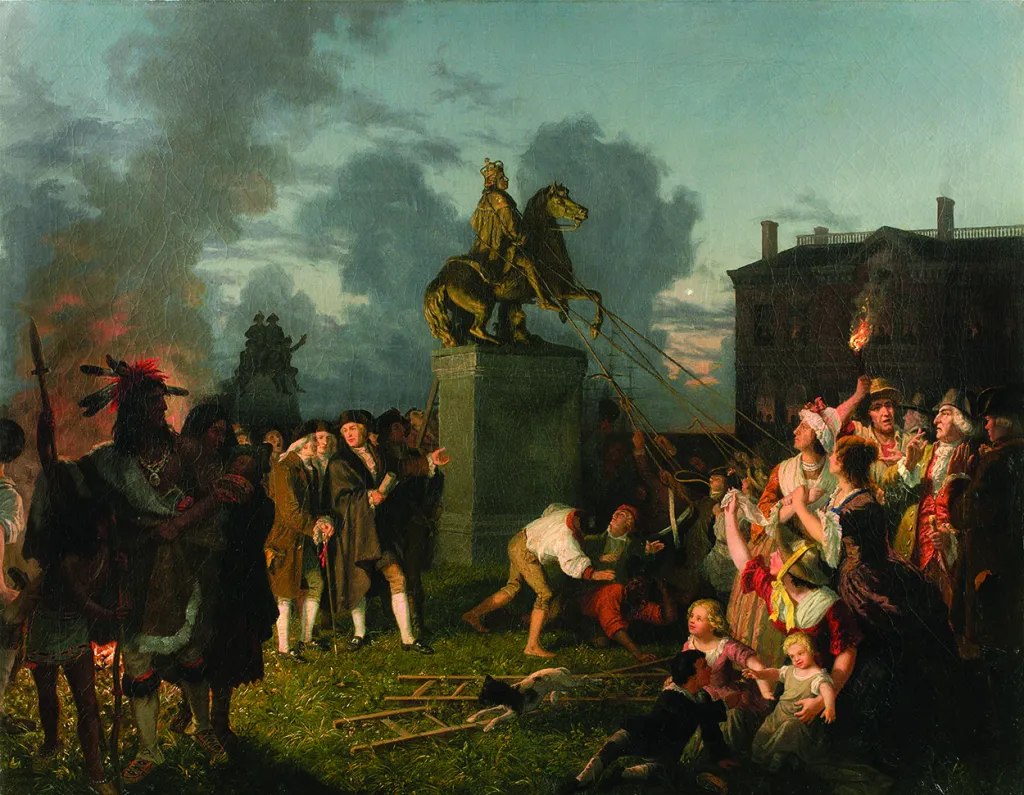
But perhaps no single show better anticipates this moment than “Democracy Matters,” the inaugural exhibition at the new Tang Wing for American Democracy at the New York Historical Society, which “will explore democratic rights, including voting, worshiping, speaking, and protesting; the triumphs and challenges of upholding democracy throughout US history; citizenship and the question of what it means to be American; and land rights and ownership.” The show includes Johannes Adam Simon Oertel’s epic painting Pulling Down the Statue of King George III, New York City (1852–53), which echoes across time with “Monuments,” at both the Brick and MOCA in Los Angeles. That exhibition of deinstalled, destroyed, or deconstructed Confederate monuments addressed the question Christina Sharpe asked: “How do we memorialize an event that is still ongoing?” It included vital artists’ answers, updates to the stories America’s been telling itself about the Civil War and about its own history. It closed May 3 and, inexplicably, will not travel. Maybe in the spirit of “Monuments,” and in the spirit of 1776, America could honor its founding principles by toppling some more kings.


