






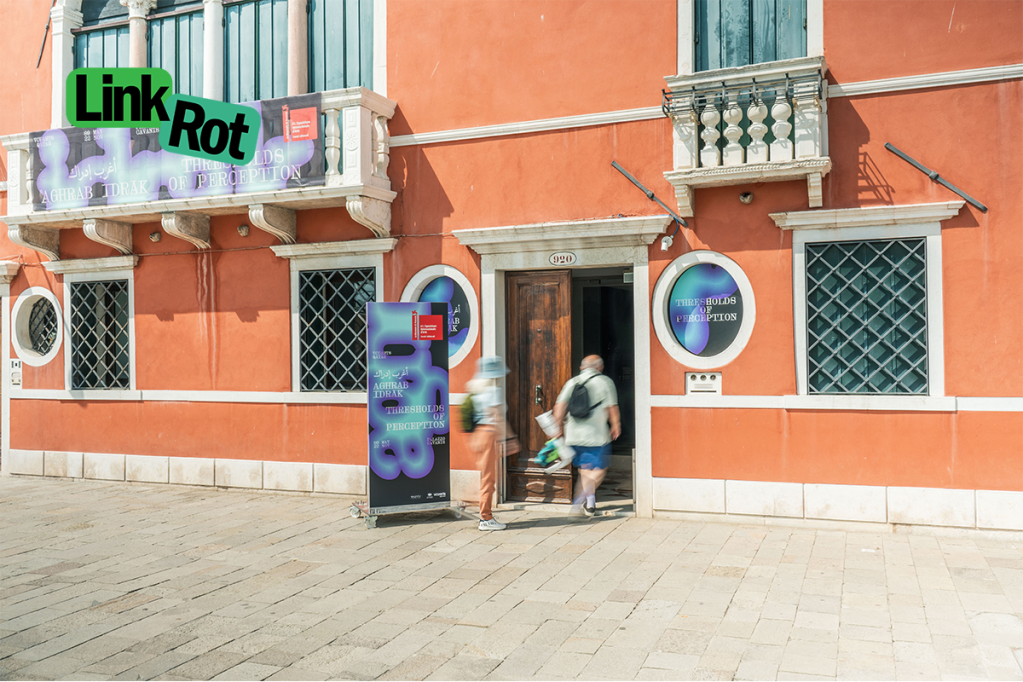
Earlier this month, Dr. Michael Rao, president of Virginia Commonwealth University, made a bold statement: it’s time to move “beyond” the educational model developed by Oxford University in the High Middle Ages. Rao was speaking at the opening of “أغرب إدراك: Aghrab Idrāk: Thresholds of Perception,” a an official Venice Biennale collateral exhibition presented by VCUarts at Palazzo Cavanis in Venice.
Indeed, “Aghrab Idrāk” is a rare show for a university, a sort of proof of concept for a new way of teaching the arts.
An interdisciplinary program, VCUarts Qatar organizes its offerings through creative research labs that mash up not just creative practices like graphic arts, textile design, audiovisual engineering, typography, and illustration, but also disciplines like anthropology, computer science, and engineering. The result is labs like Sonic Jeel, which focuses on sonic cultures; the Anthro-tech Atelier, which combines anthropology and design; and xLab, which designs typefaces and electronic displays built for Arabic scripts. It’s an unconventional structure, but one that was developed to serve VCUarts Qatar’s scale: the university hosts only about 350 students a year. By allowing professors to design interdisciplinary labs, students coming from different disciplinary backgrounds find common ground. Meanwhile, these labs allow professors to develop their creative and scientific practices.
The expansiveness of this program wouldn’t be possible without the resources being offered to institutions of higher learning in Doha—a stark contrast to the US, where universities have been losing federal funding under the Trump administration.
“We are very fortunate to exist in a country that invests a lot in culture, arts, and education,” Amir Berbic, dean of VCUarts Qatar, told ARTnews. “We know that’s not the case everywhere, and so we wanted to be very intentional about how we use these resources.”
In a country developing so rapidly, and against a backdrop of fast-paced technological change, a lab seemed like the right way to keep faculty flexible to the changing conditions of the world their students are operating in, Berbic explained. The goal was to create labs that were horizontal in structure—meaning they aren’t created or dictated by leadership but by professors—and that incorporated not just teachers and students but alumni as well. The result has been the creation of idiosyncratic labs that attract teachers whose professional backgrounds tend to venture outside disciplinary bounds.
An installation view of Sonic Fields (2026) at “Aghrab Idrāk” at Palazzo Cavanis in Venice.
Courtesy VCUarts Qatar
On view at “Aghrab Idrāk” were projects that professors have developed from within their labs. Tucked in one of the rooms of Palazzo Cavanis, a carpet is laid down and the lights are dimmed and pink. A modular synthesizer sits on the ground, surrounded by several stools and headphones. It’s a listening room set up around Sonic Fields (2026), developed by Michael Hersrud and Simone Muscolino, creators of the Sonic Jeel lab. Field recordings—from the preparation of street food to birds chirping, taken mostly in public spaces around Doha—are a kind of sonic memory of a place that is rapidly changing.
“I feel so privileged to make work as an artist while doing research, though I’ve never worked one day in my life as an architect,” said Muscolino. Like so many of the other professors at VCUarts Qatar, Muscolino sought out a genre-defying career, moving between experimental film and video production for architecture firms while playing in a band on the side. While most professors tend to complain about the impossibility of advancing their own work while keeping up with their teaching responsibilities, the lab setup—usually confined to certain scientific disciplines—seems to give these teachers a way of developing their practices while they teach. Some of the recordings for Sonic Fields come from students who took their class “Sound Exploration,” which, funnily enough, was technically offered as part of the graphic design program. Meanwhile, the lab has turned into a record label, with local musicians, many of them amateur, making records through collaborations with the lab.
Sonic Fields was far from the only piece to tackle memory and identity. For a state that is only 55 years old, the cultivation of a national identity finds an obstacle in its very rapid growth. From nomadic migrations to geek culture, many of the works seek to record and archive changing relations to place and community, not only in Doha but across the Gulf region.
As Dr. Dianne Derr, associate dean at VCUarts Qatar, put it, “Qatar has been in an emergent state for such a long time, and we’re all in this process of unpacking the past, present, and future.”
These labs seem like one way of doing that.


