







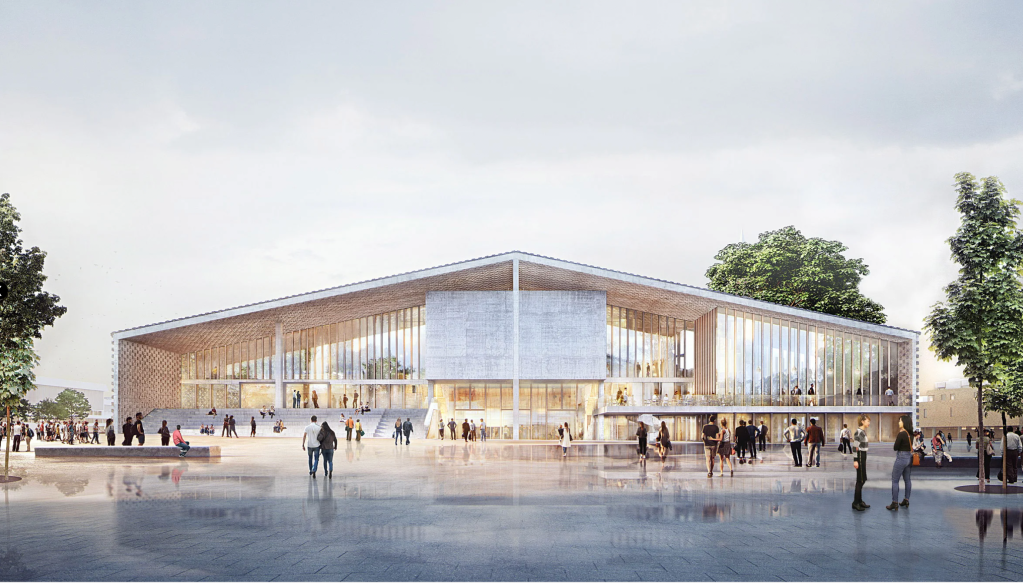
Another day, another setback for Berlin’s long awaited Berlin Modern, as moisture damage in the building’s shell and microbial contamination in other parts of the structure have forced the postponement of the museum to 2030.
The Prussian Cultural Heritage Foundation announced the delay earlier this week, according to Monopol, after the Berlin-Brandenburg Broadcasting Corporation broke the story on the issues.
The latest delay adds approximately eight months to the construction timeline for the Herzog & de Meuron-designed building, which was originally scheduled to open this year as the Museum of the 20th Century.
“All available measures were taken to repair the damage as quickly as possible, and construction did not have to be halted,” an SPK spokesperson told Monopol. The Neue Nationalgalerie plans to begin exhibiting art in the building before its official opening, as that institution can only display a portion of its collection at its current premises.
The museum has faced multiple setbacks and criticism over its design since groundbreaking began in December 2019. At the time, completion was scheduled for 2026, but was later pushed to 2028. During the topping out ceremony last October, the museum said the date was being pushed again to 2029.
As ARTnews reported in 2022, the museum project has drawn considerable scrutiny from architecture and conservation critics since groundbreaking, with many pointing to flaws in the construction plan and unsustainable design choices, like the use of a concrete and an energy-intensive ventilation system. The cost of the project has ballooned as well, from an original projection of €200 million to €507 million, according to recent estimates.
The building project, an extension of the Neue Nationalgalerie in Berlin, officially began in 2019 when German officials unveiled plans to build an exhibition space that would hold a large collection of art produced by European artists in the 20th century, including works by Gerhard Richter, Joseph Beuys, and Ernst Ludwig Kirchner.
Herzog & de Meuron, the Basel-based firm behind the Tate Modern, the Elbphilharmonie in Hamburg, and the de Young Museum in San Francisco, won the architectural commission in 2016 after a competitive design process. The Museum has said that the idea of the building’s design is to serve as “an open and connecting element in the Kulturforum,” integrating with the area’s existing cultural institutions.


