






Editor’s Note: This story originally appeared in On Balance, the ARTnews newsletter about the art market and beyond. Sign up here to receive it every Wednesday.
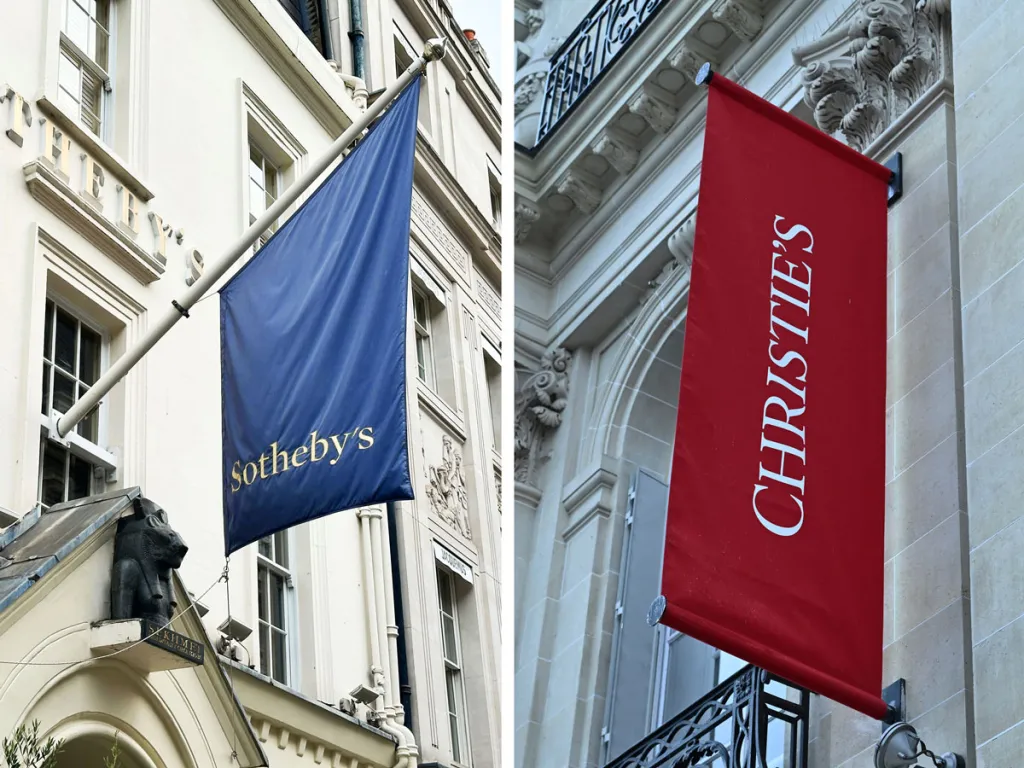
As summer turns to fall, the November auctions in New York are just over the horizon. And while much of the art world might be signing off for the next few weeks, the rainmakers at Christie’s and Sotheby’s are fighting over consignments, including what remains of the art collection of Herbert Lust. Prior to his death this past May at 99 years old, he had already donated hundreds of works to multiple museums. But, there is apparently plenty still left to fight over. Lust’s estate is currently shopping roughly 300 pieces, collectively valued in the range of $60 million, sources familiar with the negotiations tell ARTnews.
The majority of the Lust works are modestly scaled with low values, likely to be sold during day sales, but around 10 are considered major works, the top lot almost certainly a large sculpture by Alberto Giacometti. Also in the mix will be works by Robert Indiana, Mary Bauermeister, Frank Stella, and Hans Bellmer. Lust is likely the largest collector of Bellmer’s work, quipping at one point he could buy 50 great Bellmers for the price of one great Magritte. “I have more Bellmers than the top four museums put together,” he once said.
Both auction houses declined to comment on whether they were pursuing the sale.
An investment banker and famously eccentric collector, Lust was a fixture of the postwar art world on both sides of the Atlantic. Over the better part of a century, he amassed thousands of works, including deep holdings of Giacometti, Indiana, and Alexander Calder. His collection was less the product of some grand strategy than an extraordinarily long social life, a curious eye, and a healthy dose of pragmatism: also included in the offerings
It’s possible that Sotheby’s has a leg up in this fight. The auction house has spent years cultivating Lust and his collection. In 2017, it offered 27 works by Indiana from his holdings. Two years later, Sotheby’s sent a camera crew to Lust’s home in Greenwich, Connecticut, where the collector, then 93, happily held court amid an mind-boggling quantity of art, across a range of movements and styles: Stellas and Bellmers hanging on the walls, Calder mobiles suspended from the ceiling, Giacomettis seemingly everywhere.
One trophy lot in the sale will likely be an edition of Giacometti’s Figure, demie grandeur, which seemingly appears to be shown installed in Lust’s home about four minutes into the Sotheby’s documentary. According to the Giacometti Foundation website, these sculptures were made in an edition of six in 1964 and stand about 45 inches tall. Lust, who met Giacometti after arriving in Paris on a Fulbright scholarship in 1949, initially found the artist’s attenuated figures awful. Then Lust read Sartre. “If Sartre and people like that said he was the greatest living artist,” Lust later recalled, “there was something wrong with me.” He reconsidered, and started on his journey to build up a massive store of Giacometti’s work.
Giacometti would hold a special place in Lust’s collecting heart for the rest of his life. In a 2003 interview, he said that if he were marooned on a desert island and allowed one work of art, he would choose Giacometti’s Standing Woman, though it’s unclear if he owned that one at the time of his death. A 2020 New York Times profile mentions an important early Giacometti bronze of a woman, which Lust, who paid $89,000 for it in installments, described as his “most prized possession,” though the Times doesn’t give a title or date.
The Sotheby’s film, however, does give us a glimpse into the depth of Lust’s holdings, when the camera pans over Figure, demie grandeur, “the only nude [Giacometti made] that has a real face,” as Lust put it. Given that characterization, Giacometti-heads will likely fork over serious dough for this work, especially given its provenance. The closest comp, by size, is the artist’s 46-inch Femme de Venise III (1958, edition 5 of 6), which sold for a hair over $25 million at Christie’s New York in 2022.
Still, any of Giacometti’s standing women could bring in top dollar, as these sculptures occupy some of the priciest territory in both the artist’s oeuvre and modern sculpture more broadly. Standing just over five feet tall, Femme Leoni (conceived in 1947, cast 1960) sold for $28.4 million at Sotheby’s New York in 2023 against a $25 million to $35 million estimate (including buyer’s premium). At the other end of the scale are the roughly nine-foot Grandes femmes debout Giacometti, the largest sculptures he ever made for an unrealized 1960 commission at Chase Manhattan Plaza. A 1961 cast of Grande femme debout II sold for $27.5 million at Christie’s in 2008, according to ARTDAI. And let’s not forget that Giacometti still holds the title when it comes to most expensive sculpture to ever sell at auction: L’Homme au doigt, a 1947 bronze, sold for more than $141 million at Christie’s in 2015.
But Lust’s Giacomettis represent the tip of the iceberg of this obsessive collector.
By the time of the Sotheby’s and Times interviews, Lust had already thinned out his holdings via several high-profile museum donations, though he still had over 1,000 objects on hand in Greenwich and his Manhattan pied-à-terre. The largest beneficiary of his largesse, the Tel Aviv Museum of Art, has over the decades received a 1961 Indiana, three Man Rays, five Bellmers, and 200 Giacomettis.
Then there is the Hirshhorn Museum and Sculpture Garden in Washington, D.C., whose namesake, Joseph Hirshhorn, had been Lust’s neighbor and friend. Shortly before his death in 1981, Hirshhorn asked Lust to donate to the fledgling institution, to which Lust agreed. Lust good on the promise in 2020, giving the museum more than 70 photographs, including works by Berenice Abbott, Henri Cartier-Bresson, Eugène Atget, Aaron Siskind and Eadweard Muybridge, as well as Herbert Matter’s images of Giacometti and his studio. At the time, Lust said he intended to give the museum the lion’s share of his roughly 400 photographs in another round, though that gift has not been publicly announced, if it’s still in the works. (The museum didn’t immediately answer a request for comment.)
None of these dispersals seem to have slowed Lust down much. In 2020, he was still making the rounds of New York galleries, his home still somewhere between a private museum and an overstuffed storeroom. The year prior, Sotheby’s had gone as far as saying the collection was still “one of the greatest of [Lust’s] generation.” Lust himself was considerably less grand about it. “I never thought it would become worth [so much],” he told Sotheby’s. “I chalk it up to one word: love. Always buy what you love.”


