





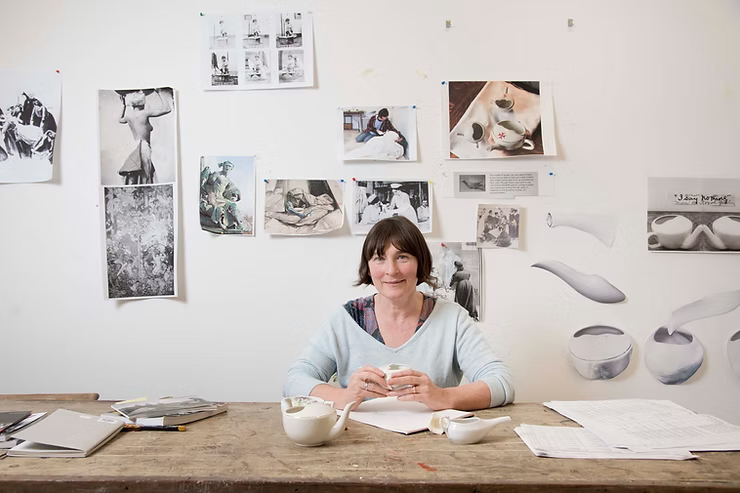
Christine Borland, a Scottish artist whose research-intensive work delved into such subjects as forensic science, the history of medicine, and human genetics, died on Sunday at the age of 60. Her death was confirmed by Patricia Fleming Gallery in Glasgow, which represented Borland. Her death followed a battle with cancer.
Borland was nominated for the prestigious Turner Prize in 1997, for artwork “exploring themes of creation and destruction through institutional (scientific/forensic/police) analysis and reconstitution since the early 1990s,” according to Tate Britain, which administers the prize. “Beginning with specific behavioural experiments in which objects were destroyed (by having bullets shot at them) to create hypothetical forensic material, she made a series of works in which she gathered together fragments and documentation in order to suggest the process of piecing together a jigsaw of significant evidence.”
“From Life,” an exhibition at Tramway in Glasgow in 1994, began with the purchase of a female skeleton from a medical educational supplier and “traced negotiations with forensic anthropologists, facial reconstruction and identification experts through to the production of a reconstructed portrait in bronze,” as described on Borland’s own website. To the Power of Twelve, a 2018 exhibition at Mount Stuart, a former World War I-era naval hospital, included works made with materials including more than 400 hand-blown glass spheres and a silk army parachute stuffed with sphagnum moss.
Borland was born in 1965 in Darvel, Ayrshire, Scotland, and studied environmental art at the Glasgow School of Art before earning a master’s degree in fine art from the University of Ulster in 1988. She was a founder of the Cultural Negotiation of Science, a research group that engages “expert cultures across a spectrum of science and technology” at Northumbria University, where she also taught. Her “rigorous training informed nearly 40 years of forensic research and meticulous processes,” according to a tribute posted to Instagram by Patricia Fleming Gallery. “Her legacy is reflected in nearly 60 solo international exhibitions and over 200 group exhibitions and events.”
About her working process, Borland told an interviewer in 2022: “Whether it’s formalised or informal, I always incorporate a period of research that’s about asking open-ended questions, building relationships with people, following wrong turns and making U-turns. It’s an exciting time of ranging around that I absolutely love in new projects.”
Christine Borland, To the Power of Twelve, 2018.
Courtesy Patricia Fleming Gallery


