






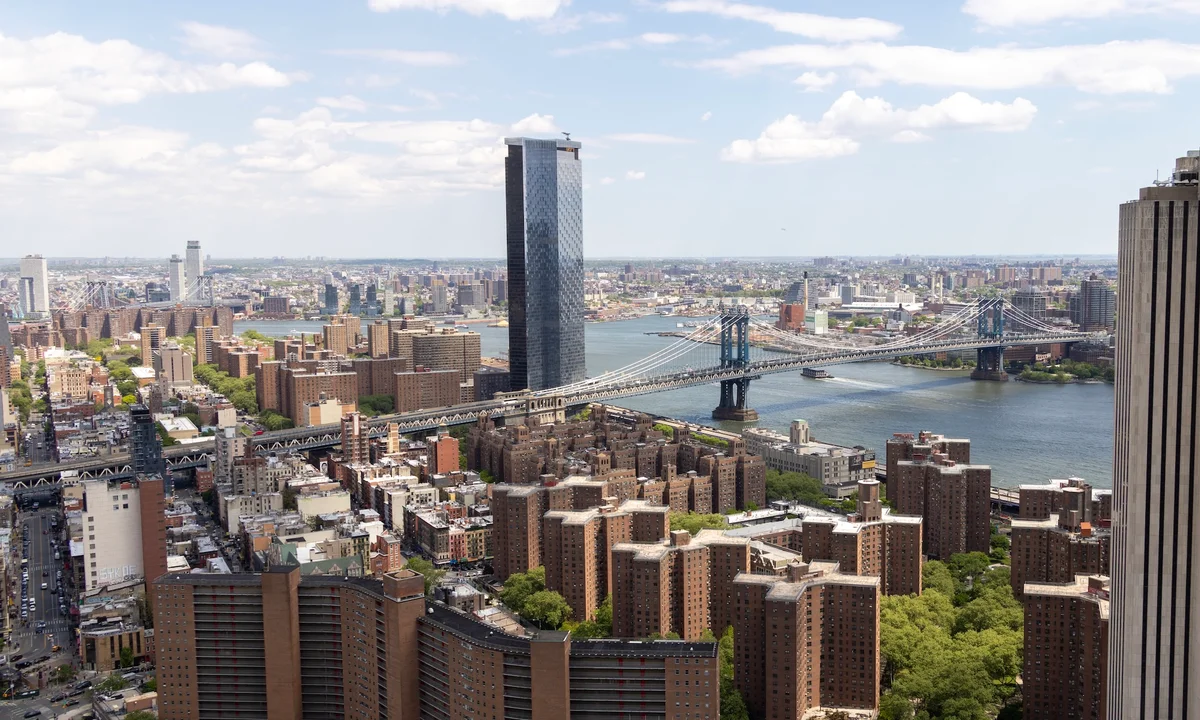
During my decades of exploring New York City, a longstanding bucket-list goal has been to reach the domed crown of one of the US’s oldest civic skyscrapers, the David N. Dinkins Municipal Building at 1 Centre Street. I came satisfyingly close this summer, thanks to the city’s recent $6m restoration of the building’s central spindly tower. Last month, the building’s colonnaded cupola opened to the public on a regular basis for the first time, sans admission fee, as a circular observation deck.
The creamy granite building was designed in the 1910s by the eminent architecture firm McKim, Mead & White. I have long been fascinated by its strange polygonal footprint and spiky silhouette, looming over the Manhattan ramp of the Brooklyn Bridge. Colonnaded pedestrian passageways and subway entries pierce the building’s base. The roofline bristles with pyramids, cones, spheres and hemispheres, their vaulted underbellies reinforced by interlocking tiles designed by the Spanish-born Guastavino dynasty of architectural engineers.
The façades teem with sculptures by the German-born artist Adolph Alexander Weinman. (Among his other masterworks are stone eagles that were once perched along New York’s 1910s Penn Station—a McKim, Mead & White transit palace that was famously razed in the 1960s.) Weinman depicted angels along the Municipal Building, as well as windmills and beavers reflecting the roots of New Yorkers’ wealth in industrious early Dutch settlers and fur trappers.
The Municipal Building, topped by the Civic Fame statue, has a new public observation deck in the colonnade (where the green fencing is installed) Photo: Portable NYC Tours, via Wikimedia Commons
Weinman’s tower finial on the Municipal Building, best viewed from the Brooklyn Bridge, is a gilded female statue officially titled Civic Fame. Clad in a laurel headdress and a billowing gown, she proffers a crown with five points, symbolising the five boroughs. At about 580ft overhead, she ranks as the city’s loftiest allegorical sculpture.
The primary muse for this work was Weinman’s longtime friend Hettie Anderson, the country’s first Black supermodel. A South Carolinian-turned-New Yorker, she was known in her day as “the Goddess-like Miss Anderson”. She is portrayed in windblown robes on numerous high-profile statues, including Augustus Saint-Gaudens’s allegorical Victory on the Sherman Monument in front of the Plaza Hotel.
Over the years, the city has adapted the Municipal Building’s uppermost floors for various functions, including a radio-station office. More creative uses of the spaces—a gym, a women’s lunchroom and a mayoral sanctuary accessible by ladder and trapdoor—have been proposed since the 1910s. Now, at long last, the general public can take in the unique view.
The city’s restoration project to open the new observation deck included repairs to the cupola roof, stonework and Guastavino tiles, as well as the installation of new glass safety barriers between columns. The public route to the top involves a twisty series of elevator banks and corridors, with one hallway lined in huge enlargements of 1910s photos of the structure under construction as horse-drawn carriages clomped past.

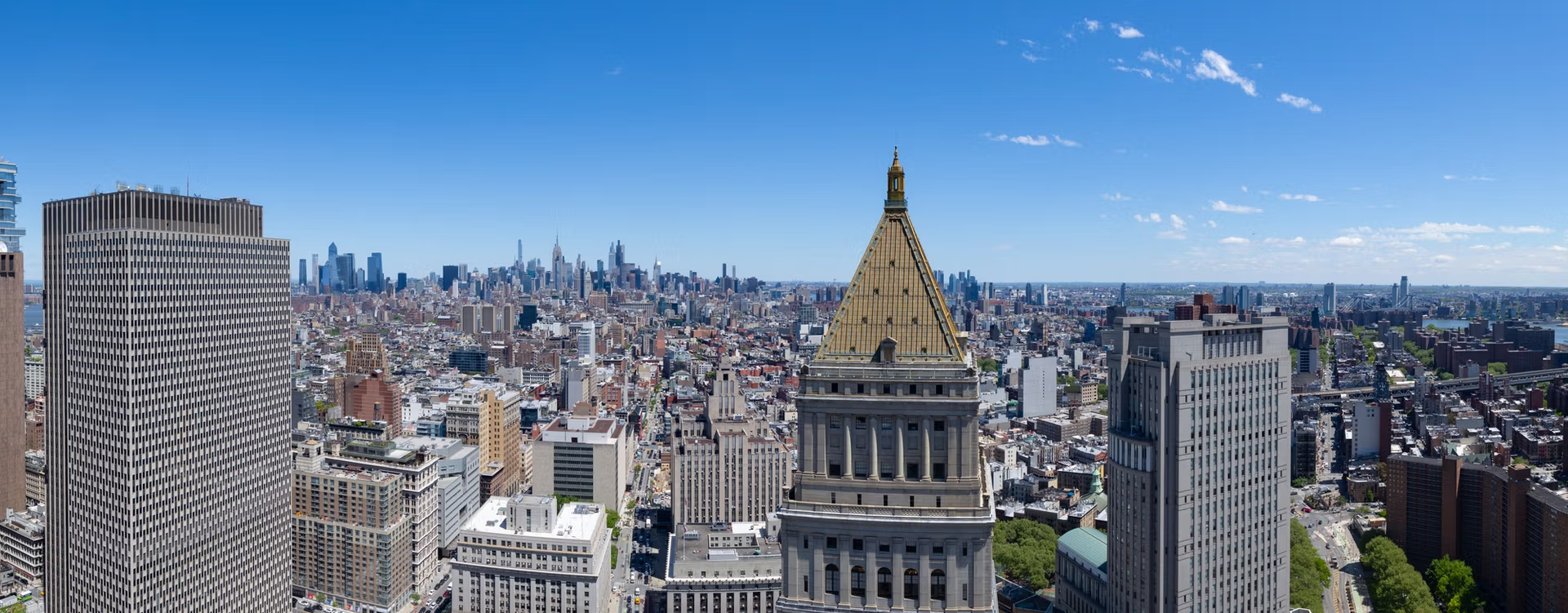
A view to the north from the Municipal Building’s cupola Courtesy NYC Department of Citywide Administrative Services
There are closeups of glittery Civic Fame; Weinman realistically detailed even her earlobes, toenails and unfurrowed brow. The brief wall labels explain that the building was named in 2015 after the city’s pioneering Black mayor David N. Dinkins. But the texts identify the model for Civic Fame as Audrey Munson. A sometime actress who spent much of her life confined to an asylum, Munson did occasionally pose for Weinman. However, scholars have concluded in recent years that Civic Fame was based mainly on Anderson. (A spokesperson for the Department of Citywide Administrative Services tells me that they are now “reviewing materials attributing the model to Hettie Anderson”.)
During my early morning visit to the circular deck, the windows were slightly smudged with traces of visitors pressing noses to the glass. The panoramic view from more than 40 storeys above the street (much lower than counterparts like the Empire State Building) gives an unusual perspective of eye level with nearby skyscrapers. Daredevil graffiti artists have sprayed their ephemeral tags along the shafts of nearby towers under construction. At the peaks of older spires, I noticed penthouses with curiously domestic gables and dormers; when the skyscraper was disconcertingly new, did its architects hope to reassure clients and tenants with some trace of homeyness in the clouds?
On the cupola ceiling, new netting protects the Guastavino-tile herringbone, supported by columns with leafy capitals. The leaves even have deeply incised veins. Such was the original builders’ dedication to botanical accuracy, under the calm gaze of Civic Fame, visible to hardly anyone until this year.
- Reservations for weekday guided tours, with a maximum five people at a time, are released on the first of each month


