





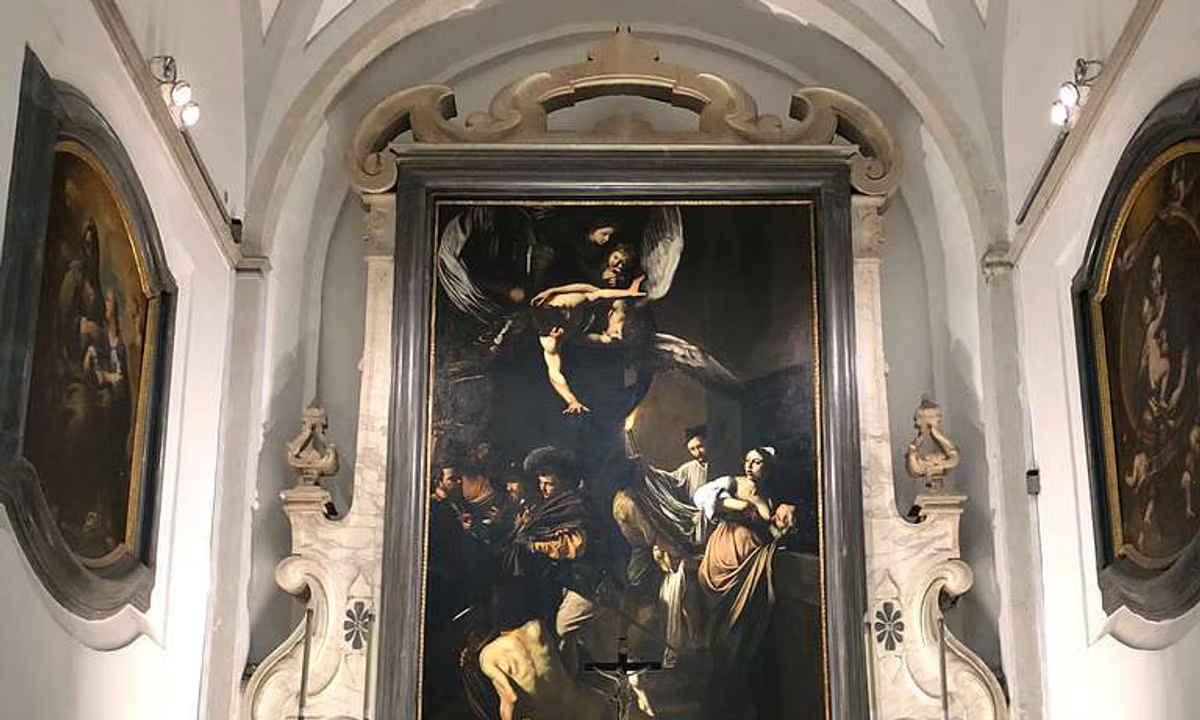
Art historians have many tools to help us understand a work of art, but probably the most important is reconstructing the context in which it was made. Just occasionally, however, all you need to know about a painting can be gained simply by standing in front of it, as if by revelation. I recently had such an experience in a small chapel in Naples, before Caravaggio’s extraordinary Seven Acts of Mercy.
The painting was made in 1607 for the Pio Monte della Misericordia, a charity for promoting the acts of mercy all good Catholics are asked to perform, from burying the dead to feeding the hungry. The charity still exists, doing good works in one of Europe’s most turbulent cities. The first thing you understand about the Seven Acts of Mercy is that it’s a living object, still serving its purpose.
And then there is the composition. Many readers will already know the image; it is a dense, swirling mass of 13 dramatically lit figures (14 if you count the feet of a corpse), which at first can seem too cramped. But knowing the image and encountering it are very different things, because if you arrive at the painting through the historic, crowded, dirty, noisy streets of Naples, you suddenly realise—the composition is Naples. Caravaggio was painting the Neapolitan life he saw around him and revealing the sacred within it. The only thing you are less likely to encounter in Naples today is the angel.
Just outside the city centre, the Museo di Capodimonte offers a striking Caravaggio contrast. His Flagellation of Christ, also painted in 1607, was moved there in 1972 from the church of San Domenico Maggiore on grounds of security. The reasoning was sound, but the result was a painting marooned. In San Domenico Maggiore the Flagellation had a job to do: to confront the faithful with the suffering of Christ. In the museum that contract is broken. The visitor is asked to register its greatness, perhaps take a photo, and then move on. One of Caravaggio’s most powerful paintings has been promoted to a masterpiece but demoted to an object, its context subcontracted to a label.
Stripped of meaning
Standing before the Flagellation I had another, more heretical revelation: that we have made a catastrophe of the way we encounter art. In our eagerness to preserve artworks and gather them into temples of culture, we have stripped away the very thing that once gave them meaning: their place in the world. To take a painting from its altar or a fresco from its wall is not an act of preservation but of amputation. We assume that what matters about an artwork is the object itself, but what we blithely destruct, because it is intangible and easy to overlook, is the context in which the work was made not merely to be seen, but to be experienced, and in turn allowed to do its work upon us.
This feeling was reinforced on a visit to nearby Pompeii. Amid the miraculously (if tragically) preserved ruins, you encounter fresher scars: the ghosts of wall paintings carried off to private collections and museums. The impulse to remove them was understandable when excavations began in the 18th century. But it is telling that many of those left in situ for us to enjoy today are those in buildings earlier generations declined to touch, among them the Lupanar, or brothel. The prurience of our Enlightenment ancestors was its own kind of preservative.
I wonder who now gains from so many ancient paintings in storage, while the walls they were made for stand bare? Were we discovering Pompeii today, nobody would propose removing them. But perhaps no art historian should complain too loudly about art being wrenched from its context. Reconstructing it, after all, is what we are here for.


