





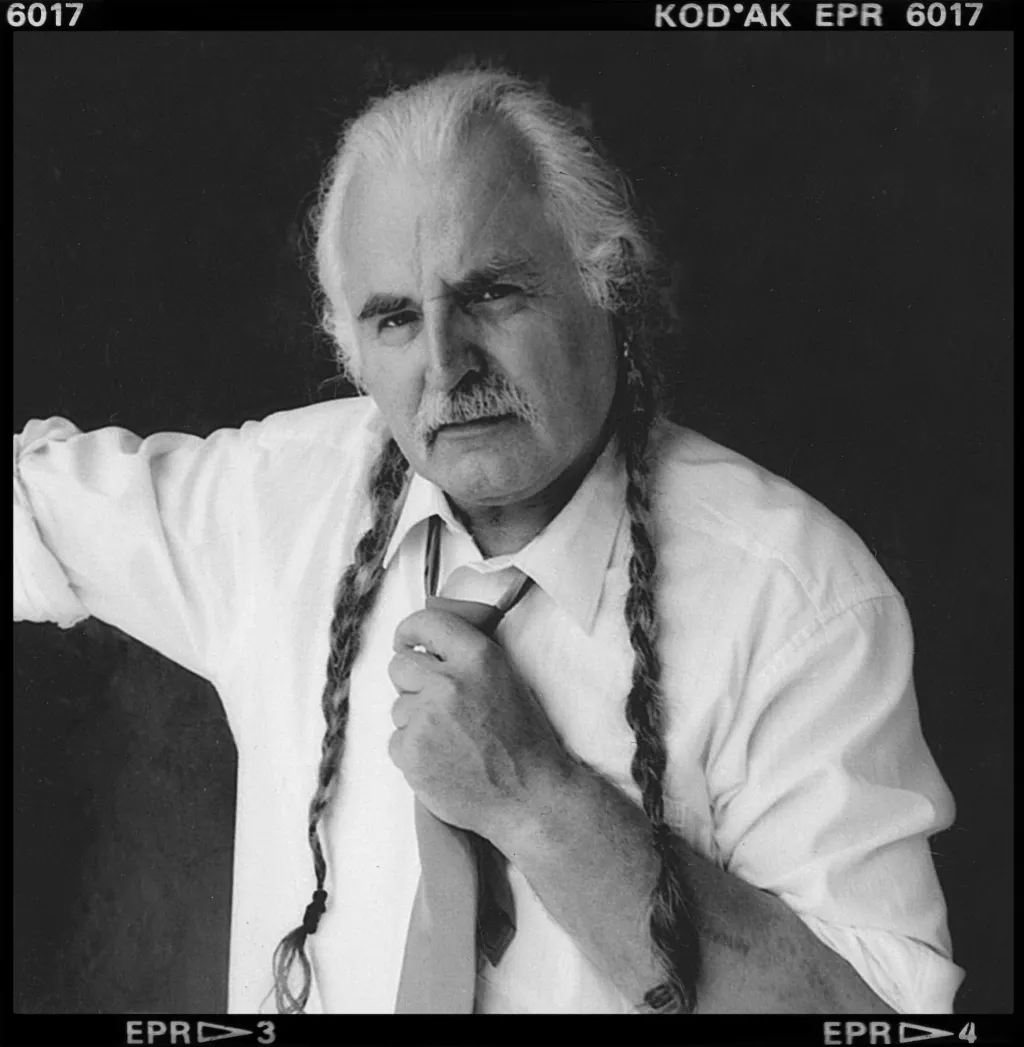
Milan Knížák, the Czech artist and performer and a former director of the country’s National Gallery director, died on July 26 at the age of 86. Czech culture minister Oto Klempíř announced his death on X.
In his post, Klempíř called Knížák an “author who was part of the history of modern Czech art and shaped it for decades” and “a personality who made a significant impact not only on the art world, but also helped shape Czech society with his unique perspective.”
Knížák, won the Medal of Merit from the Czech Republic in 2010, ”defended freedom of creation and human freedom throughout his life… Czech culture has lost one of its most prominent figures of modern times today,” Klempíř added.
At the end of the 1960s, Knížák founded the Aktual Club and a musical group of the same name, an important underground band during the Communist regime. While lecturing in the US around that time, he participated in Fluxus Happenings. During the illiberal “Normalization” period in Czechoslovakia, from 1968 to 1989, Knížák was subject to police harassment, arrest, and imprisonment as an “enemy of the state.”
According to his website, his work appears in global institutions such as the Sprengel Museum in Hanover, Germany; the Neuberger Museum in Purchase, New York; the Sammlung Ludwig in Aachen, Germany; Tate Gallery in London; the National Gallery in Prague; the Museum of Modern Art in New York; and the Whitney Museum in New York.
Knížák appeared in international exhibitions such as the 1990 Venice Biennale; the 1996 São Paulo Bienal; “Fluxus” (1988) at MoMA; “In the Spirit of Fluxus” (1993), which appeared at the Walker Art Center in Minneapolis, the Whitney, and the Museum of Contemporary Art, Chicago; “Fluxus in Deutschland 1962-1994,” which began traveling to museums all over the world in 2006; and “Out of Actions: Between Performance and the Object, 1949–1979,” which opened at the Museum of Contemporary Art Los Angeles in 1998 before touring museums globally.
Knížák’s work comes under discussion in major tomes on performance art like Gregory Battcock’s The Art of Performance: A Critical Anthology (1984) and Claire Bishop’s Artificial Hells: Participatory Art and the Politics of Spectatorship (2012).
“Professor Knížák was a Renaissance figure, a self-confident and realistic person who always stood out, was unmistakable and had a strong opinion that was reflected in everything he did,” foreign minister Petr Macinka told iDNES.
As an administrator, Knížák was rector of the Prague Academy of Fine Arts from 1990 to 1997, and he also founded the Intermediary Studio there, leading it for 25 years. He headed the National Gallery from 1999–2011. While he balanced the budget and expanded the institution’s gallery spaces, he also was criticized for his authoritarian management style, notes iDNES. He unsuccessfully ran for Senate with the Civic Democratic Party in 1998.
“Milan Knížák was one of the greats of our country, which he loved very much,” said former president Václav Klaus, according to news site Super. “He was unique and irreplaceable. We who remain here will miss him immensely. He was my best friend.”


