





A major exhibition of Elaine de Kooning’s work will open at Berry Campbell Gallery in New York on October 29th, spanning four decades of the Abstract Expressionist’s career from 1948 to 1988. It is the first major solo presentation of her work since the National Portrait Gallery’s 2015–2016 exhibition “Elaine de Kooning: Portraits,” and many of the works, including paintings and works on paper, have not been shown publicly since the artist’s death.
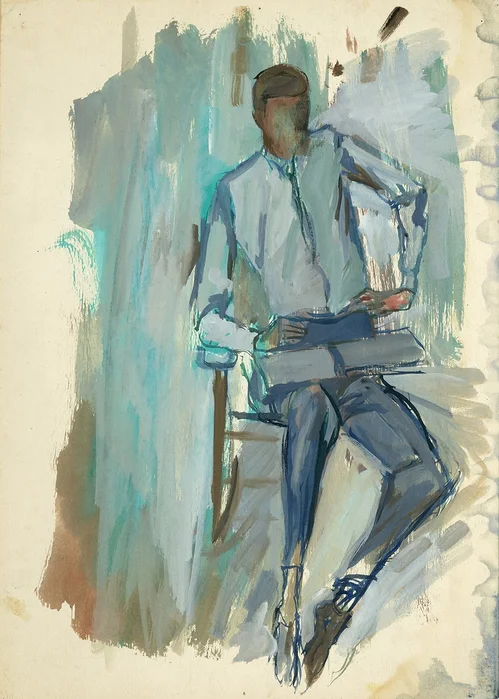
Among the highlights are paintings from De Kooning’s John F. Kennedy series, made after she was commissioned in 1962 to paint an official presidential portrait for the Harry S. Truman Library. The artist was given access to Kennedy during his winter stays in Palm Beach, Florida, in late 1962 and early 1963, but found that his constant motion—reading papers, taking calls, shifting in his chair—made a conventional single sitting impossible. Instead, she worked from rapid sketches, later telling ARTnews that she required “absolute immobility of the sitter,” which the president rarely gave her. By her own account, published in Life magazine in 1964, the process ultimately produced “hundreds of sketches and 23 finished paintings.” Kennedy’s assassination in November 1963 halted her work on the series; she later described the year she’d spent painting him as “real trauma.”
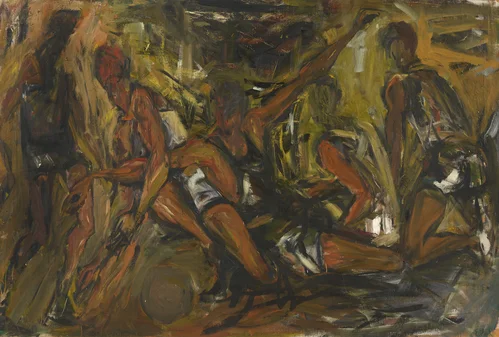

The exhibition will also include California (1958–1960), an 11-foot-wide abstraction that ranks among the largest she ever painted, and Bacchus #20-G (1983), part of a series inspired by Jules Dalou’s 19th-century bronze The Triumph of Silenus in Paris’s Jardin du Luxembourg. An earlier interest in motion appears in Scrimmage (Basketball #3) (1948). Portraits on view include Alex Katz II (1967), Kaldis #12 (1978), depicting her friend and fellow 8th Street Club member Aristodimos Kaldis, and Toni #2 (Toni Ross) (1982), a portrait of the artist she mentored.
De Kooning was a founding member of the 8th Street Club and one of 11 women included in the landmark 1951 Ninth Street Show, part of a generation of women later dubbed the “Ninth Street Women” whose contributions to Abstract Expressionism have undergone renewed scholarly attention in recent years. De Kooning also worked as an art critic for ARTnews, helping introduce the movement to wider audiences.
The show will follow the Speed Art Museum’s “Abstract Expressionists: The Women,” on view in Louisville, Kentucky, through August, which similarly reexamines the movement’s women artists and counts Berry Campbell among its supporters.
The exhibition is accompanied by a 98-page catalogue featuring memoirs by art dealer Arlene Bujese, De Kooning’s goddaughter Denise Lassaw, and artist Toni Ross, along with a biography by Aliza Edelman, Ph.D.


