





The European Union has officially suspended its €2 million ($2.3 million) grant to the Venice Biennale after a review of the inclusion of the Russian Pavilion in its official program.
The decision was announced by the European Education and Culture Executive Agency (EACEA) after a legal review and on the recommendation of the European Commission, Monopol reported Tuesday. Last week, the Commission announced its recommendation to suspend the funding, which represents a fraction of the festival’s overall budget.
“Cultural projects financed with European taxpayers’ money should uphold democratic values and promote open dialogue, diversity and freedom of expression—values that are not respected in today’s Russia,” a spokesperson for the European Commission said during the announcement of the grant’s suspension in Brussels.
The inclusion of Russia has been a point of contention for the EU since before the Biennale opened in early May. In April, the European Commission gave the Biennale 30 days to “clear its name” regarding Russia’s participation. A letter sent to the Biennale at the time stated that the Commission believed “the pavilion could serve as a platform for messages sponsored” by Russia or “otherwise contribute to the circumvention of EU sanctions.”
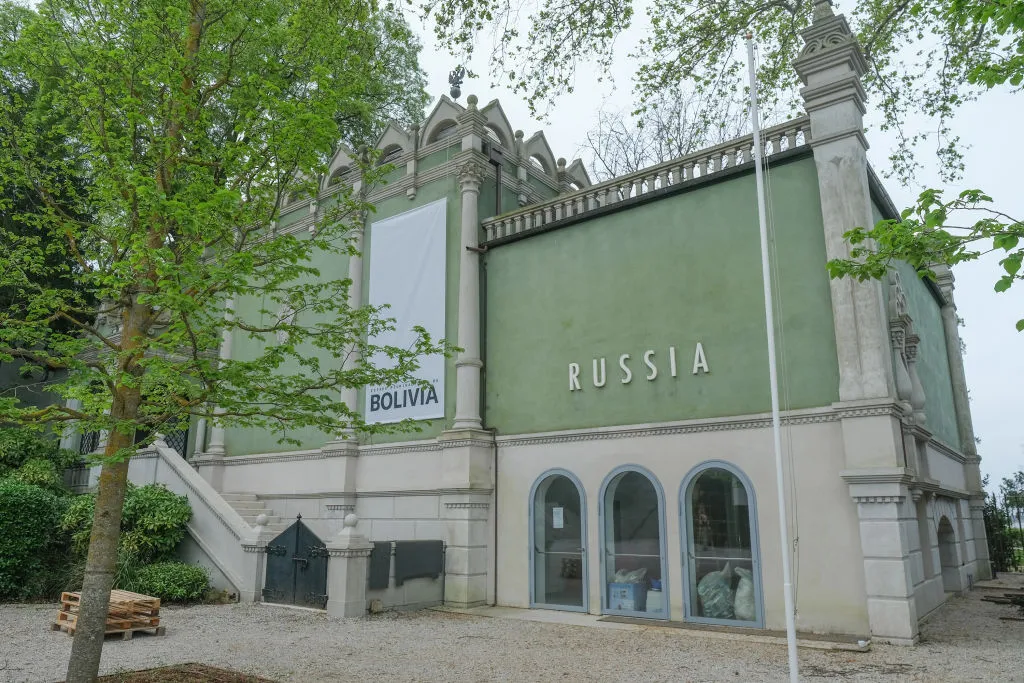
The Biennale has repeatedly stated that it cannot remove Russia from the Biennale’s official program because any country that has a permanent structure in the Giardini, as Russia does, need only inform the Biennale of its intent to mount pavilion. It has also stated that it has not violated EU sanctions by allowing Russia to organize its exhibition.
ARTnews has reached out to the Biennale for comment on EU’s confirmation of the funding suspension.
This pavilion would have been the first since Russia invaded Ukraine in February 2022; Russia canceled its 2022 pavilion and in 2024 gave over its pavilion to Bolivia. The Russian Pavilion opened during the preview days but closed ahead of the public opening and remains closed.
During the Biennale’s preview days, several protests were staged over both the inclusion of Russia and Israel, with several pavilions going on strike before the public opening, though the EU has focused only on Russia’s inclusion.


