






This 4 July marks the 250th anniversary of the adoption of the Declaration of Independence in Philadelphia—then the seat of the fledgling United States—an occasion being both celebrated and contested nationwide. Although a rare copy of the Declaration document handwritten by Thomas Jefferson will be on show from 1 to 7 July at the New York Public Library’s Stephen A. Schwarzman branch, the commemoration is already underway in some of the city’s other institutions.
While the Trump administration may be reshaping the Smithsonian and the very definition of patriotism, New York’s America 250 programming is advancing an inclusive, prismatic view of the anniversary, from Dutch Golden Age paintings to contemporary Native American art.
A transatlantic approach
National anniversaries can easily lend themselves to geographic silos, but several New York exhibitions are taking a transatlantic approach. One of them is the New York Historical’s Old Masters, New Amsterdam (until 30 August). One of several America 250 shows at the museum this year, it is drawn entirely from the Leiden Collection—philanthropist Thomas Kaplan’s self-described “lending library” of 17th-century Netherlandish masterpieces (which is also set to be offered for fractional ownership).
The exhibition foregrounds a less examined, yet foundational perspective on early American history: the lives and ambitions of New York’s original Dutch colonists. Its aim is to offer a cross-section of early settler society, from doctors and accountants to ordinary working people.
Arthur K. Wheelock Jr, a senior adviser to the Leiden Collection, says the works on view capture “the sights and sounds of people and the activities that gave life to New Amsterdam, ones that have persisted to the present day”.
For Russell Shorto, the director of the New Amsterdam Project and the co-curator of the exhibition, the “modern conception of the self” is central to these scenes. “Previously, in Europe, your ‘self’ was essentially defined by your roles in society … but in this era, the Dutch began to look at themselves as having something unique at their core,” he says. He adds that diary-keeping, memoir-writing and a “mania for portraiture” all “helped to seed the American belief in the importance of ordinary people, which, a century later, would become central to the Revolution”.
Goya disturbingly depicted the 1808-14 Peninsular War, one of many that swept Europe in the wake of the French Revolution, which was inspired partly by the American Revolution
Photo by Alfonso Lozano
The Hispanic Society Museum & Library moves the American story further forward in Goya and the Age of Revolution (until 28 June), an exhibition which approaches the semiquincentennial through the lens of intertwined revolutions. “The American Revolution inspired the French Revolution (1789), an event which the Spanish king Charles IV and his ministers watched with great anxiety. In 1808, Napoleon coerced the unfortunate monarch to abdicate and then invaded the Iberian Peninsula, unleashing a brutal civil war (1808-14),” says Patrick Lenaghan, the society’s head of prints and photographs. “As a witness … Goya experienced first-hand how the ideals of liberty and equality led to acts of uncompromising brutality.”
That upheaval inspired some of Goya’s most indelible images of violence and human suffering, particularly his print series The Disasters of War (1810-20), posthumously published in 1863. “The series presents not just a searing indictment of war and its brutality but also a frank depiction of the horrifying price civilians pay,” Lenaghan says. He adds that the series’ “attack on entrenched power and superstition warrants a closer look today”.
Immersive revolutions
Another group of exhibitions turns to the birth of the US by investigating what American art means through time. The Metropolitan Museum of Art has a focused installation in its American Wing, Revolution! (until 2 August), which recasts the history of that upheaval through everything from portraits of revolutionaries such as Benjamin Franklin and George Washington to the British fusillades that mowed down American patriots, and Native American pipes.
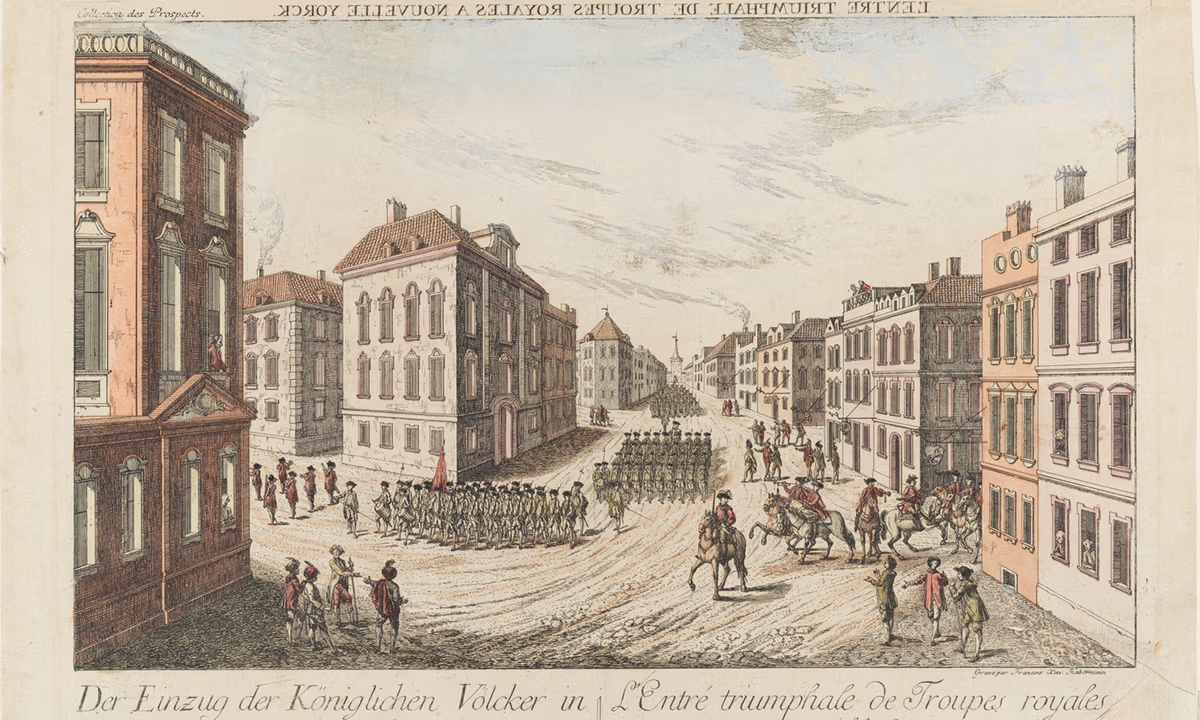
The Museum of the City of New York is pursuing similar questions in a more immersive register. The Occupied City (until April 2027) places fine and decorative arts from the museum’s collection within period-specific environments that include a tavern, a vignette of Alexander Hamilton’s office and a coffeehouse. The last of these features a portrait of King George III alongside a “No Stamp Act” teapot celebrating the 1766 repeal of the Stamp Act of 1765, the much-maligned British tax on American colonists.
Interactive elements include an installation allowing visitors to topple a VR version of the statue of George III that once stood at Bowling Green. Elisabeth Sherman, the museum’s chief curator and deputy director, says these spaces extend the museum’s period-room tradition and make “the distant past more present for contemporary audiences”.
The show spotlights the intertwined histories of New York’s diverse demographics during this turbulent period, including its women, Native and enslaved residents. Although the exhibition received funding from the National Endowment for the Arts, the museum has encountered no pushback in its messaging, allowing it to show that all people who lived through the revolution “are not so different in their needs and desires as we are”, Sherman adds.
The Native perspective today
House Made of Dawn: Art by Native Americans, 1880-Now at the New York Historical (until 16 August) carries this approach into the present. The show takes its title from the Hsu-Tang Collection (part of which has been promised to the institution) and from N. Scott Momaday’s 1969 novel House Made of Dawn. It examines the legacy of American history not only through Indigenous artists and subjects but also through the ways in which Native history has been depicted and taught.
Wendy Nālani E. Ikemoto, the vice president and chief curator of the New York Historical, identifies the Institute of American Indian Arts (IAIA) in New Mexico as forming a “key pillar” for the exhibition. “Amid the 1960s art-school boom, the IAIA became a vital space for Native artists working across a variety of Indigenous and contemporary art practices and helped to usher in a dynamic new era of expression … particularly in contrast to the assimilationist model that continued to shape federal Native education policy at the time,” she says.

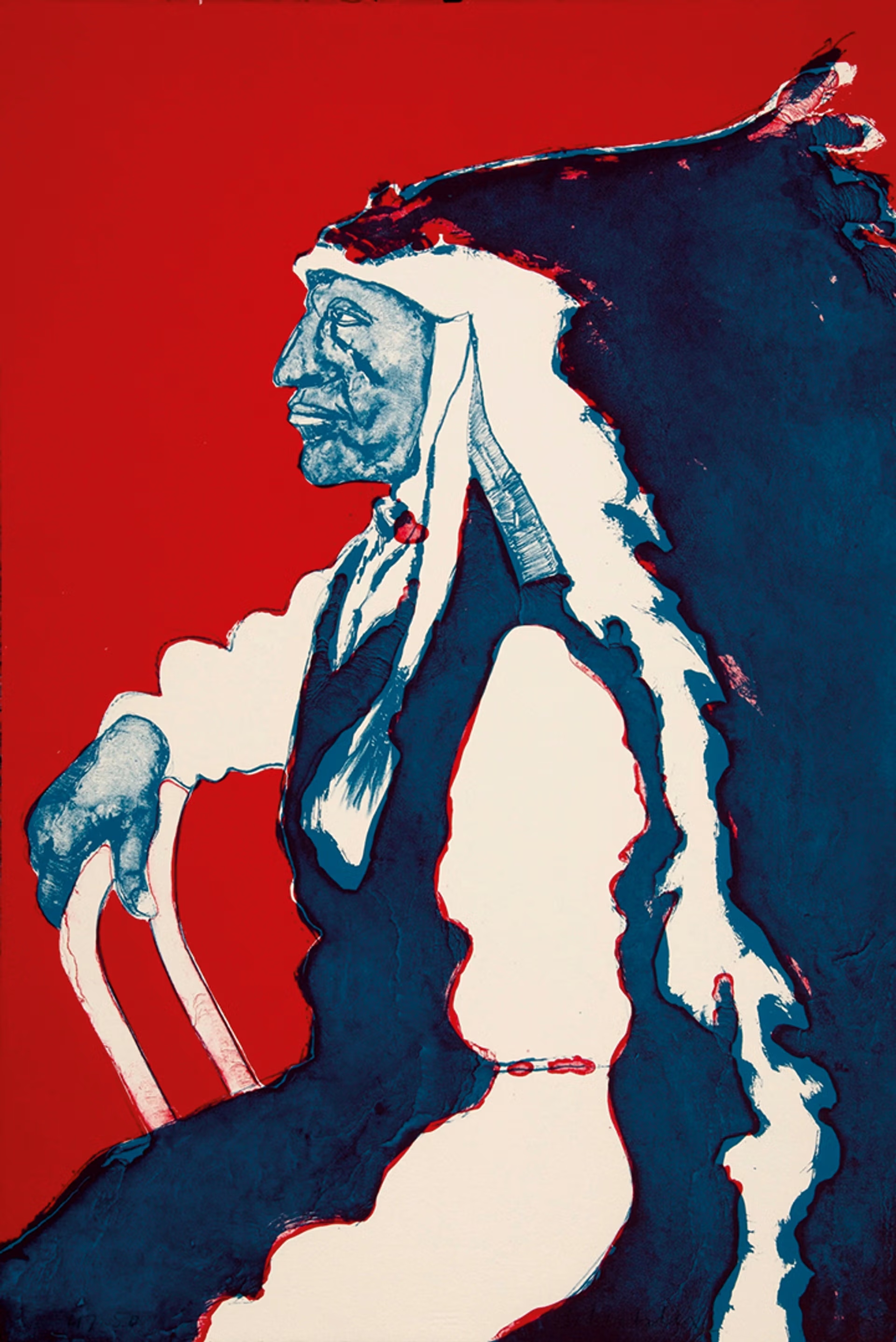
Patriotic Indian (1975) by Fritz Scholder, a Native American artist who created it to show “the Indian Real, not Red” as part of a series of stereotype-challenging prints shortly before the US launched its bicentennial celebrations
Agent of the artist’s Estate and the Scholder Collection, courtesy of New York Historical
Among the works Ikemoto highlights is Fritz Scholder’s American Landscape (1976), in which the artist recasts Edgar Samuel Paxson’s painting Custer’s Last Stand (1899) in the colours of the American flag. “In doing so, Scholder exposes how this particular understanding of the event—as an exemplar of heroic frontier valour—has been emblazoned in the American psyche and how dominant perspectives on American history have become mythologised,” she says.
Several of the themes that Ikemoto describes—“land as a living presence, the search for identity, and history as a force that shapes the present”—resonate across the city’s America 250 exhibitions this year. For better and worse, those themes are also evergreen.


