






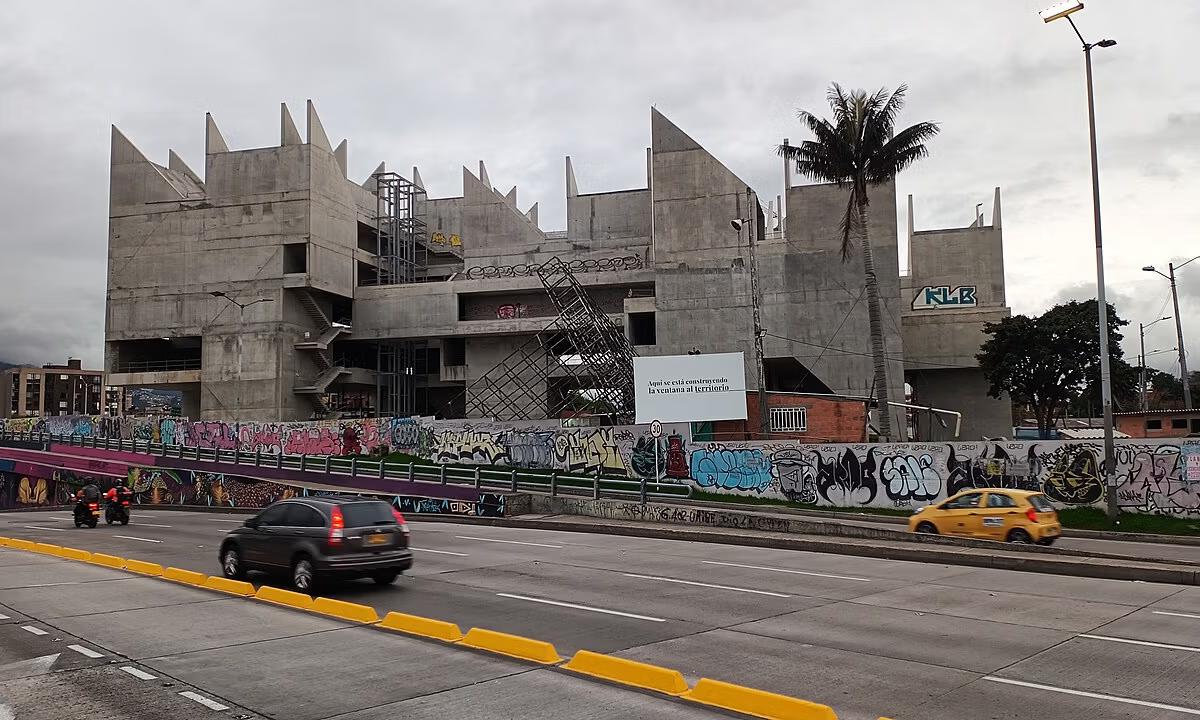
After three years on hold, work has resumed on Bogotá’s Museo de Memoria de Colombia, one of the country’s most ambitious cultural projects. It confronts the legacy of Colombia’s internal armed conflict and honours victims of the violence that has marked the country for more than seven decades. But the recent narrow election victory of the right-wing lawyer Abelardo de la Espriella to be Colombia’s next president has added new uncertainty to the museum’s future.
The museum building was more than 70% complete when construction finally resumed a few months ago. And even though De la Espriella has not spoken directly about the museum, his presidential campaign focused on pursuing a hardline security agenda, ending peace negotiations and sharply reducing the size of the state. Human-rights groups have warned that his programme could weaken or merge institutions linked to peace, victims’ rights and historical memory—including the Centro Nacional de Memoria Histórica (CNMH), the government agency on which the museum depends. De la Espriella will begin his term as president on 7 August.
“The museum is expected to open in part in 2027, with approximately 56,000 sq. ft of space, and to be completed by 2029,” Adriana María González Maxcyclak, the museum’s director, tells The Art Newspaper. She adds that addressing Colombia’s armed conflict is a “complex task” because of its multiple dimensions and profound impact on civil society over more than 75 years. “Memory is not a static or monolithic narrative,” González says, “but a field in constant tension, especially because the conflict is ongoing.”
The museum traces its origins to the 2011 Victims and Land Restitution Law, which tasked the CNMH with creating a space for victims of the armed conflict. The 2016 peace agreement between the government and the country’s largest guerrilla group, the Revolutionary Armed Forces of Colombia (Farc), later reinforced this effort, underscoring the need for symbolic reparation and memory.
Rendering of the future Museo de Memoria de Colombia, scheduled for completion in 2029 Courtesy Centro Nacional de Memoria Histórica
In a statement issued on 6 March, the CNMH described the project’s continuation as “a significant development for the country”, adding that “truth, memory and the dignity of the victims are central to the nation’s democratic life”.
The initiative has faced delays and controversy over the years, with construction halted by contractual issues, legal disputes and lack of funding. People in Bogotá have described it as a “white elephant”, a term used in Latin America for large public projects left unfinished.
In 2020, the building contract was awarded to the Spanish firm OHLA (Obrascón Huarte Lain), with an initial investment of nearly $16m. The museum was originally scheduled to open in October 2022, but the project stalled. While the first phase advanced with excavation and structural work, the contract expired in 2022 with only half of the building completed. The contractor’s breach of contract triggered a series of legal battles, including multimillion-dollar lawsuits between the company and the government. As a result, the cost of the project increased significantly.
Construction remained suspended for more than three years, not only due to legal disputes but also because funding still had to be secured. “Progress depends on the availability of resources,” González says.
New funding secured in 2025 allowed the project to move forward, with construction resuming in March 2026. “The allocation of these resources made it possible to restart the project with a new contractor,” González says.
Located on Avenida El Dorado, also known as Calle 26, the museum building sits along a major artery linking Bogotá’s historic centre to the airport, in an area that is home to key public institutions and cultural landmarks. During a press visit to the site in early March, María Gaitán Valencia, the director of the CNMH, highlighted the symbolic importance of the museum. By 2027, the project is expected to include a memorial wall for the victims of forced disappearance, a bookstore, café and the museum’s first permanent gallery.

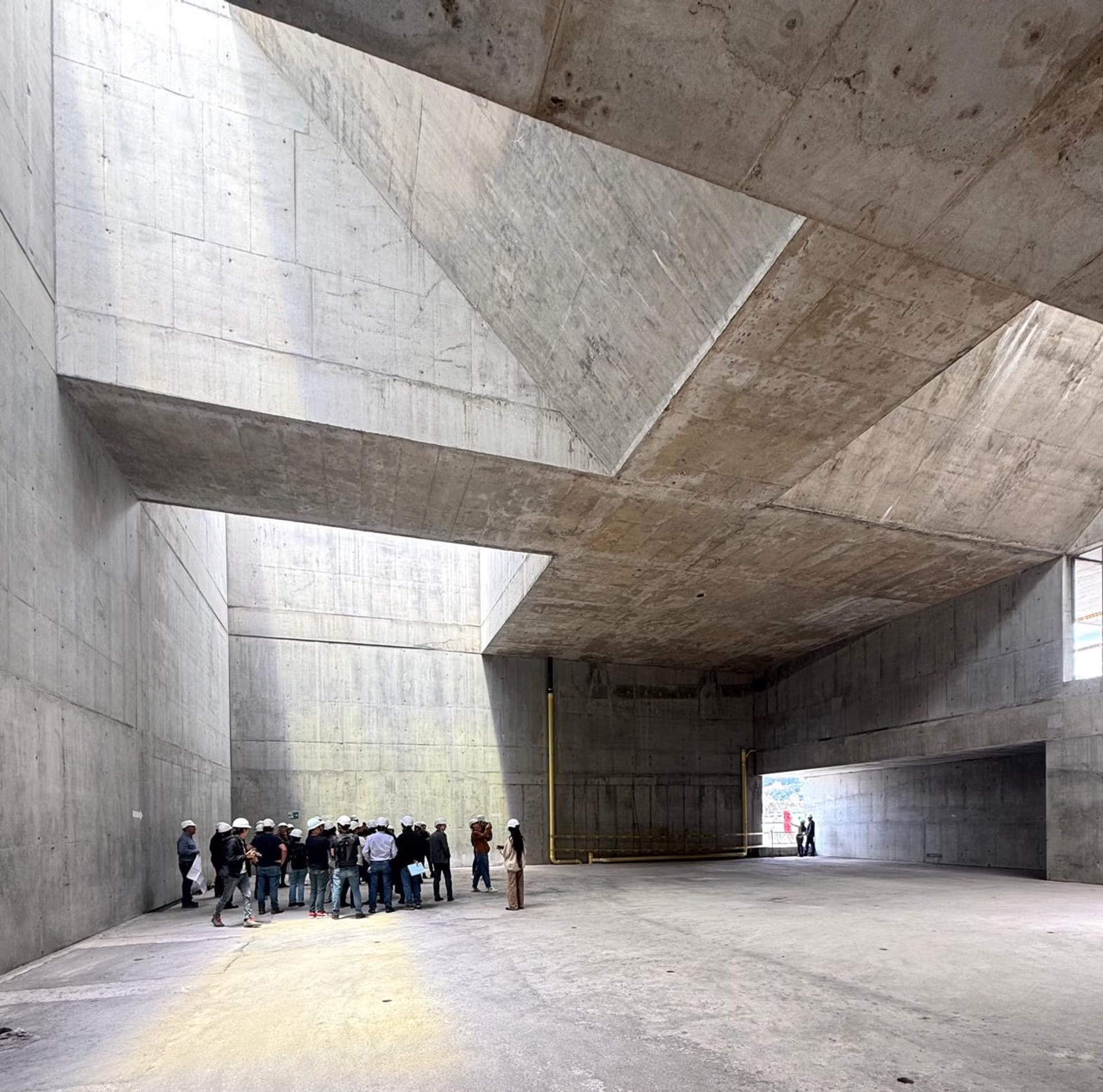
Inside the Museo de Memoria de Colombia as it looks now Courtesy Centro Nacional de Memoria Histórica
Conflict, the museum’s first exhibition, will trace key moments in Colombia’s armed struggle, from the 1930s to the signing of the peace agreement in 2016—including agrarian reform and counter-reform, the emergence of armed groups, drug trafficking and the assassination of social leaders. The curatorial approach places particular emphasis on experience and participation.
The museum’s approach to this history is reminiscent of that of the Colombian artist Doris Salcedo, who has long explored the country’s political violence and the suffering of its victims through her work. In Andreas Huyssen’s book Memory Art in the Contemporary World: Confronting Violence in the Global South (2022), the German critic examines her art in relation to the difficulty of constructing narratives about traumatic pasts. Rather than depicting the conflict directly, Salcedo’s work centres on absence and silence, shaping a fragmented memory marked by what cannot be fully told. It is precisely this tension that the Museo de Memoria’s curators seek to address.
Huyssen says that civil-society organisations should play a central role in shaping how the history of conflict is presented. Without that, he warns, a museum risks “recycling the official story about the violence as a struggle between the state and terrorism, thus erasing the social and political issues that had nurtured the civil war”.
When asked about the museum’s future, González stresses that it is protected by a legal framework that extends beyond political cycles. “The next administration will be obligated to ensure the continuity of the Museo de Memoria de Colombia project,” she says.


