






Good Morning!
- Controversy has erupted in Spain over the appointment of a high school art teacher as director of the Galician Center for Contemporary Art.
- President Trump’s no-bid contract to paint the Lincoln Memorial Reflecting Pool blue and stop leaks granted an inflated profit to the construction company on the job.
- The $102 million Louvre heist is set to be adapted into a film by French filmmaker Romain Gavras.
The Headlines
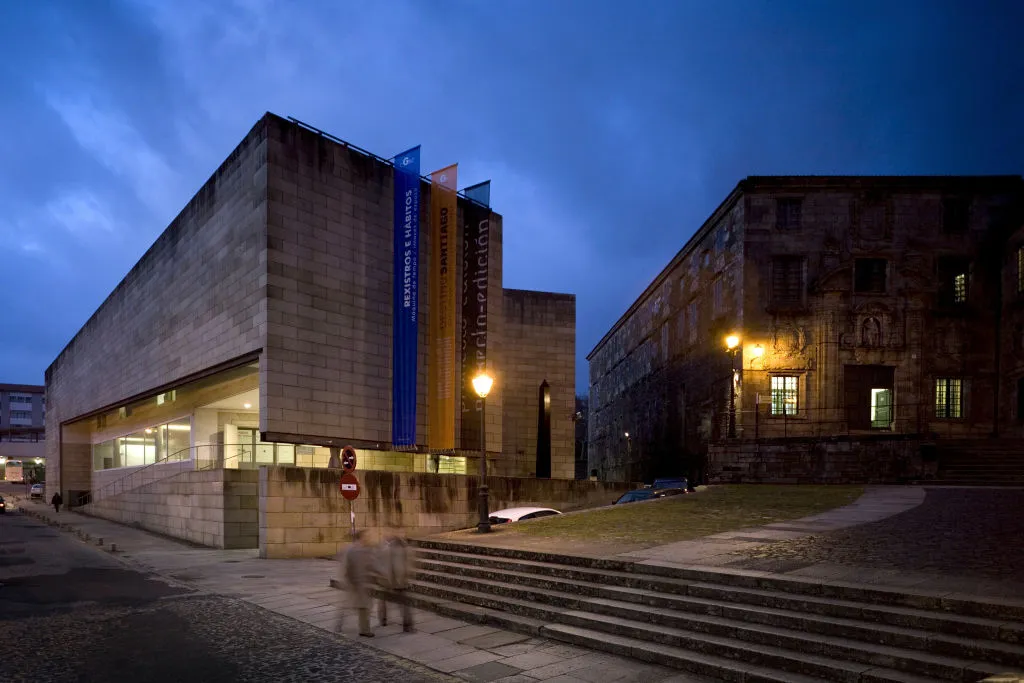
TEMPEST IN A TEAPOT. Spain’s Galician Center for Contemporary Art (CGAC) is in open revolt after the regional government appointed Eva López Tarrío—a high school art teacher and civil servant with no significant curatorial or international art world experience—to lead the prestigious Santiago de Compostela institution, El Pais reports. (It should be noted that she does have a PhD in Fine Arts.) The move drew immediate and widespread condemnation from more than 1,400 artists, critics, gallery owners, and academics across Spain, who signed an open letter warning that limiting the directorship to civil servants would “impoverish and politicize” the center. Among those speaking out is Susana Cendán, a PhD curator and lecturer at the University of Vigo who confirmed she applied and called the selection process ‘not based on professional merit,’ while Alberto Ruiz de Samaniego, a professor, critic, and curator of the Spanish Pavilion at the 2007 Venice Biennale, said on Instagram that competing CVs showed “more solid and recognized professional, academic, and international track records.” Adding fuel to the fire: apparent errors in López Tarrío’s CV—including a claim that she worked for the Laxeiro Foundation before it legally existed—and the revelation that three of five members of the CGAC’s advisory board have resigned in protest.
LEAKY BOTTOM. The New York Times has revealed that President Trump‘s contested, no-bid contract to paint the Lincoln Memorial Reflecting Pool blue allocated an inflated 20 percent profit to the construction company doing the job. Typically, government contracts ask for a 6 to 12 percent profit margin. The legally challenged reflecting pool paint job and leak repairs reportedly cost $13.1 million—seven times the initial price touted to journalists—and are being funded by entrance fees paid by visitors to national parks. Seven million dollars of National Park Service ticket sales are being used to pay for the pool, and a total of $67 million of national park pass sales is funding an array of Trump’s monument projects in Washington, D.C. The looming 250th American anniversary deadline was used as justification for rushing the no-bid contract. While Virginia-based Atlantic Industrial Coatings appears to be working on the massive pool, Park Service documents reveal the company has yet to figure out how to stop it from leaking, with no completion date in sight. Meanwhile, House Democrats have introduced legislation to block Trump’s planned triumphal arch near Arlington National Cemetery, reports the Washington Post. The bill faces opposition in Congress, but a poll showed 52 percent of Americans oppose the arch, versus just 21 percent in favor.
The Digest
Last year’s robbery of $102 million in crown jewels from the Louvre is set to be adapted into a film directed by Romain Gavras, whose most recent film, Sacrifice, starring Anya Taylor-Joy and Chris Evans, will be released on Netflix later this year. [Le Monde]
A fabled but long-lost Leonora Carrington painting, Villa Pilar, 1940, has surfaced and is heading to the Freud Museum in London for an exhibition about the artist’s time at a psychiatric hospital outside Santander, Spain. [Artnet News]
Florentina Holzinger followed up her headline-grabbing Venice pavilion exhibition with a set of bloody, endurance-testing New Testament–themed performances in Austria over the course of a single day, titled Whitsun Play. [Monopol]
King Louis XVI‘s gilded 18th-century bed at the Château de Versailles, incinerated by French Revolutionaries, has been painstakingly reproduced after years of research, thanks to clues from rare surviving royal textiles and written descriptions from the period. [Le Journal des Arts]
A Caravaggio painting of Cardinal Maffeo Barberini—depicted before he became pope—recently purchased by the Italian state for about $34.5 million, is on display in Rome’s Senate building through June 21, where it can be seen for free, before heading to the Palazzo Barberini collection. [Artribune]
The Kicker
TAMING OF THE ARTIST. Is art dangerous? Philosopher Daisy Dixon thinks so and wrote a book about it: Depraved: The Story of Dangerous Art. Meanwhile, Chinese dissident artist Ai Weiwei has written his own tome addressing similar questions, albeit from a different perspective, according to Nadia Beard for the Financial Times. Dixon argues that art shapes our morals and can even “seduce us into doing the most abominable things.” But Beard highlights where this line of thought fails, noting its assumption that art is like an easily readable form of “speech” that doesn’t require highly nuanced interpretation. Ai Weiwei on Censorship, on the other hand, expresses very different fears: that artistic censorship will mean art could eventually fail to shape how we view the world at all. The risk of “omnipresent censorship,” per the Chinese artist, is what happens as culture is pressured into consensus—which “often signals a lack of depth or a fundamental misunderstanding of its purpose,” he writes. The two do appear to agree, however, that censorship is not the answer. For Dixon, so-called “dangerous art” must be faced and understood rather than cancelled. Yet she offers a foreboding, if vague, solution that raises more questions: “Depraved art is a many-headed monster, but one that we must tame rather than slaughter,” she writes. We’ll just have to read her book to find out how taming art differs from censoring it—and what exactly that would entail.


