






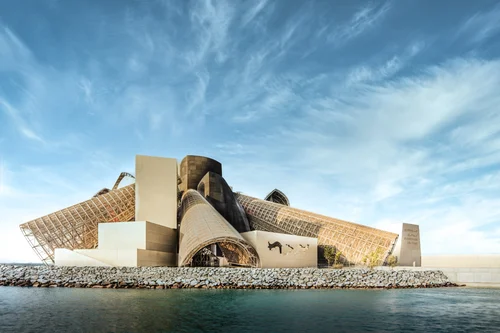
The Guggenheim Abu Dhabi will open to the public on December 11, Abu Dhabi’s Department of Culture and Tourism has announced. First announced in 2006, the museum is one of the most anticipated museum openings in decades.
Designed by the late Frank Gehry, the building is defined by ten sculptural cones rising to heights of up to 88 metres. Nine are surrounded by stainless steel mesh, providing natural ventilation and shade while giving the structure its distinctive skyline. Its 30 galleries, across 11,600 square meters of interior space, are connected by a central atrium, with a further 23,000 square meters of outdoor exhibition areas. The total built-up area totals 80,000 square metres, the largest of the four Guggenheim locations.
The museum will focus on modern and contemporary art from the 1960s to the present, with a particular emphasis on North Africa, and West and South Asia. Rather than presenting art chronologically, the collection will be organised around thematic and geographic groupings. Among the sections are “Abstractions,” “Popular Culture,” “Land,” and “Language and Storytelling.” The collection has been in development since 2009.
Guggenheim Abu Dhabi joins the Guggenheim Foundation’s constellation of museums in New York, Venice, and Bilbao, while maintaining, its organisers say, a distinct identity rooted in the cultural and historical position of the United Arab Emirates. It is located on Saadiyat Island, where several high profile museums have opened in recent years, such as Louvre Abu Dhabi, the Zayed National Museum, Natural History Museum Abu Dhabi, and teamLab Phenomena Abu Dhabi.
“The Guggenheim Foundation is proud and delighted to be a longstanding partner with the Department of Culture and Tourism –Abu Dhabi in shaping a museum of contemporary art of magnificent scope and aspiration,” said Dr. Mariët Westermann, director and CEO of the Solomon R. Guggenheim Foundation, in a statement. “The museum’s art collection is uniquely local and global, centered in the region but with works from all continents.”


