Yayoi Kusama, the Japanese artist whose polka dots, pumpkins and infinity rooms made her one of the most recognisable artists in the world, died at a hospital in Tokyo on 14 August. She was 97. Across a seven-decade career, Kusama worked in painting, sculpture, installation, performance, film, fiction and poetry. She began making these mirrored environments in New York in the mid-1960s. Despite showing widely in the United States and Europe in that decade, her influence was forgotten after her return to Japan in 1973, eclipsed by the dominance of Anglo-American male artists. Renewed attention followed the 1989 exhibitions at the Center for International Contemporary Arts, New York and the Museum of Modern Art, Oxford, in addition to the major 1998-9 exhibition Love Forever: Yayoi Kusama, 1958-1968, which toured Los Angeles, New York, Minneapolis, and Tokyo. Retrospectives at Tate Modern in 2012 and commercial work for major brands, such as Louis Vuitton, made her an international phenomenon, as renowned for her public persona as for her art.
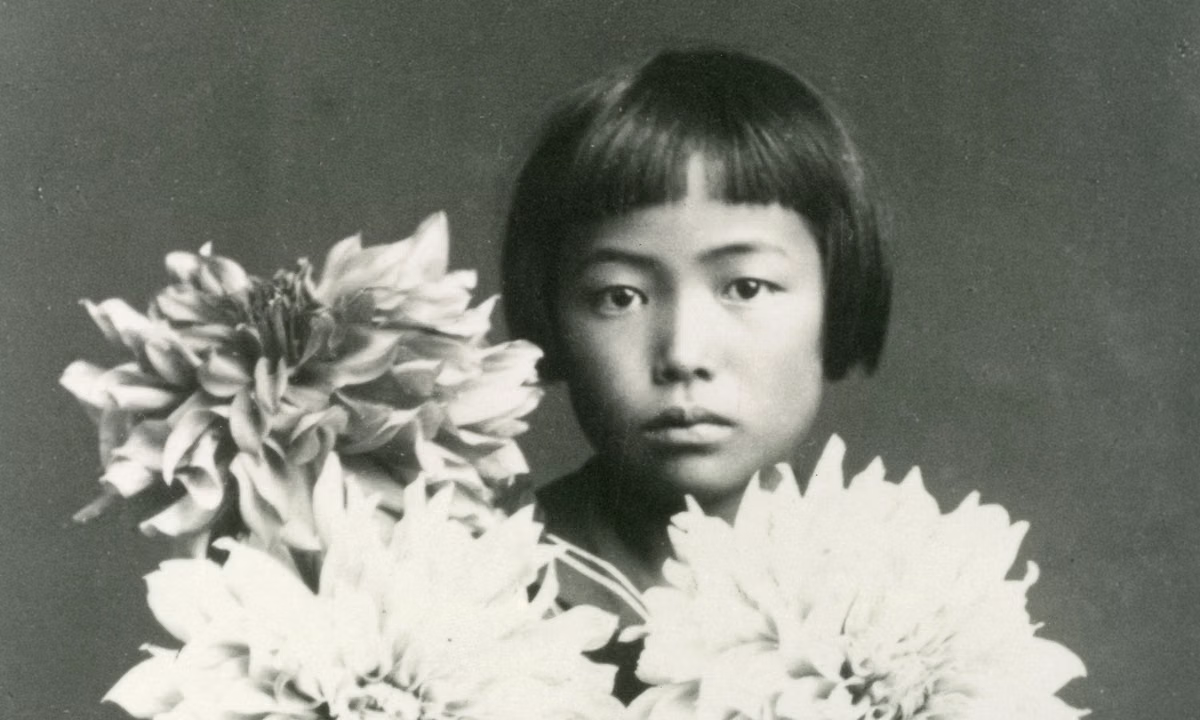
Kusama was born on 22 March 1929 in Matsumoto City, Nagano Prefecture, a provincial mountainous region surrounded by the Japanese Alps. The youngest child of Kamon and Shigeru Kusama, she grew up in a conservative, affluent household that owned Nakatsutaya, a wholesale plant nursery, and she took her sketchbooks into the seed-harvesting fields to draw. Kusama had one of her first hallucinatory episodes in violet beds, describing it in her 2002 autobiography as if each flower had its “own individual, human-like facial expression” and “they were all talking to me”. These overwhelming visions also included persistent images of proliferating nets and dots. It wasn’t until the mid-1970s that Kusama began discussing her psychological condition as the driving force behind her practice, in addition to art being a cathartic refuge from traumatic familial dynamics. Kusama’s birth coincided with a global economic depression and her youth was affected by increasing social unrest and the terror and deprivation of the Second World War. Under Japan’s military regime, school-aged children were required to plant crops, and in July 1944, aged 15, Kusama was sent to sew fabrics at the Kureha Textile factory, producing uniforms and parachutes.
After the war, Kusama began participating in regional open competitions and group exhibitions. Due to her social class and gender, her traditional parents vehemently objected to her forging a career as a professional artist. In 1948, she left home to study the modern Nihonga style of painting at the Kyoto Municipal Hiyoshigaoka Upper SecondarySchool. Disillusioned by restrictive, hierarchical teaching methods and the nationalist ideology that underscored Nihonga, Kusama began experimenting with a range of Western art practices, producing hundreds of semi-abstract works on paper, utilising ink, pastel, gouache and watercolour. In 1952, she staged two solo exhibitions at The First Community Centre, Matsumoto, and by 1955, emboldened by the critical success of three exhibitions in Tokyo and the inclusion of her work in the International Watercolor Exhibition: 18th Biennial at the Brooklyn Museum, New York, she became determined to move to United States. “Staying in Japan was out of the question,” she wrote. “This country was too small, too servile, too feudalistic, and too scornful of women. My art needed a more unlimited freedom.”
In 1955, Kusama had initiated a written correspondence with Georgia O’Keeffe, whose work she discovered in a second-hand bookshop, and wrote to Kenneth Callahan, a Pacific Northwest painter she learned about via one of the American Cultural Centers set up by the US Information Service during the Occupation. While O’Keeffe and Kusama wouldn’t meet until 1961, Callahan shared Kusama’s watercolours with the Seattle art dealer Zoë Dusanne, who offered Kusama her first solo exhibition in United States. After destroying most of her early works before she left, she arrived in Seattle in November 1957 with a few thousand US dollars sewn into her dress and stuffed into the toes of her shoes. Kusama moved to New York in 1958. She organised her first solo exhibition in October 1959 at Brata Gallery, debuting five large-scale white Infinity Net paintings, expansive monochromatic canvases covered with a repetitive mesh of interlocking reticulated shapes, which she continued to make on a compulsive and quasi-industrial scale, often working in uninterrupted stretches of 50 hours.
The aspiration of the Infinity Nets, the largest of which measured ten metres wide, directly rivalled the gestural machismo of the dominant New York School. They were also well received in Europe in the 1960s and were included in significant exhibitions associated with the Zero and Nul groups. The series shown at Brata garnered favourable press and was notably commended by Donald Judd in ARTNews, who bought a painting. Kusama’s friendship with Judd, forged when she moved into the studio below him at 53 East 19th Street in 1961, and later Joseph Cornell, were especially significant to her New York years.
By 1962, Kusama had initiated her Accumulation sculptures, debuting two assemblages in a group exhibition at Green Gallery, New York, showing alongside Robert Morris, Claes Oldenburg, James Rosenquist, and Andy Warhol, among others. In a perverse and parodic critique of post-war industrialisation and mass consumption, Kusama covered salvaged items of furniture, clothing, and accessories with protuberances of sewn and densely stuffed fabric phalli. In 1963, her Aggregation: One Thousand Boats Show at Gertrude Stein Gallery demonstrated a transition into room-sized installations, setting a single phalli-studded rowboat in a room wallpapered with 999 black-and-white photographic reproductions of the same boat. This was followed by a series of ambitious three-dimensional environments shown at Castellane Gallery, with Infinity MirrorRoom – Phalli’s Field (1965) and Kusama’s Peep Show (1966) both skilfully utilising mirrors and lights to produce infinitely reflected images. Discussing the former, where the floor was covered with hundreds of red-spotted stuffed phallic forms, Kusama described her desire for “self-obliteration”, becoming “one of the dots among the millions of dots in the universe”.
As art historians have since argued, Kusama’s work in New York was evidently influential to her peers, many of whom benefitted from the substantial support of a gallery and dealer, which she lacked. Kusama noted her surprise that Claes Oldenburg, who was still working in plaster and papier-mâché when they showed together at Green Gallery, had turned to sewn and stuffed forms within months. Others have also suggested that Warhol took the idea from Kusama’s Gertrude Stein Gallery show of 1963 when he covered Leo Castelli’s walls with Cow three years later. Kusama’s first infinity room, meanwhile, preceded Lucas Samaras’s better-known mirrored environment at Pace in 1966.
In the late 1960s, Kusama turned to political demonstrations against the Vietnam War. The demonstrations, known as the Anatomic Explosion, used guerrilla tactics and notoriously featured naked performers. She targeted high-profile locations, among them the New York Stock Exchange, the United Nations and the Statue of Liberty. Her command of media attention had been sharpened by the flurry of press surrounding Narcissus Garden at the 1966 Venice Biennale. Dressed in a kimono, Kusama had placed 1,500 plastic mirror balls on the lawn in front of the Italian Pavilion, playfully offering them for $2 apiece, before being shut down. Her public performances espoused pacifism through the countercultural language of erotic liberation, hippie psychedelia, and free love: publishing the pornographic tabloid KUSAMA orgy and organising a series of nude body-painting festivals in New York and Europe. She also established a series of commercial enterprises, including Kusama Fashion Co., Ltd, which manufactured a ready-to-wear polka-dot collection, in addition to garments with large holes that exposed the wearer’s buttocks, breasts, and genitalia. Others, such as the shibori-dyed “orgy dress” worn at her 1968 Homosexual Wedding happening and later modelled by John Lennon and Yoko Ono in 1969, were designed to fit between two and 25 people.
Accused of narcissistic over-exposure, Kusama soon met sustained critical hostility. Enduring increasing financial pressure and psychic burnout, she permanently relocated to Japan in 1973. In 1977, she elected to move into a psychiatric hospital in Tokyo, where she lived voluntarily for the rest of her life, later setting up a studio across the street. In 1978, she published her first novel Manhattan Suicide Addict, followed by numerous works of poetry and fiction, while also embarking on a new series of ceramics, collages and prints. By the 1990s, Kusama had revived the biomorphic visual vocabulary of her early work, conjuring organic motifs and microscopic cellular patterns in her paintings, and in the mid-2000s, creating vivid, graphic renderings of plants, animals and people, alongside producing large-scale pumpkin and flower sculptures. In 1993, she represented Japan at the Venice Biennale with Mirror Room (Pumpkin) (1991), a yellow and black spot-covered environment which encompassed a small mirrored-infinity room filled with polka-dot pumpkins. This was followed in 1997 by the Dots Obsession works, filling galleries with giant ballons. Thinking beyond some of the “selfie culture” cynicism that has underscored the mass popularity of Kusama’s late oeuvre, the experiential nature of and world-building within the infinity rooms clearly resonated with a contemporary desire for participation and social kinship, however mediated. As the artist herself proclaimed: “Forget yourself. Become one with eternity. Become part of your environment.”