








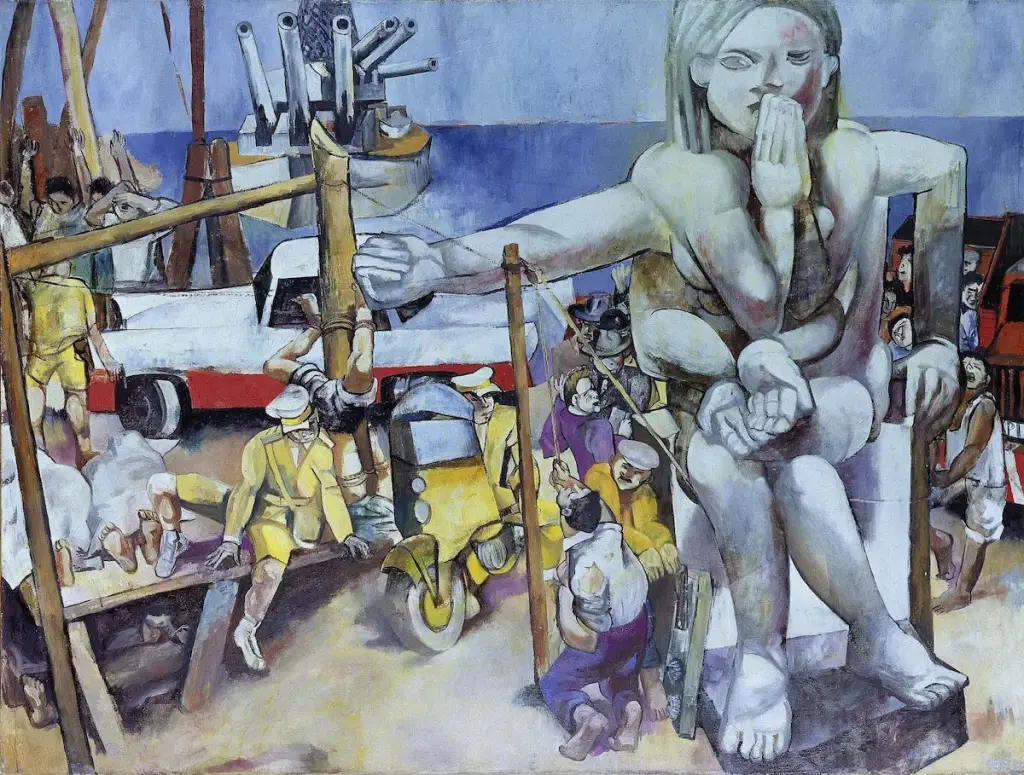
Harald Metzkes, the so-called “Cézannist of Prenzlauer Berg” who made classically indebted and symbolically rich paintings following Germany’s surrender in World War II, died last Thursday in Brandenburg at the age of 97. His death was confirmed to the German Press Agency by his son, the sculptor Robert Metzkes.
“Metzkes became particularly well-known in East Germany because he had no interest in socialist realism,” wrote Monopol, which asserted that he created his own “world theater” in work that wriggled free of East German strictures. The magazine quoted Robert Metzkes saying, of his father, “He wasn’t concerned with implementing cultural policy demands.”
Metzkes was born in 1929 in Saxony, Germany, and in 1949 started studying painting at the Dresden Academy of Fine Arts. In 1959 he moved to East Berlin, where he established a distinctive painterly style that “combined poetic imagery, references to classical modernism, and deeply symbolic visual worlds,” according to the Neue Nationalgalerie.
That museum is currently showing Metzkes’s Removal of the Six-Armed Goddess (1956) in an exhibition titled “Extreme Tension. Art between Politics and Society Collection of the Nationalgalerie 1945–2000.” In an Instagram tribute to the artist posted on Tuesday, the institution wrote: “Painted shortly after his studies in the GDR and influenced by the atmosphere of the first documenta, as well as artists such as Max Beckmann and Pablo Picasso, the work unfolds as a powerful scene between beauty, violence, fragility, and loss.”


