






One year into Donald Trump’s second term as US president, the state of democracy in the country has been variously described as in “decline” or “collapse”, pummelled by attacks on the press, the courts, watchdogs, universities, federal agencies and political opponents. It is at this moment of democratic precarity that the New York Historical in Manhattan unveils the Tang Wing for American Democracy—a 71,000 sq. ft extension scheduled to open on Thursday (18 June) that replaces a rear courtyard formerly used for outdoor exhibitions.
Designed by Robert A.M. Stern Architects (Ramsa), the same firm behind the Museum of the American Revolution in Philadelphia, the Tang Wing has taken three years and $175m to build—$75m supplied by public funding, and $100m through private philanthropy. The wing is named after the financier Oscar Tang and his wife, the archaeologist and art historian Agnes Hsu-Tang (the museum’s board chair), in honour of their $20m donation.
Focusing on local and national history, the Historical is New York’s oldest museum and considers itself a “museum of museums”. The main building nests the DiMenna Children’s History Museum and the Center for Women’s History, while the new wing contains the Stuart and Jane Weitzman Shoe Museum—showing around 150 pairs of women’s shoes—and the American LGBTQ+ Museum, slated to open on the fourth floor in late 2027.
The Tang Wing’s Leni and Peter May Conservation Studio at the New York Historical Photo: © Bridgit Beyer, courtesy New York HIstorical
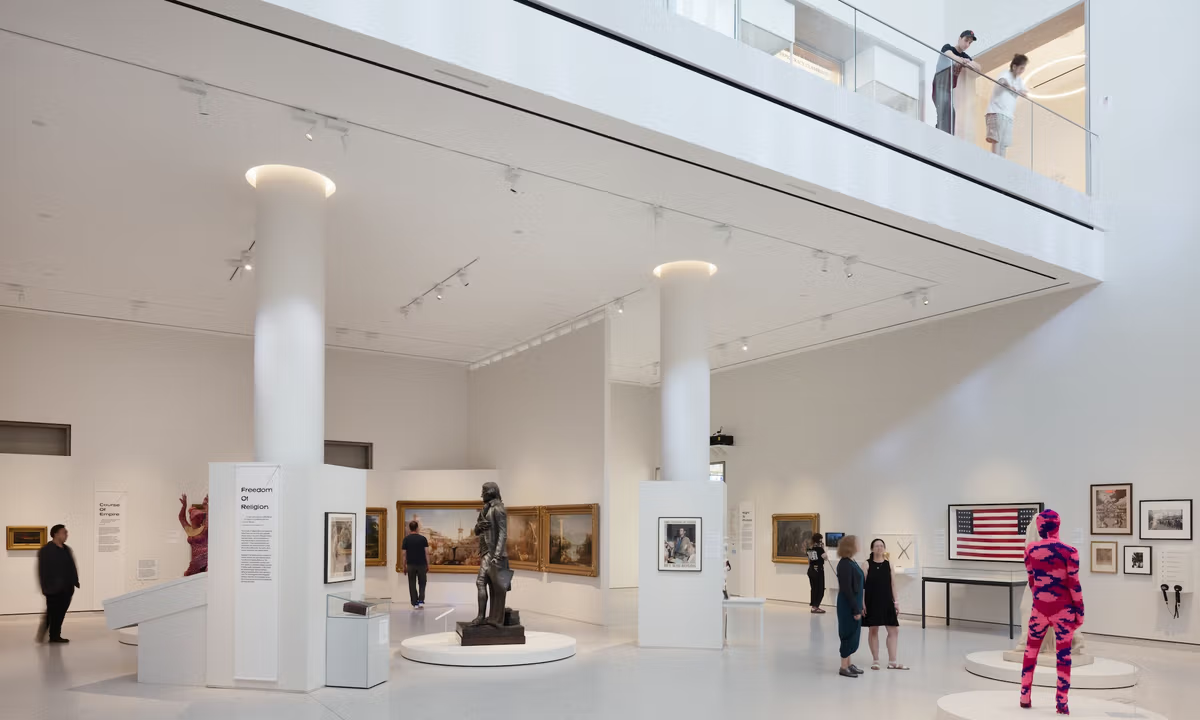
The Tang Wing adds two new exhibition halls. The larger of these is the Klingenstein Family Gallery, a soaring space with triple-height ceilings whose inaugural exhibition, Democracy Matters (18 June-1 November), coincides with the US’s semiquincentennial. It traces the evolution of the world’s longest-running democracy. Items on view include fragments of the equestrian statue of George III toppled in 1776 and a recent piece by the Cree painter Kent Monkman reimagining an Albert Bierstadt landscape.
“The 250th anniversary invites reflection on the ongoing legacy of 1776,” Wendy Ikemoto, the museum’s vice president and chief curator, tells The Art Newspaper. She hopes the show prompts visitors to consider the promising and problematic aspects of the US’s founding ideals, and that the grand exhibition space serves as “a temple in which to stand in awe of some of the greatest works of human creativity and a forum in which to consider the many challenges of history and its telling”.
Located one floor above, the Joyce B. Cowin Gallery presents a permanent installation of sculptures by Elie Nadelman—including The Four Seasons (around 1912), a set of terracotta statuettes that once decorated the Fifth Avenue salon of the cosmetics tycoon and fellow Polish immigrant Helena Rubinstein. On the lower level, a new conservation studio is equipped for working with paper, paintings, textiles and historical objects. Previously, only paper conservation was performed at the museum.

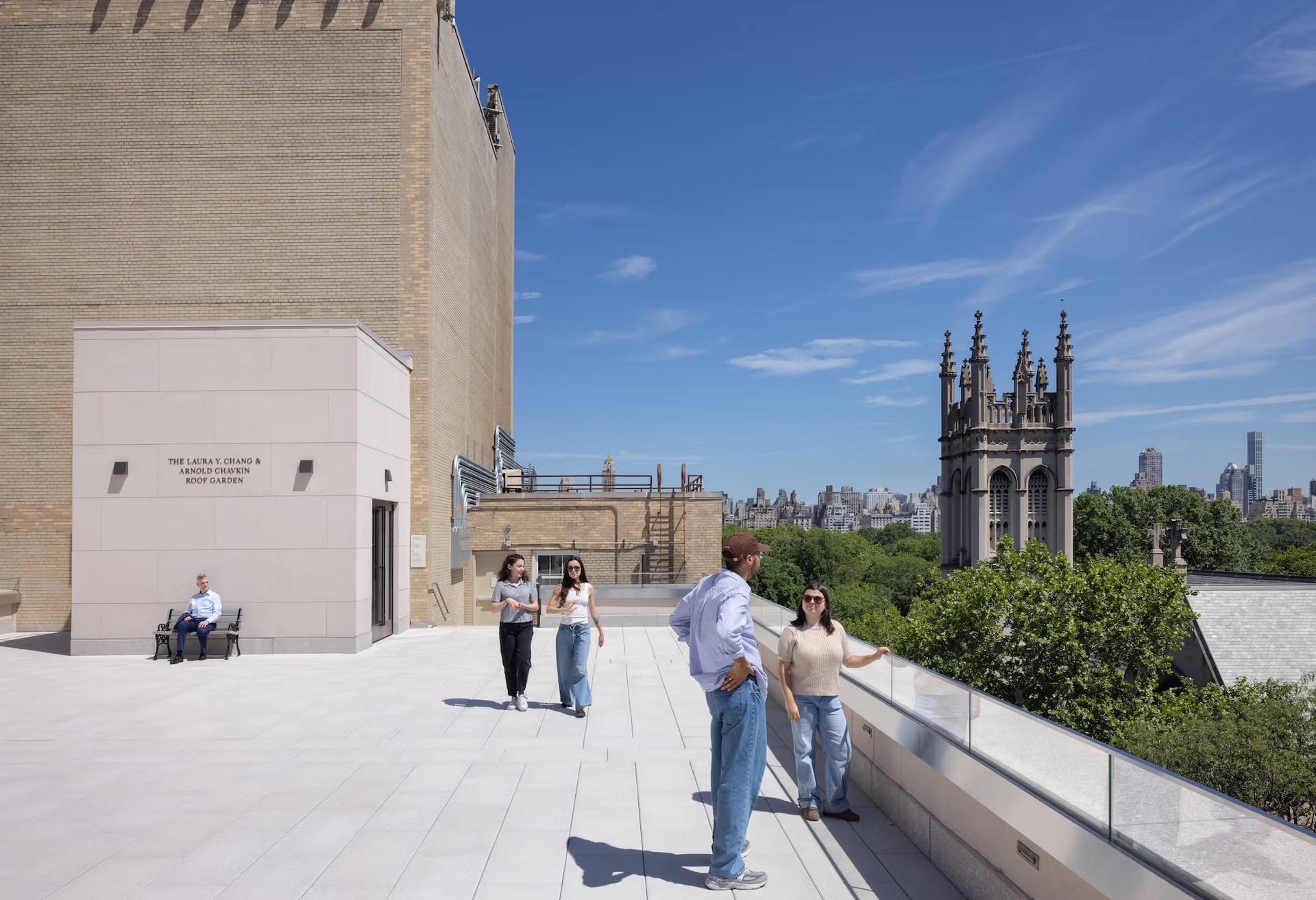
The Tang Wing’s Laura Y. Chang and Arnold Chavkin Roof Garden at the New York Historical Photo: © Bridgit Beyer, courtesy New York HIstorical
The Tang Wing is a boon to the Historical’s robust educational programming, much of which is offered free of charge. “Education is at the forefront of everything we do,” says Louise Mirrer, the museum’s president and chief executive. “We support nearly 300,000 public-school students and teachers annually.”
With two new classrooms on the second floor supplementing the two in the main building, the museum’s Academy for American Democracy can now host 30,000 students annually in a four-day course for sixth-graders—up from 3,000. One classroom features a mural of the ancient Agora of Athens; the other, which doubles as an exhibition space, has a video installation about immigration and citizenship. “The new wing also enables us to dramatically increase the number of educators reached through the Dorothy Tapper Goldman Center for Teaching Democracy,” Mirrer says.
The tallest section of the Tang Wing is an 11-floor storage tower housing the bookstacks for the museum’s Patricia D. Klingenstein Library, which had been closed for renovation. The tower significantly expands on-site storage of the library’s collections—including the archives of the media company Time Inc., the writer Robert A. Caro and the tennis player Billie Jean King, along with millions of books, maps, photographs and other historical documents. The new Sid and Ruth Lapidus Reading Room provides collection access to researchers, particularly students in the Master of Arts in Museum Studies programme jointly offered by the Historical and the CUNY School of Professional Studies.

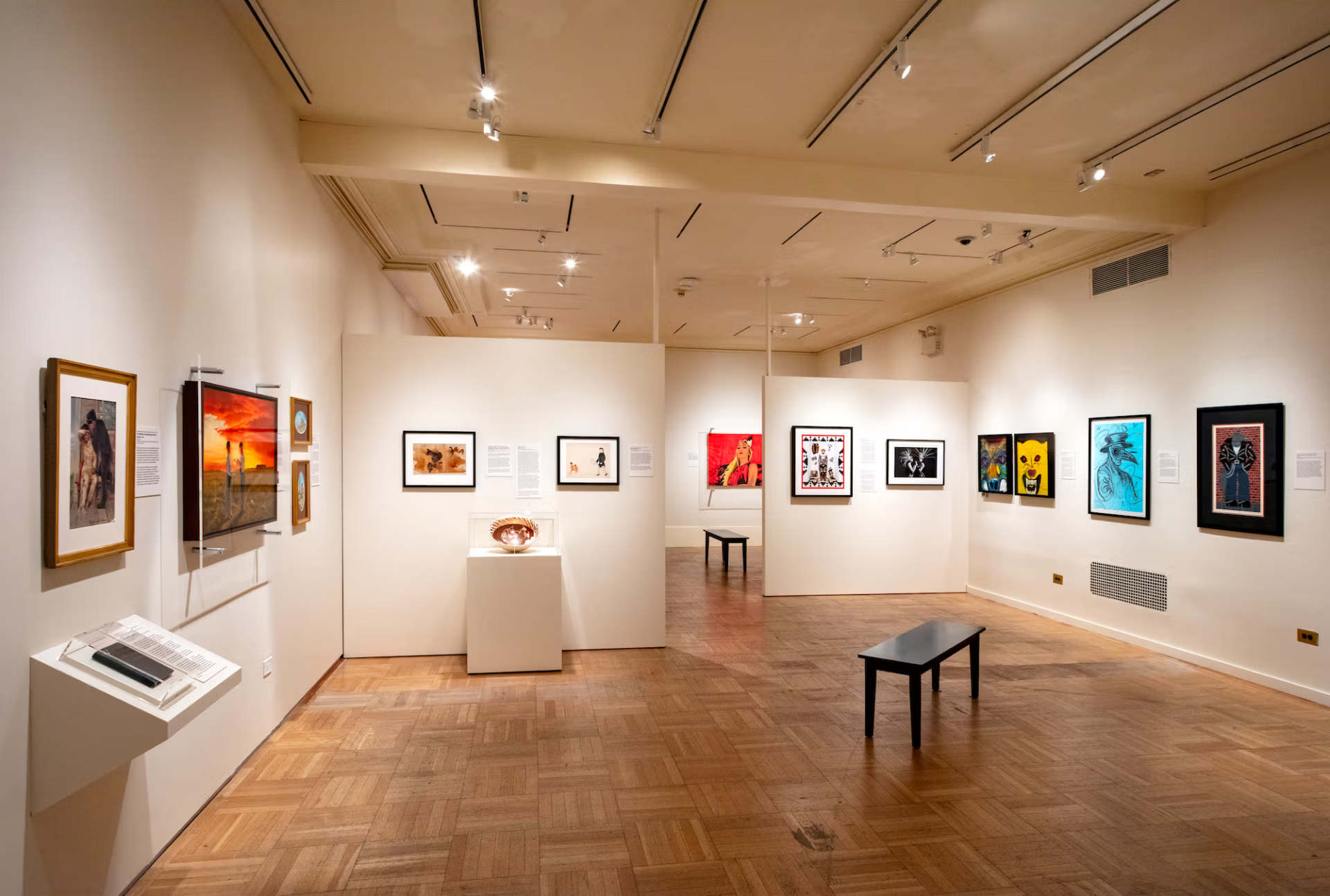
Installation view of House Made of Dawn at the New York Historical Photo: © Glenn Castellano, courtesy New York Historical
Matching the original Beaux Arts details
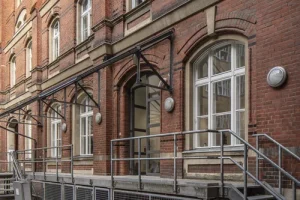
Founded in 1804, the Historical completed the first portion of its current building in 1908 and expanded it on either side in 1938. Ramsa’s approach to designing the Tang Wing was to create a continuation of the surrounding architecture. The extension largely matches the height of neighbouring brownstones and the Beaux Arts details of the museum, such as bronze-clad windows and copper acroteria adorning the roof. Materials like terrazzo, mosaic tile and Tennessee marble echo existing interiors. Granite for the façade was sourced from the same quarry in Deer Isle, Maine, used in the 1908 construction. The Tang Wing is rounded off by two green spaces: a sculpture garden on the ground floor, featuring bronze statues of Aaron Burr and Alexander Hamilton’s deadly duel, and a rooftop garden designed by Nelson Byrd Woltz that will stay open throughout the year.
Besides funding the new wing, the Tangs recently donated 150 works by Indigenous artists to the museum, selections of which are on view in the exhibition House Made of Dawn (until 16 August). Another piece, Contact 2,021 (2021) by the Shinnecock artist Courtney M. Leonard, is displayed at the entrance to the new wing.
Owing to the couple’s philanthropy, another Tang Wing is springing up across Central Park at the Metropolitan Museum of Art, where Oscar Tang has served on the board for three decades. Designed by the Mexican architect Frida Escobedo and scheduled to open in 2030, the Oscar L. Tang and H.M. Agnes Hsu-Tang Wing was named in recognition of their lead contribution of $125m—the largest cash gift in the Met’s history.


