







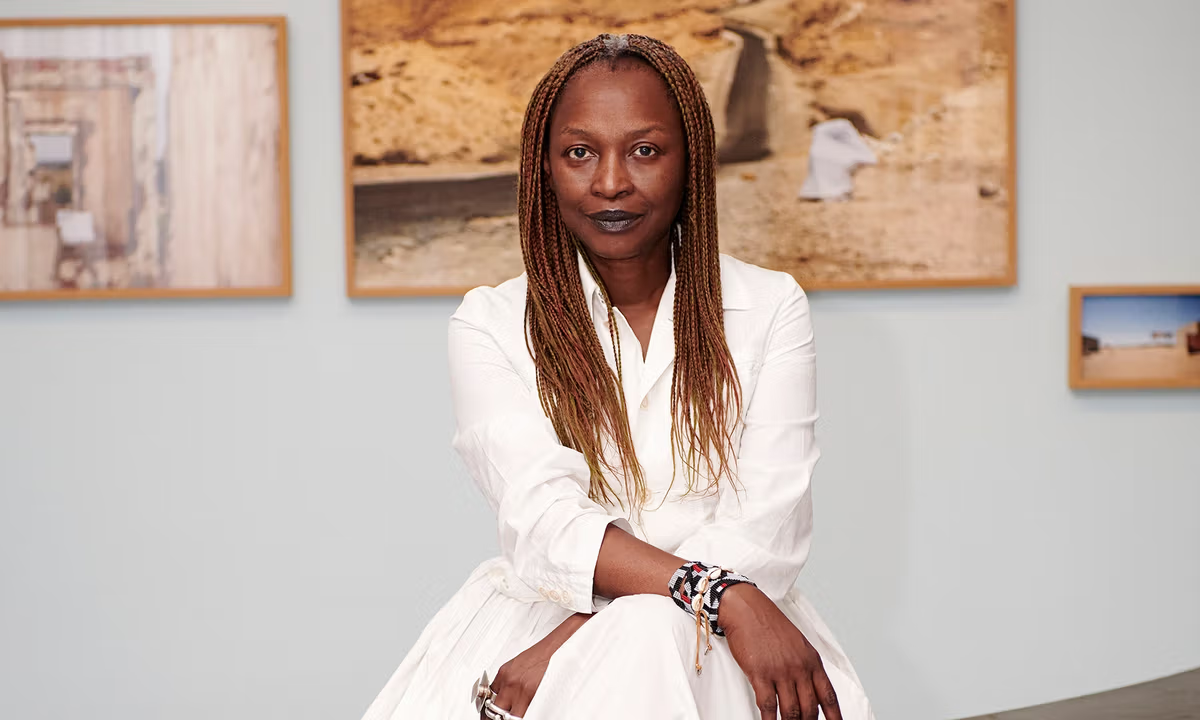
Everything about the international exhibition for the 61st Venice Biennale feels anomalous. When the tragic death of its artistic director, Koyo Kouoh, was announced in May 2025, it sent a shockwave through the art world. Inevitably, there were questions about if—and, as importantly, how—her vision for the Biennale could be realised.
In the months since, those questions have been answered. The title of the exhibition and a text written by Kouoh were published soon after her death, immediately reflecting how advanced the fundamental themes of the Biennale were. And her long-established collaborative practice proved crucial. We now know that a group of five of Kouoh’s collaborators, which for the purpose of the Biennale has been named “la squadra di Koyo Kouoh”—Koyo Kouoh’s team—had been working with her for several months before she died and met with her in Dakar, Senegal, a little more than a month before her death to finalise its themes and scenography, refine the artist list and chosen works, and even go so far as to establish the exhibition’s graphic identity.
At the press conference in February, they announced the full concept, with a list of 111 invited individual artists, duos and collectives, and—a key factor—artist-led organisations. Each of the five members of La squadra spoke, emphasising their collective role in realising Kouoh’s vision, rather than presenting themselves as replacements. Significantly, they did not take questions and none was put forward as a spokesperson. The message was clear: this is Koyo Kouoh’s exhibition. And while, for the first time in a number of years, The Art Newspaper cannot feature an interview about the international exhibition on these pages, we can still take a deep dive into its themes, its organisation and its protagonists.
In Minor Keys, in Koyo Kouoh’s own words
It is striking, and deeply pertinent to the overarching themes, format and pacing of the exhibition, that Kouoh begins her text on it, delivered to the Biennale on 8 April 2025 but published posthumously, with an incantation of the kind that might begin a meditation:
[Take a deep breath]
[Exhale]
[Drop your shoulders]
[Close your eyes]
This is an exhibition that asks us to pause, to slow down, even—quite explicitly—to rest. Venice Biennale shows, however effective and stimulating they may be, are also always simultaneously draining—an inevitable descent into footsoreness and brain fog. Kouoh states that she wants the exhibition to be “renewing rather than exhausting”, and wants us to “shift to a slower gear and tune in to the frequencies of the minor keys”.
She explains that the musical concept evokes both form and content: a structure and a mood. And, she writes, it “spills with metaphor”. One potent example is of music evoking all the cultural production that will feature in the show, and for the kinds of places and communities in which it is made. She does not propose an escape from what she calls “the anxious cacophony of the present chaos raging through the world”; rather, she attempts to offer a counterbalance. Despite geopolitical strife and the historic conditions that continue to influence it, Kouoh suggests, “the music continues. The songs of those producing beauty in spite of tragedy, the tunes of the fugitives recovering from the ruins, the harmonies of those repairing wounds and worlds.”
Resistance and survival
For Kouoh, minor keys are a form of resistance and survival; they “refuse orchestral bombast and goose-step military marches” in favour of, among much else, “the lament… the whisper… the lower frequencies…the hums”. This seems set to be an exhibition of nuance and subtlety. But while she acknowledges that minor keys are often associated with melancholy and sorrow, she says that, in her show, “their joy, solace, hope and transcendence manifest as well”.
This upbeat element will likely be visible in the sense of community and interrelation that Kouoh was keen to foster. She writes about her inclusion of artistic practices that “prompt relation and relationship, that advance concept and form through networks and schools—understood freely and informally”. In one of the most explicit musical references, she states that she intends the effect to be one that “scrambles cohesion and dissonance in the manner of a free-jazz ensemble, or perhaps, at the scale of the Biennale Arte, a festival of ensembles with a common premise: that poetics liberate and people make beauty together”.
This was evident in the images La squadra showed at the conference: clear visual and thematic associations between the work of diverse artists across widespread geographies. While the intellectual structure is rigorous, she wanted the experience of the exhibition to be “more sensory than didactic”. Artists, as “channels to and between the minor keys”, will be left to speak for themselves, rather than crowbarred into a conceptual framework: “listening to, rather than speaking for them is at the core of the curatorial conceit”.
Off the treadmill
Again, though, the journeys she hopes to send us on are not presented as escapist balm. Kouoh notes that she wants visitors “to marvel, meditate, dream, revel, reflect and commune in realms where time is not corporate property nor at the mercy of relentlessly accelerated productivity”. She invites us, in other words, to step off the capitalist treadmill.
And if there is a singular political message of the show, it is this: art and cultural production are a form of resistance, a refusal of what Kouoh calls “the spectacle of horror”—the “headstrong pursuit of growth supported by ruthlessness and greed” embodied in “the enduring time of capital and empire”, with its destruction of communities (with their attendant culture and knowledge) and ecologies.
She suggests it is time “to find the oases, the islands, where the dignity of all living beings is safeguarded”. She thus invokes another meaning of minor keys: a geographical one. A minor cay (pronounced “key”) is a small island. This is both a reference to the diverse voices in the show—artists from “minor keys” across the globe feature—and also another metaphor. The small islands are “worlds amid oceans with distinct and endlessly rich ecosystems” that are embodied in “the other worlds that artists make, the intimate and convivial universes that refresh and sustain even in terrible times”. Kouoh’s exhibition—a “collective score composed together with artists who have built universes of imagination”—aims to be a resonant and sonorous experience.
From left: Rasha Salti, Siddhartha Mitter, Marie Hélène Pereira, Gabe Beckhurst Feijoo and Rory Tsapayi have realised Kouoh’s plans for the Biennale
Photo by Andrea Avezzu
La squadra di Koyo Kouoh
The group of five specialists who will realise Kouoh’s show consists of three “advisers”—Gabe Beckhurst Feijoo, Marie Hélène Pereira and Rasha Salti—an editor-in-chief, Siddhartha Mitter, and Rory Tsapayi, research assistant. Beckhurst Feijoo, who is based in London, worked with both Kouoh and Salti on the 8th Triennial of Photography Hamburg in 2022. Salti also worked with Kouoh on the research project Saving Bruce Lee: African and Arab Cinema in the Era of Soviet Cultural Diplomacy, which had manifestations at the Garage Museum of Contemporary Art in Moscow and the Haus der Kulturen der Welt in Berlin. Pereira is a senior curator at that Berlin institution and was the director of programmes at Raw Material Company, the Dakar nonprofit founded by Kouoh, where she remains an adviser. Mitter, whose background is in criticism, collaborated with Kouoh on a research residency for the US-French organisation, Villa Albertine. Tsapayi, meanwhile, worked with Kouoh during her directorship of Zeitz Mocaa in Cape Town, South Africa.
The crucial moment in the collaboration took place in Dakar, at Raw Material Company, in April 2025, when the team met for a week of work with Kouoh in person after months of online meetings. This meeting was evoked powerfully and enchantingly in a text written by the team and read by Salti at the press conference: she described the setting, beneath a straw roof, with their conversations punctuated by the sound of falling mangoes from a nearby tree. Salti recalled the gathering as being like “a rehearsal for a musical performance: [Kouoh] was our conductor, and while each of us arrived with a finely tuned instrument, it took those few days for us to tune to one another. She composed as we improvised.” And while no exact details were given, Salti described how on the final day of the convention, Kouoh “assigned missions to each of us”. Those roles might become clearer when the exhibition opens.
Since then, the team has brought the vision to practical fruition, with regular online meetings and in-person convenings in Venice in May and October 2025, and in Dakar in June 2025. Alongside her team, Kouoh appointed the Cape Town practice Wolff Architects as exhibition designers, and the intelligence of their scenography, according to the curators, lies in “its generosity to each artist’s universe and to the sensorial experience that can open up between constellations of practices”. Indigo banners from floor to ceiling will appear at key moments in the show, “calming the senses at the dénouement of one phase and signalling the opening of another”, Kouoh’s team say.

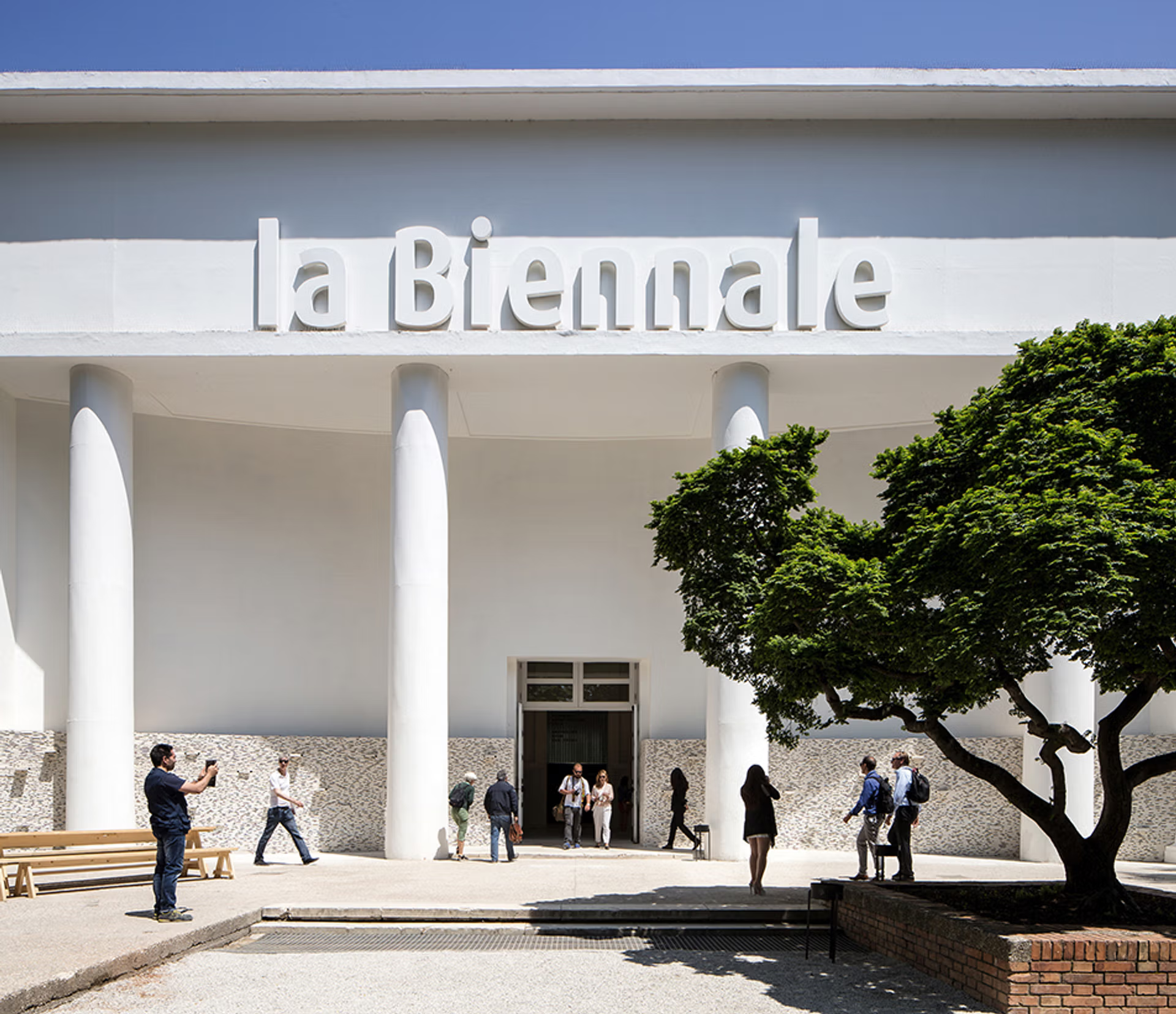
The Biennale will run from Saturday 9 May to Sunday 22 November
Photo by Francesco Galli
‘Undercurrent priorities’
The exhibition will be structured according not to clear sections, but what the curatorial team call “undercurrent priorities”—strands that will “leap from practice to practice, snaking an intergenerational path to build across the sites of In Minor Keys”. The first is Shrines. If visitors begin with the former Italian pavilion in the Giardini before continuing their journey at the Arsenale, they will encounter in the opening space—the Sala Chini with its ceiling murals—environments created by two artists whom Kouoh saw as the “lodestars” for her exhibition: the Senegalese multimedia artist and organiser, Issa Samb, a mentor for Kouoh, and the US sculptor and installation artist Beverly Buchanan.
The next strand is Processional Assemblies, particularly focusing on gatherings in African Atlantic communities. Think carnivals and other exuberant expressions—for instance, in the work of the US artist Nick Cave and the London-based Alvaro Barrington, but in spiritual and mourning rituals, too. Procession and gathering also appears to be a guiding principle; we learn that Kouoh wanted it to be open—“to refuse solid walls where possible”, as the curators put it—so that visitors are “invited to become part of this assembly”. The exhibition expands on the carnivalesque theme, identifying in it a capacity for subverting systems and structures of power, particularly in relation to histories and thus archives. Among the artists the curators cite here are the Ghanaian British painter and collagist Godfried Donkor and Yoshiko Shimada, the feminist artist who has explored violence and the role of women in Japanese imperialist histories.
Enchantment is perhaps the most optimistic strand, in that it addresses the transformative effect of making “in the face of cynicism about what art can do”. Here, among other things, we will encounter works that respond to daily life and find unexpected moments of poetry within them—for instance, in the playful and quietly touching installations of the US artist Rose Salane, which find humanity in the quirky subversion of urban systems, and Billie Zangewa’s beautiful silk fragments of quotidian life.
Island universes
The geographical keys, those “small islands of artists’ universes”, are represented in part by Oases, sites for spiritual and physical rest and repose. They are informed by various concepts, including the “creole garden”, as termed by the Martiniquan poet Édouard Glissant—biodiverse spaces cultivated by enslaved people in the Caribbean and Americas as acts of defiance and sustenance. Works relating to this theme are presented by, among others, Wangechi Mutu, who creates works in sculpture, painting and other media in which the speculative and social are brought into exquisite tension, and the artist María Magdalena Campos-Pons and musician Kamaal Malak, whose collaborative installations both enchant and unsettle in their exploration of colonial and ecological histories. Dedicated rest spaces featuring the work of other artists will also appear at various points. These are moments that, according to La squadra, “invite reverie, solemnity, devotion, and wonder”, by artists as diverse as Mohammed Z. Rahman, a painter of marvellously lyrical scenes that quietly evoke sociopolitical histories, and the great US sonic and performance artist, Laurie Anderson. Other oases include an evocation of Samb’s courtyard in Dakar and a response to Marcel Duchamp’s New York studio, where he secretly made his last work, Étant Donnés (1946-66).
Lastly, seven artist-centred institutions, or Schools, punctuate the exhibition. Though not technically academic institutions, these artist-run initiatives are centres of profound learning, spaces for gathering and making, for discussion and communion. Inevitably, they include Raw Material Company, but also Denniston Hill, the institution founded by Julie Mehretu, Paul Pfeiffer and Lawrence Chua in the Catskills, New York State, and GAS Foundation, the institution founded by Yinka Shonibare in Nigeria.
Literary influences
Poetry, according to Kouoh’s team, “was to her the guiding light of a curatorial gesture”. And literature looms large in this Biennale. Other shows have chosen a more theoretical umbrella under which to organise the artists but, for Kouoh, it is poetry and the novel that guide her thesis. Quotes by James Baldwin, Glissant and others rhythmically appear in her exhibition text, but two masterworks of literature are touchstones: Toni Morrison’s Beloved (1987) and Gabriel García Márquez’s One Hundred Years of Solitude (1967). As the curators put it, the two books are connected “in their evocation of thresholds between lifeworlds and temporalities”. They both grapple with vast themes—respectively, the legacies of slavery and a modern history of Colombia—via the realms of a haunting imagination. To emphasise the importance of poetry, one of a series of performances programmed for the Biennale will connect profoundly to Kouoh’s personal history. “A procession of poets” will appear in the Giardini, a direct response to an early moment of inspiration for her: the Poetry Caravan, a journey she made from Dakar to Timbuktu in 1999 with nine African poets. If one element of the Biennale acts as a memorial for its curator, surely this is it.
Major artists in minor keys
Rather than being divided into discrete sections, the Biennale is organised around what the curatorial team call “undercurrent priorities” or strands that “leap from practice to practice”

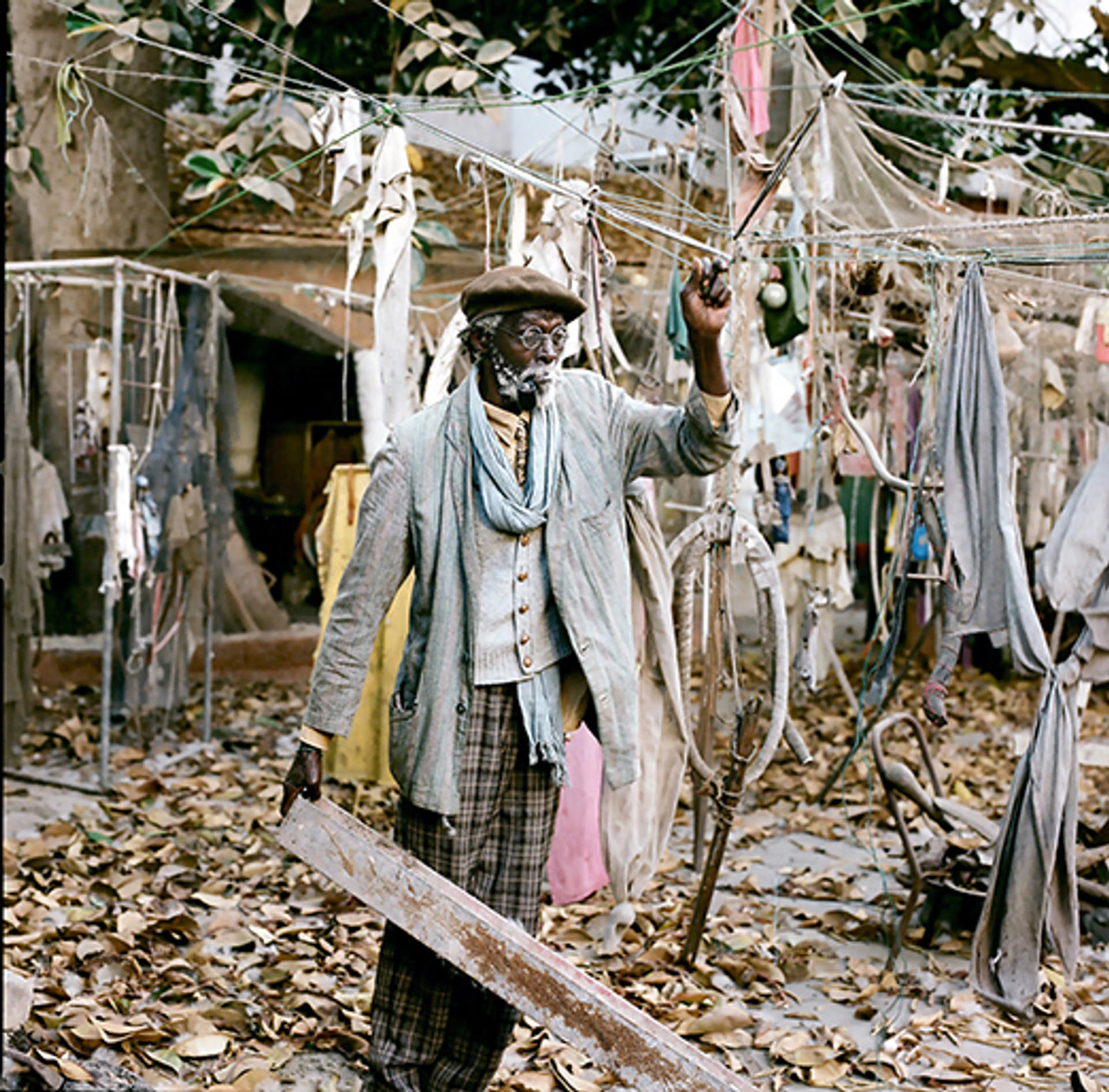
Issa Samb
Photo by Sophie Thun, courtesy of RAW Material Company
Issa Samb
One of the two “lodestar” artists, Samb was a pivotal figure for Koyo Kouoh. Their collaboration began in 2010 and Kouoh went on to curate a number of projects exploring his singular activities, from the radical artist collective Laboratoire Agit’Art, which he co-founded in Dakar in the early 1970s, to more individual activities. His courtyard in Dakar, recreated in part for the Biennale, was his studio, but also a centre for community and cultural activities, and a Gesamtkunstwerk. A marker of his influence on Kouoh can be found in her 2017 description of him as “an enabler of creative processes, a mediator of artistic energy and of exhibition practice”. She could have been describing herself.

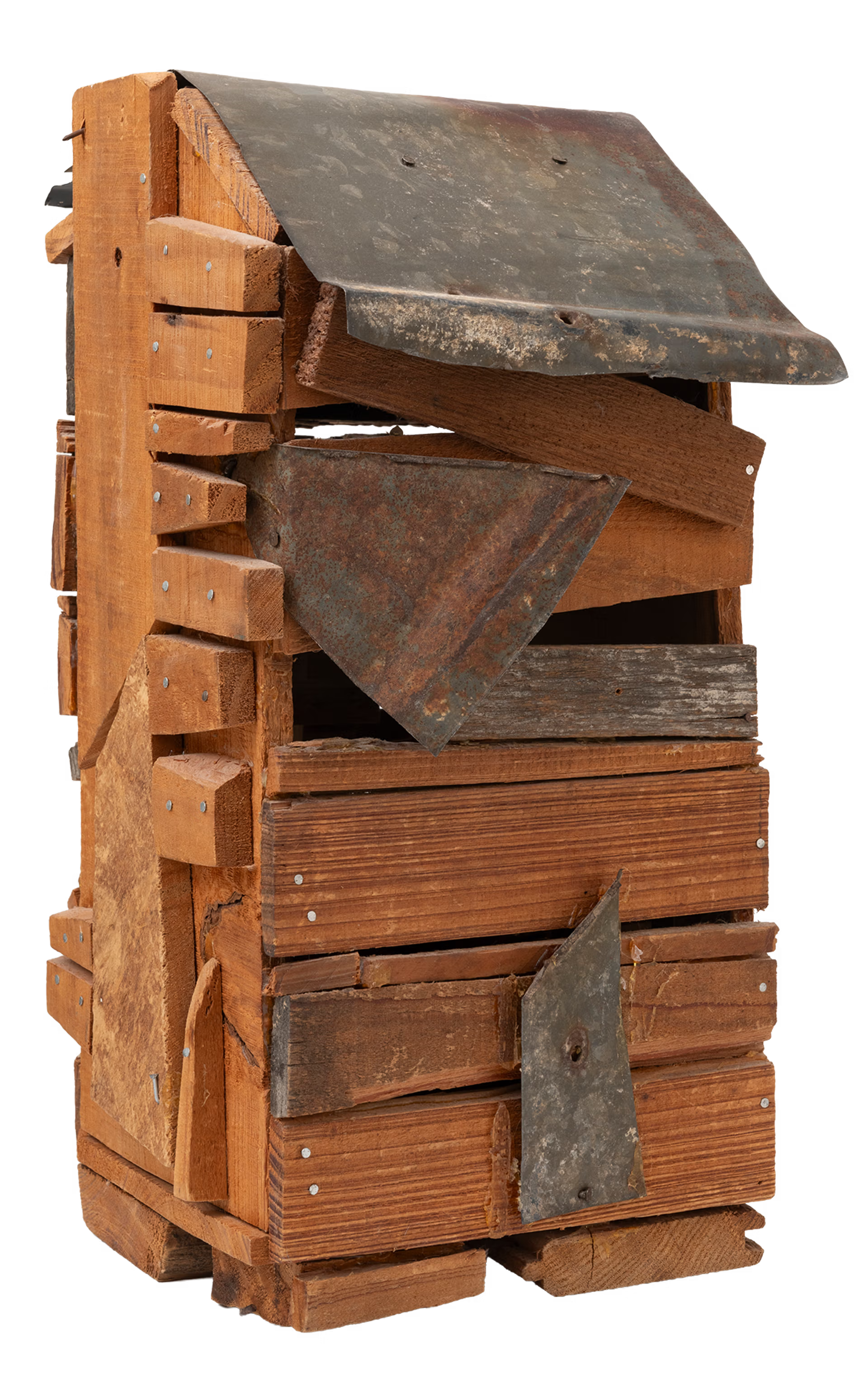
Buchanan’s Shack (1989) was inspired by improvised buildings in Georgia
Courtesy of the Estate of Beverly Buchanan and Andrew Edlin Gallery, New York
Beverly Buchanan
Kouoh discovered her other lodestar artist much later than Samb, but was profoundly moved by her sculpture and public art practice. Buchanan began her artistic career as a painter in the 1960s but made sculptures from the 1970s onwards, including a group of stone works that deliberately evoked ruins. She is best known for her drawings and sculptures known as shacks, inspired by the improvised vernacular architecture in the southern US, and particularly in Georgia, where she was based. Accompanying texts reflected the fact that, for Buchanan, the shacks were as much portraits of people as representations of buildings.

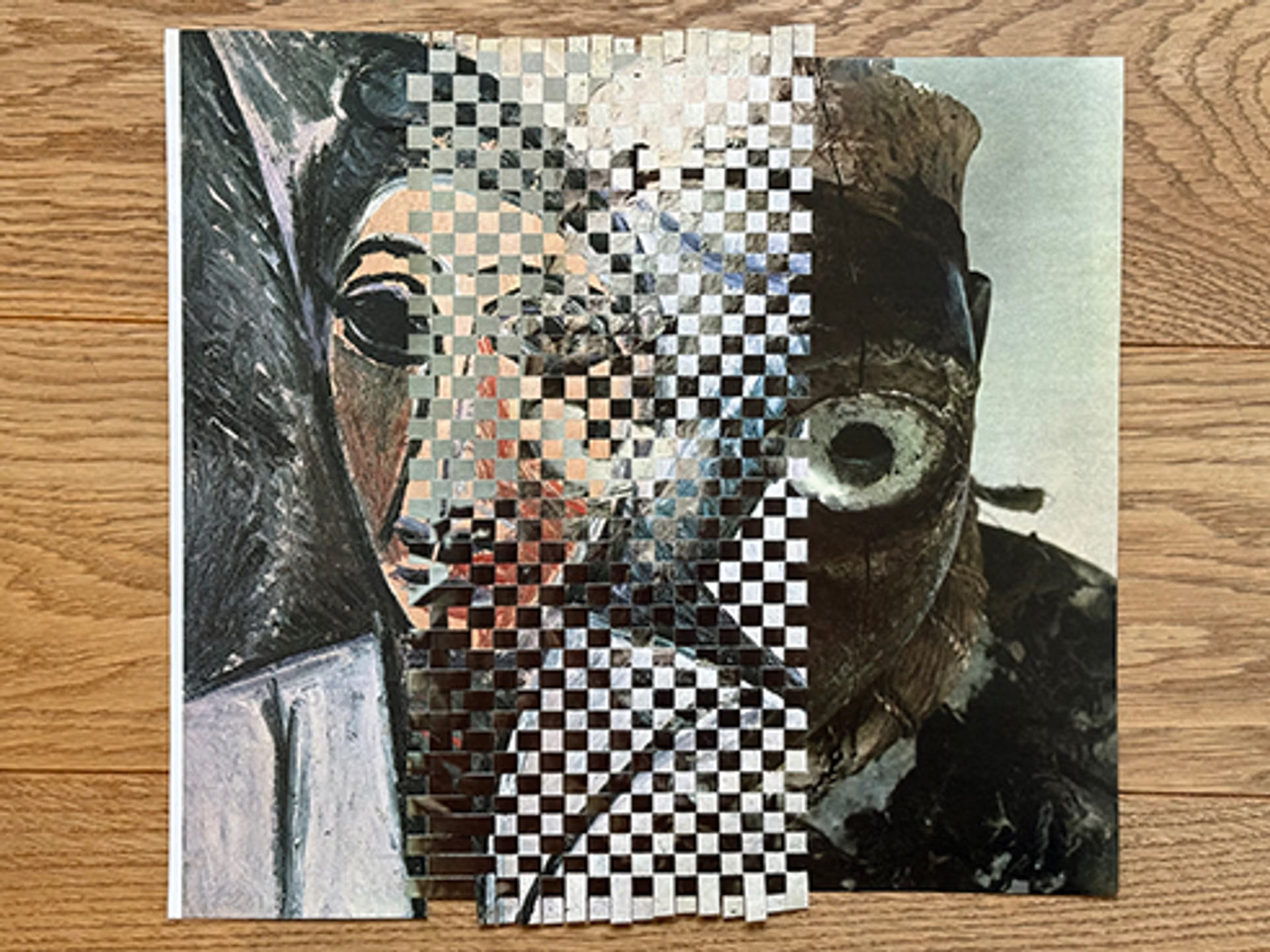
Embrace of Traces (2026) by Kader Attia; the artist will feature at a “rest space”
Courtesy the artist
Kader Attia
Kader Attia provides one of the “rest spaces” that offer a pause for mental and physical repose throughout the show. Attia’s practice is enormously diverse in form—he began as a photographer three decades ago, and has since expanded his language into sculpture, collage and installation—but it has an unerringly consistent theme: repair. Two recent sculptural installations, Resonance and Pluvialité (both 2025), seem likely candidates to be shown in the Biennale, in being installations that foreground sound, respectively in the form of birdcages containing bells and animated rainsticks.

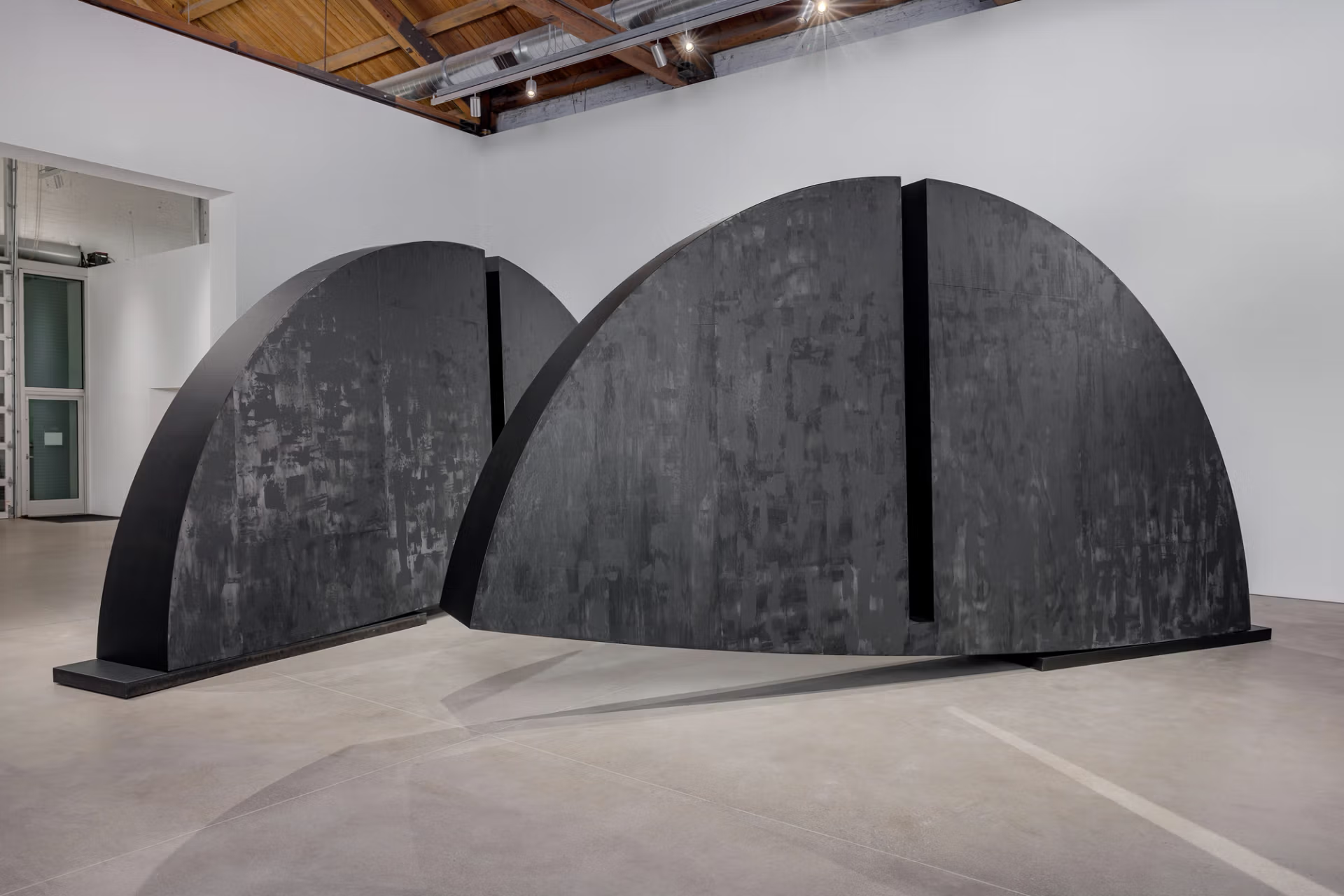
Aya (2024) by Torkwase Dyson; the artist is a proponent of “Black Compositional Thought”
© Torkwase Dyson, photo by Evan Jenkins, courtesy Gray Chicago/New York
Torkwase Dyson
Though Dyson’s vast, often monochrome installations, sculptures and paintings might initially appear abstract—even minimalist—they deal with maximal subjects, including what she describes as “the ways Black and brown bodies perceive and negotiate space as information”. The ongoing concept at the core of her work is Black Compositional Thought, which takes human-made structures and geographies, including architecture, waterways and forms of cartography, explores their history of oppression, and suggests how they might be inhabited by Black bodies and reimagined as places of liberation. Examples of this are her “hypershapes”: geometric forms that relate to specific 19th-century figures who escaped enslavement. Dyson is gathered among the artists who respond to the legacies of historic violence and environmental destruction.
Billie Zangewa
Included among the artists whose work relates to the strand of enchantment, Billie Zangewa’s hand-stitched raw-silk works poetically tell fragments of her life story. Unconventional in shape, they seek to document aspects of women’s—and especially Black women’s—lives that are often ignored or underrepresented in art—a process that she describes as “daily feminism”. Though they might illustrate domestic labour and other apparently mundane subject matter, Zangewa sees these textiles as political acts, in addressing gender and racial stereotypes, and as representations of humdrum pleasures. Her use of sewing and silk embodies her themes: it is a conscious engagement with the gendered associations of art or craft materials.
Alfredo Jaar
Like Dyson, Jaar is identified by the curators as one of the artists who use radical approaches to grapple with “seismic events that refuse to settle or go quietly”. From his early work Public Interventions (Studies on Happiness), begun in 1979—billboards in Chilean public spaces while the country was under the dictatorship of General Pinochet, asking: “Are you happy?”—Jaar has unflinchingly addressed state-sponsored violence and social injustice, and how these issues are reported on by the international media. A veteran of multiple Venice Biennales, from 1986 to 2013, Jaar’s works have addressed, among much else, the Rwandan genocide of the 1990s, and Chairman Mao’s detainment and murder of Chinese intellectuals.


