







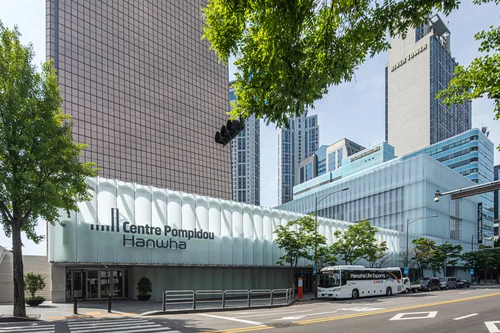
The Centre Pompidou is set to deepen its anchor in East Asia with the grand opening of the Centre Pompidou Hanwha in downtown Seoul on June 4th. The launch marks a pivotal moment in France’s ongoing cultural diplomacy strategy, which has seen the Paris-based institution expand its network across the region.
The Seoul opening follows a string of high-profile partnerships for the Pompidou. Last year, it renewed its five-year collaboration with Shanghai’s West Bund Museum. Earlier this month, it signed a five-year memorandum of understanding with Hong Kong’s M+ museum, where each will co-curate shows for their respective institutions.
Over the past decade, the Korean art scene has experienced explosive growth, underpinned by the country’s chaebols—the large, family-owned conglomerates that dominate the local economy. Corporate giants like Samsung and Amorepacific have long driven the ecosystem through their own world-class private institutions, most notably Samsung’s Leeum Museum of Art.
Still, the Centre Pompidou Hanwha represents the first time a major international museum brand has established a long-term, structural presence in South Korea. Its arrival signals a new chapter of global integration for Seoul’s rapidly ascending cultural capital.
Here’s what you need to know about the new institution.
What is the new Centre Pompidou Hanwha?

Situated on Yeouido Island, Seoul’s financial district, Centre Pompidou Hanwha will operate under a four-year partnership between the Hanwha Foundation of Culture—the philanthropic arm of Hanwha Group, the 7th largest conglomerate in South Korea—and the Centre Pompidou.
It occupies a former aquarium inside the landmark 63 Building, the tallest skyscraper in the city until 2003. The building was originally constructed as a landmark for the 1988 Summer Olympics.
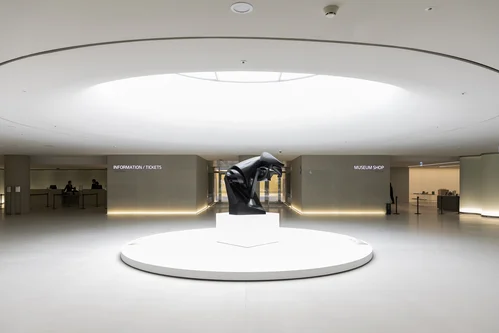
The institution spans 11,000 square meters across four stories. The ground floor houses a large bookstore, while a café and an auditorium are located on the first floor. A rooftop garden crowns the building above, where a restaurant overlooking the Han River is planned for a later phase.
The museum’s core is split across two galleries on the second and third floors, each spanning roughly 1,600 square meters. Gallery 1, on the second floor, is a double-height space with seven-meter ceilings engineered to accommodate large-scale touring exhibitions drawn from the permanent collection of Paris’s Centre Pompidou. Gallery 2, on the floor above, is a split-level space with a mezzanine, reserved for contemporary exhibitions curated by the Hanwha Foundation of Culture.
Who designed the new Centre Pompidou Hanwha?
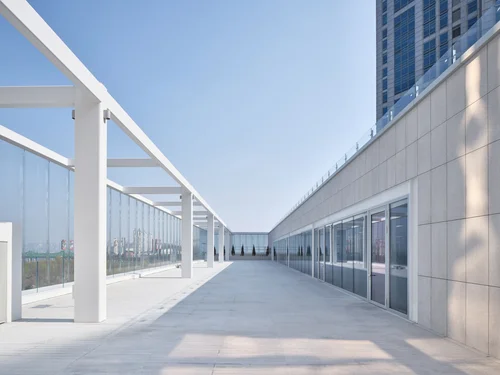

The building is the work of Jean-Michel Wilmotte, the French architect behind the Grand Palais Éphémère in Paris and the Ullens Center for Contemporary Art in Beijing.
Wilmotte’s ties to Korea run deep: His Korean commissions include the Gana Art Gallery, completed in 1998, and the Seoul Auction Gangnam Center in 2019. A new museum on Jeju Island, also funded by the Gana Foundation, is expected to open this year.
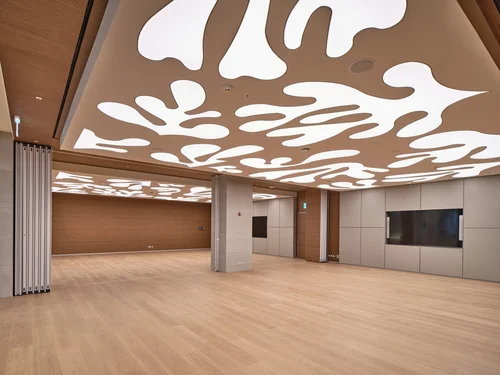
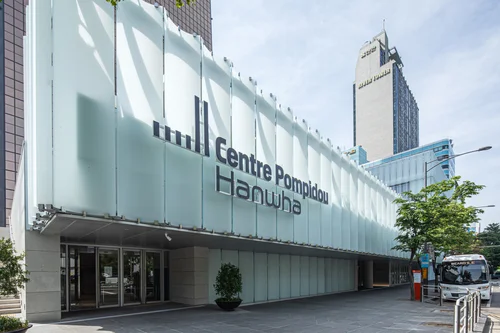
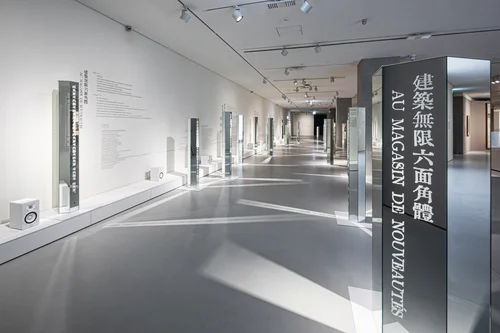
Widely praised for his balanced forms, deft use of natural and artificial light, and ability to integrate contemporary design into existing urban fabric, Wilmotte conceived Centre Pompidou Hanwha as what he calls “a box of light.”
Wrapped in a translucent glass envelope, the building drinks in natural light during the day and glows as an urban lantern after dark. In a subtle gesture toward local tradition, the building’s curved exterior is designed to evoke the silhouettes of traditional Korean roof tiles.
What art will Centre Pompidou Hanwha show?
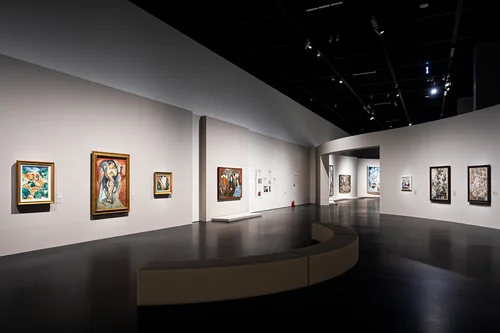
Centre Pompidou Hanwha will mount two major exhibitions per year over the next four years, drawing from its modern and contemporary collection. This program features a series of eight monographic and thematic exhibitions, which will focus on the artists and movements that defined the 20th century. Running alongside it, a dedicated contemporary program will spotlight Korean artists, weaving the country’s cultural context into the broader narratives of art history.
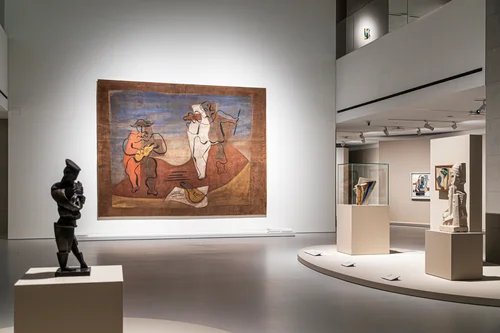
The inaugural show, “The Cubists: Inventing Modern Vision,” will bring together 112 works by 54 artists—91 works by 43 Cubist figures alongside 21 works by 11 modern and contemporary Korean artists—assembled by a joint French and Korean curatorial team. The exhibition traces Cubism from its emergence around 1907 through the 1920s, charting its evolution into an international artistic movement shaped by intersecting experiments across regions, media, and artistic groups.
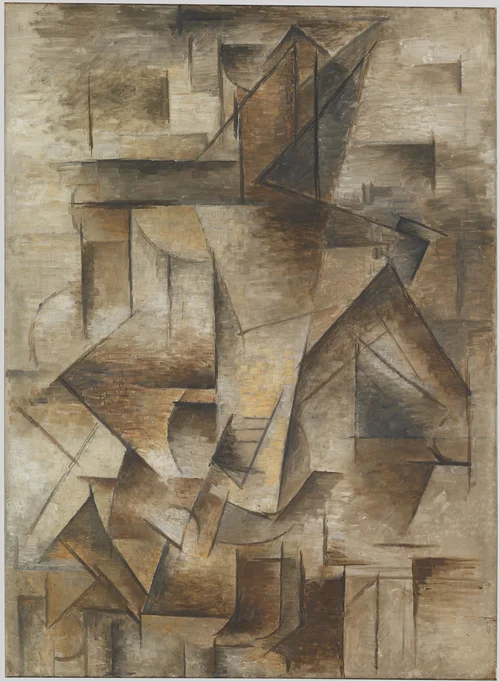


Organized into nine sections, the show features key works including The Viaduct at L’Estaque (1908) by Georges Braque—which revisits a landscape in a manner that foreshadows Analytical Cubism—and Pablo Picasso’s The Guitarist (1910), a landmark of the same movement in which the human form and instrument are systematically dismantled into fragmented, overlapping geometric planes.
The exhibition also gives sustained attention to historical currents less familiar to Korean audiences, among them Orphic Cubism and Salon Cubism. A dedicated section, “Korean Focus,” installed in the mezzanine of Gallery 2, examines how Cubism and other Western avant-garde movements entered and transformed Korean modern art, with works by Lee Soo-auck, Ham Dae-jung, and Park Re-hyun.
When does Centre Pompidou Hanwha open?
The museum opens to the public on June 4th. Admission is 28,000 KRW (approximately US$18).
A program of public events accompanies the opening. On June 4th, Youngna Kim, professor emerita at Seoul National University, will deliver a special lecture on Cubism and Korean modern art, followed by a talk from Woo Jung-Ah, professor at POSTECH University, on the expanding legacy of Cubism.
Two curator talks are planned for July—one focused on Cubism within the Centre Pompidou collection, the other on its Korean dimension. The institution says further programming will be announced in the coming weeks.
What Centre Pompidou Hanwha means for Seoul’s cultural scene
From K-pop to contemporary art, South Korea has proven a formidable exporter of cultural influence. Centre Pompidou Hanwha’s emphasis on weaving Korean artistic identity into its curatorial framework could further raise the international profile of Korean artists, situating their work within the broader narratives of art history on a global stage.
The museum, however, arrives amid unresolved questions about its principal backer. Hanwha Group, South Korea’s seventh-largest conglomerate, has faced international scrutiny over its reported ties to the Israel Defense Forces through the arms manufacturer Elbit Systems. The Hanwha Foundation of Culture has previously stated that all of Hanwha’s exports comply with South Korean law and foreign policy and has emphasized that Centre Pompidou Hanwha operates independently of the broader conglomerate. “Hanwha has never been involved in the development of any inhumane weapons,” a statement from the Hanwha Foundation, reported by The Art Newspaper, read. Hanwha, it added, has “no record of exporting weapons to Israel.”
“The Cubists: Inventing Modern Vision” runs from June 4th to October 4th.


