






Isaiah Davis’s Midtown Manhattan studio was once Christian Louboutin’s atelier, and it still has red carpeting that evokes the lacquered undersides of the designer’s signature stilettos. When I visited Davis’s studio this past winter, that red peeked out from under heaps of black and brown leather the artist was working with.
Leather appeared in Davis’s 2021 show at New York’s Participant Inc: White American Flag (2021) is a wall work with stars and stripes but no red or blue. Projected onto its surface was a film that prominently featured a Black man in a leather jacket bearing an NYPD patch. Expounding on the piece’s meaning, Davis—himself clad in black leather during our visit—rattled off a litany of associations the material evokes, naming the motorcycle community, S&M culture, police uniforms, and even outfits worn by singers such as Glenn Hughes and Freddie Mercury. But he said the leather he purchases secondhand intrigues him most because it has an “implied legacy,” bearing traces of its previous wearers—and of the animals who died in the making.
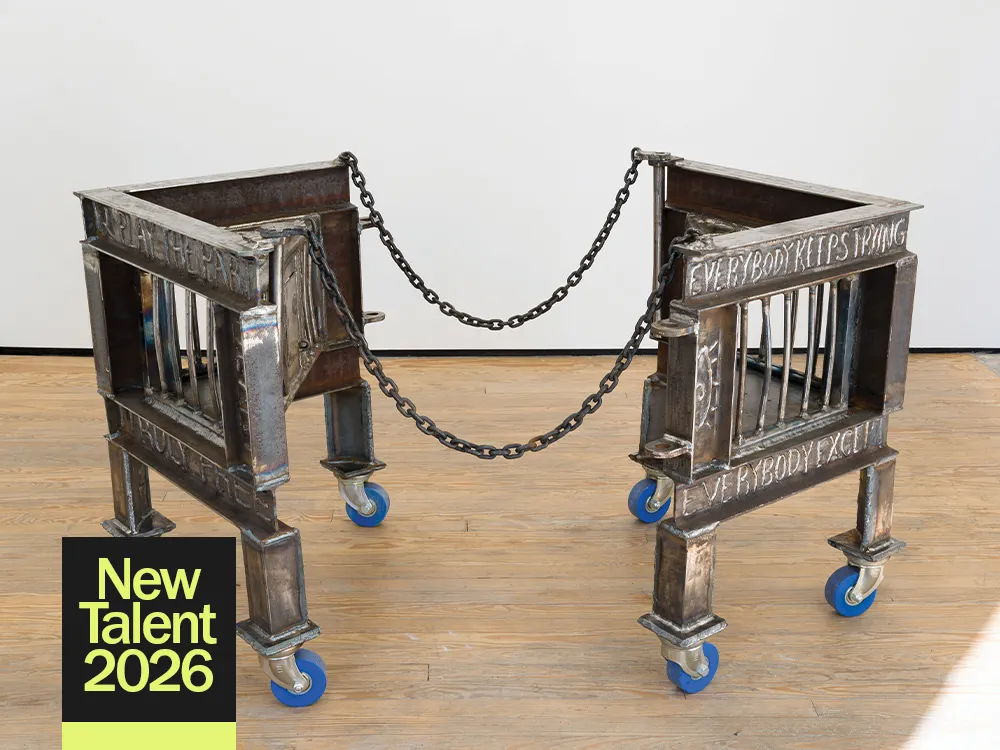
Davis’s sculptures evoke the ways materials morph across time, and act as a prism through which to consider notions around masculinity, queerness, and Blackness. Perhaps this is why steel, a material that can be melted and remade again and again, is his other medium of choice. For sculptures in his 2025 show at King’s Leap Fine Arts in New York, Davis repurposed disused beams from Bethlehem, a steel town in Pennsylvania, and from a building at Columbia University, where he received his MFA that year. One, titled Slave (2025), looks like a wheeled crib, but chains connect its two halves; lyrics from a song with the same name by Prince are scarred into its surface. “The whole thing is about transformation—these things appearing one way, when in reality, there’s something else: serious durability,” Davis said.
Davis traced his interest in steel back to a formative viewing of 1991’s Terminator 2: Judgment Day, whose climax involves two cyborgs duking it out in a steel mill. But he also attributed the interest to a childhood fascination with masculinity. He grew up in the Bronx, where he was born to a Nigerian mother and an American father who, he said, would relay “crazy stories about fighting people, thuggery, and experiencing life in a world full of men.” His mother, meanwhile, spoke of her own endurance—including 20 hours she spent in labor when Davis was born, an act that seemed as “macho” to Davis as his father’s brawls.
The adage that masculinity is a prison got a workup in Davis’s King’s Leap show, where his sculptures featured chains, cage-like enclosures, and locks. Made using a blowtorch whose heat causes the works to take on shades of blue that resemble bruises, these sculptures allude to the violence of containment. Davis built on this interpretation when he told me that, as a Black man in America, “not a day goes by where I don’t think about prison.” But he also expressed hope that his sculptures might be viewed on different terms—as a means of converting a strong, heavy material into a softer one. “That’s the magic of vulnerability,” he said, adding, “It’s alchemy.”


