








Is fashion art? Last night's Met Gala returned to the steps of the Metropolitan Museum of Art to make that case. The annual convergence of fashion, art, entertainment, and high society marked the opening of the Costume Institute's spring exhibition, "Costume Art," with a dress code that made its position explicit: "Fashion Is Art."
On the red carpet, that proposition unfolded through citation, homage, and self-reference. Singer Troye Sivan, in Prada, channeled Robert Mapplethorpe, echoing the late photographer's 1980 self-portrait in a fur coat. Amy Sherald, arriving on the heels of her "American Sublime" solo show opening at the High Museum of Art next week, turned inward, referencing her own Miss Everything (Unsuppressed Deliverance) (2014) in collaboration with designer Thom Browne. Actor Luke Evans leaned into the coded eroticism of Tom of Finland with a full brown leather look, while singer Sam Smith's embellished robe by Christian Cowan nodded to the glamour of Erté illustrations.
Elsewhere, singer Gracie Abrams in Chanel and actor Hunter Schafer in Prada played with interpretations of Gustav Klimt paintings, while Jon Batiste offered one of the evening's most direct tributes to Barkley L. Hendricks. The singer began in a blue Superman T-shirt and shades, evoking Icon for My Man Superman (Superman Never Saved Any Black People—Bobby Seale) (1969). He later changed into an all-white puffer coat, pants, and cummerbund, bringing to mind Hendricks's Steve (1976). Actor Angela Bassett, meanwhile, paid homage to Laura Wheeler Waring's Girl in Pink Dress (1927), a painting in the Met's permanent collection.
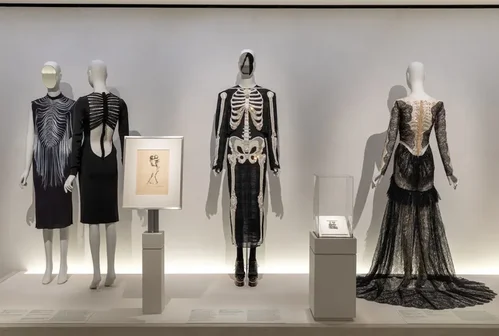

If the red carpet made the argument outwardly, "Costume Art" brings it into focus within the galleries. Organized around thematic "body types"—the Classic Body, the Pregnant Body, the Anatomical Body, and so on—the exhibition examines the dressed figure as both subject and surface. It traces the interplay between clothing and the body, revealing how representations of the figure are shaped by what it wears, and how garments, in turn, construct the body they adorn.
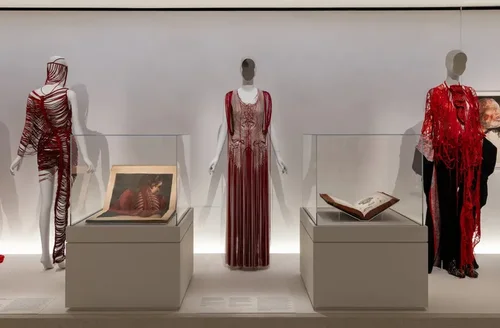
The show also inaugurates the Costume Institute's new Condé M. Nast galleries, tucked just beyond the museum's Byzantine displays. It opens with a meditation on the nude and the naked body: Adam-and-Eve–like garments by designers Lùchen and Walter Van Beirendonck placed in dialogue with sixteenth-century engravings by Marcantonio Raimondi and Heinrich Aldegrever. This curatorial strategy, pairing dress with objects across the museum's encyclopedic collection, sets the tone for the exhibition. A veiled silk dress by Maison Margiela is positioned alongside Raffaello Monti's The Veiled Woman (1854). Duran Lantink's bulbous "Morphing Suit" sits near a Polaroid by Lucas Samaras. Miriam Beerman's painting Bloody Heads Number 39 (1969) is paired with a red crocheted dress by Yuma Nakazato, both evoking the anatomical.

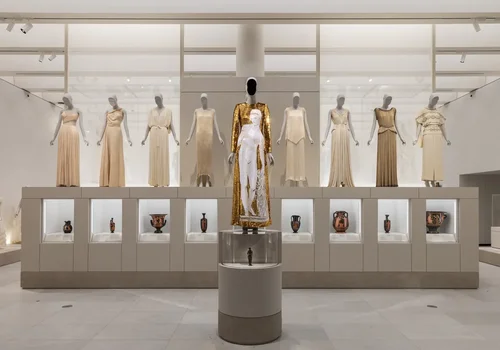
This is an exhibition designed for immersion. Mirrored mannequin heads fold the viewer into the display, reflecting the body into fashion's frame. What emerges is both a survey and a reframing: a concise history of dress. Early twentieth-century couturiers Madame Grès, Madeleine Vionnet, and Mariano Fortuny stretch through to contemporary designers like Richard Quinn, Batsheva, and Vetements—set in dialogue with a broader history of art. From Cycladic marble figures and ancient Egyptian limestone busts to Yayoi Kusama's Red and White Pumpkin (2011) and Jane Hammond's Tabula Rosa (2001), the exhibition moves fluidly across disciplines and centuries.
In doing so, "Costume Art" reframes the premise it sets out to test. Fashion is not merely adjacent to art, nor is it borrowing its language—it is operating within the same lineage. The exhibition opens May 10 and runs through January 10, 2027.


