






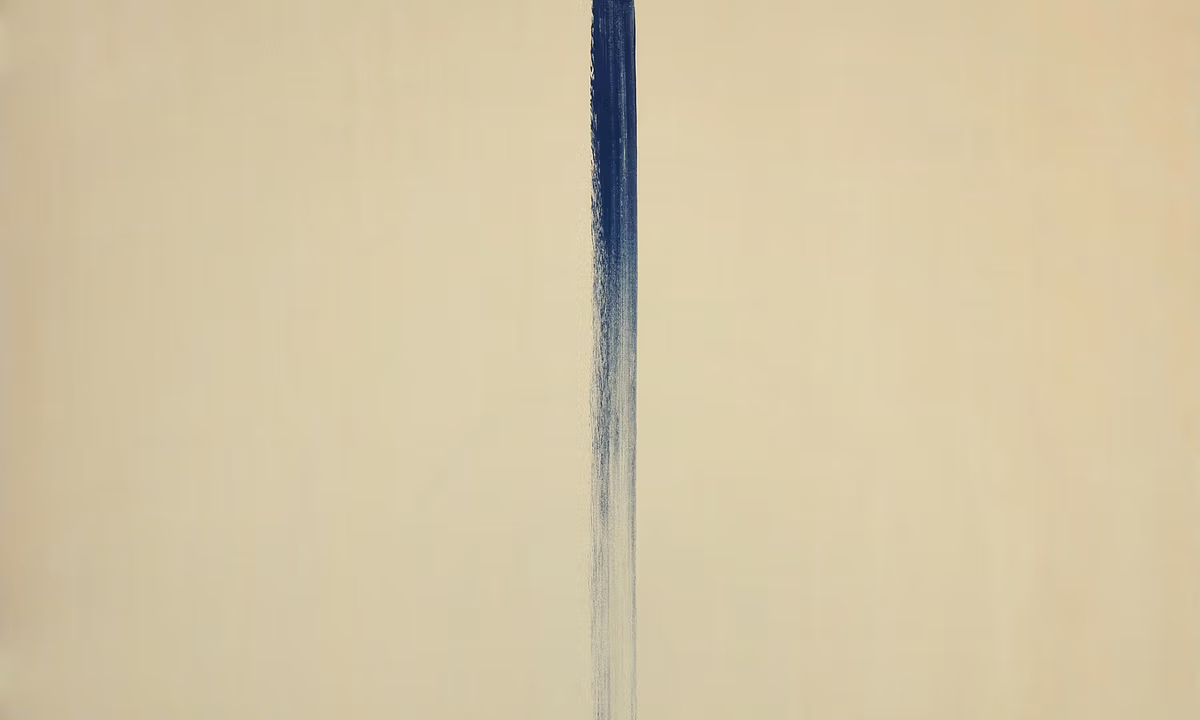
Painter, sculptor, writer and philosopher Lee Ufan came to prominence in the late 1960s as a founding member of the Mono-ha (School of Things), a loose artist group in Japan using natural and industrial materials to highlight physical properties and spatial relationships, rejecting the artist’s hand. Lee’s From Point and From Line paintings, also initiated around this time, marked the passage of time with repeated marks until no more pigment remained on the brush. Subsequent series of paintings and sculptural works have continued to amalgamate Eastern and Western aesthetics and philosophy into a distilled language around form and void, presence and absence to address relationships between time, space and metaphysics.
To mark the South Korean artist’s 90th year, Dia Art Foundation is presenting a major solo exhibition at SMAC San Marco Art Centre as an official Collateral Event of the Venice Biennale, as well as simultaneously opening a new display of his painting and sculpture at Dia Beacon in New York State. In July Lee’s first show in Portugal also opens at Casa e Parque de Serralves.
Lee Ufan was a founding member of the Japanese Mono-ha group
Photo © Paolo Roversi, courtesy Pace Gallery
The Art Newspaper: Venice is a very particular place to show, especially during the Biennale. Has this location influenced how you have approached your exhibition?
Lee Ufan: I have exhibited in Venice several times in the past; the fact that this is at the time of the world-renowned Biennale is very challenging but also a great joy for me. I understand the theme of the Biennale, but my intention is to try and exhibit my own stance and questions that I have in regards to art.
Your exhibition at SMAC offers traces the evolution of your painting, from works made in 1967 through to new works created in situ. There are also two sculptural works made especially for Venice. How do you view this journey?
I was born in Korea, I studied in Japan and I have been doing this work for close to fifty years. More than half that time has been spent outside of Asia, mainly in Europe and the United States, learning from the artists and the art scenes there. In this process I have been constantly questioning myself and thinking about the way forward. I’ve learned about Modernism in Europe and also how to criticise it, but that’s not to say I am showing or insisting on an Asian aspect. Of course I am Asian and so I’ve inherited an Asian nature and this continues to be with me. So it’s a very complicated situation: being exposed to Europe and geographies while being Asian, and I have tried to build a new way of expression and to open up my own pathway.
It seems that this approach is rooted in a more universal sense of experience and encounter as opposed to favouring a specific culture.
Rather than insisting on my own identity and upbringing I attach great importance to exchanges and dialogues with others outside of myself. I’ve always been critical of the idea of art as almighty, with the artist at the forefront, determining everything. Instead I try to keep low key and accept and express things that are from the outside.
You’ve mentioned the importance of seeing a Barnett Newman exhibition in New York in 1971.
In 1971 I went to Europe for the first time to take part in the Paris Biennale and on my way back, I stopped in New York and saw the Newman exhibition at MoMA. At the time in Japan as well as in Europe they were saying that the age of paintings had ended and so I was astonished to an exhibition of such powerful paintings. And it had a major impact on me. But I saw Newman as more of a spatial painter and I didn’t think this was something I could do. Then I was reminded that [studying calligraphy] in my childhood in Korea I learned about the points and also how to draw lines; and so it gradually came to me that maybe I can try to use my body to express the passage of time. This was something anyone could do at any time and in any place. So I became determined to aim towards making such a temporal painting, and Barnett Newman led me to do that. I thought that I should break conventional modernism and try to come up with something new. And this was because of New York.
It was around this time that you became a part of Mono Ha or “School of Things”, which challenged established boundaries between art and the world and was based in the same philosophy of the socio-political uprisings of the times.
In the late 1960s everything was very violent and destructive. There was the May Revolution in Paris, the anti-Vietnam War movement and hippies In the US. Also in Japan the intellectuals were organising riots and people were opposing colonialism, mass production and imperialism. In these early days I never exhibited any of my paintings, I was doing them at home. Instead I focused on sculptures—or happenings, as we called them then. In 1967 I dropped a stone onto glass for the first time and it was very violent and destructive. Though I didn’t say a word about this being political, you could recognise there was a political message. And so I kept on breaking, it was my starting point.
And this was the same with Mono Ha, we started out with a denial of everything. Then various museums from the US and in Europe asked me to come to their museum and break glass. In the beginning the way I broke the glass was random and disorganised as everything was a denial. But gradually I came to realise that just breaking was not enough. There had to be some sort of order, and something poetic, something interesting in this fissure that I was creating.
And this new impulse coincided with you coming back from America and developing the From Point and From Line paintings?
Yes at the same time as we were doing these very violent installations dropping stones onto glass and trying to make something out of that, with my paintings I was starting to focus on expressing the temporal process, of how time goes by. This may seem contradictory but I came to think that you had to do things systematically and that a painting could only become a work of art if there is a certain order there. That was my thinking back then. And I did that for about 10 years.
In making the From Point and From Line you drew on your childhood calligraphy training by holding your breath and then breathing out for the duration of the stroke. Has this ritual remained part of your process?
Yes, it’s like a ceremony. But it is also quite biological because all creatures have to breathe, to exhale; it’s only natural. You cannot draw a line or a point when you inhale; it’s strange, but you cannot do it right. You shouldn’t be overly conscious about how you breathe, but it’s important that either you stop breathing or quietly exhale; it’s only when you do this that you can really express what you want to express. When you exhale, the painting goes smoothly.

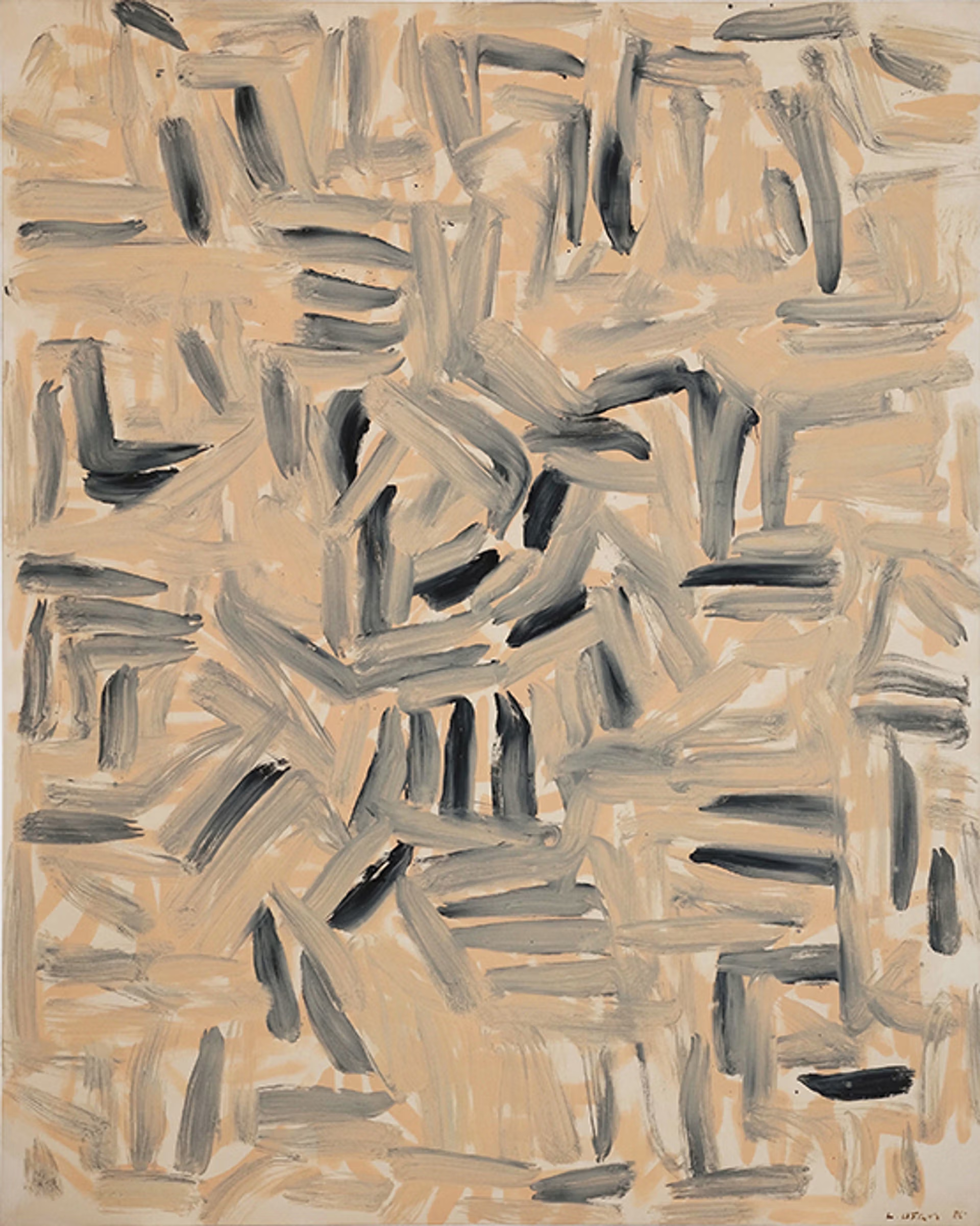
Ufan’s From Winds (1986)
Photo by Kei Miyajima, © Lee Ufan/Artists Rights Society (ARS), New York/ADAGP, Paris
In 1980 you started to make the more tumultuously gestural From Winds and With Winds paintings, which feature in both your Venice and Dia exhibitions. These will be a revelation to many people. What prompted this painterly outburst?
I felt uncomfortable having to abide by certain orders and started to question whether I really should insist on such a system. I just wanted to destroy the whole thing. The intention was to bring in the wind from outside and to break things up with this very rough, chaotic type of look. This led me to the Wind series. Then, gradually, things started to get sorted out and I came to look at those areas where it is unpainted, where there is the touched and also the untouched portion. I turned to making big brushstrokes and unexpectedly I found out that by layering the brushstrokes I could shift from the temporal to the spatial.
In your more recent Dialogue paintings, it seems that what is not there matters as much as what is.
This is very important. In the beginning, I was keen to fill the whole canvas but later I had questions about filling up the canvas with this “all-over-ism”. With the Wind paintings I went on to make a mess, and through that process I came to recognise that I should try to reduce the amount of things that I make and focus on the untouched part. Now, I’m trying to keep what I make to a minimum and to combine the painted and unpainted so as to establish a new form of expression, a dimension which goes beyond me. This is an important phase, which I’m very proud of. Even with my sculptures, I try to combine these very natural things with industrial materials, and try to bring together those things which are made and unmade, to go beyond myself and to broaden my world.
Do you still paint on the floor?
I do. If it’s a big artwork, I get on a ladder and bend over the canvas and paint. It’s like diving into the canvas, putting your whole body into the canvas and swimming there. I don’t like to have the canvas positioned on the easel and be face to face because if you take that posture then your head is straight up and your ego functions more strongly. By bending over, your body is working more than your brain. Everything is natural and it’s part of the universe, so I try to create that flow. With the wall paintings, I have to stand up but I still try to use an extension of how I draw on the floor and not face up to it. If you are too conscious, then I think that you are not able to express what you want to express. That is the reason why I take such a posture.
In Venice you are making two paintings in situ: one on the floor and one on the wall. Is there a different thinking behind making these works as distinct from painting on canvas?
Each have their own uniqueness. People tend to think of the canvas as something sacred, but canvas is a very limited and semi-materialistic space. Although you can move it and fold it, it is still a very material thing. And the size is fixed. With a painting on the floor, people can walk around the space and maybe hear the sound of the gravel. Unlike the canvas it is connected with the space. We are reminded that we are walking on this earth, and it has this characteristic of having to be at that location. Meanwhile, drawing on the wall is again one space and one fixed physical material. But one touch on a wall is very much influenced by the space around it and the outside world. That is the difference. There are these things which are very material, then there’s the space. It’s this relationship with the external space that you combine with the work. Through such expressions people feel a connection with nature and space. And this doesn’t have to be said in words.
In the past you never showed your paintings and sculpture together but your Dia and Venice exhibitions contain both paintings and sculpture, and in Dia they occupy the same rooms. How has this relationship between your paintings and sculpture evolved?
Early on when it seemed as if the order of the paintings contradicted the violence of the sculptures I thought I had to exhibit them separately. But in the late 1970s and 80s when I started to destroy the system of my paintings, I felt that the two were now in a similar situation and there was no problem in showing them either together or separately. There was also a stimulation between the two. Even with just one small stroke on the canvas, there is this void, this blank space which vibrates around it; and in the same way in the sculpture it is important to consider the whole space around the stones and the metal plates. We have to look at the relationship between what is seen and not seen, and the things that exist and don’t exist.
Sky Road, your new sculpture for Venice consists of two large stones resting on two mirror-polished stainless steel plates. The rocks in these recent sculptures tend to come from the area where they are being shown. What are your criteria for selection?
I started using stones to create works that were quite violent in terms of expression. Then I tried other things, like putting stones on cushions and lining them up in a rather mundane, primitive way. But looking at the history of humankind, I came to recognise that stones were an indispensable part of human culture and civilisation, and to understand that there was something very supreme about stone. It has this big power. It’s not just a material and it goes beyond being something natural. So I started to think of how I could use these stones. I try to use the local stones as much as possible—nothing special, just very ordinary stones. But it makes it all that more difficult to find those things. Now I’m very curious about the existence of stones and I want to research more so that I can really appreciate the outstanding features of them.
Your early paintings were often dark blue or rusty orange. Then your With Winds and From Wind paintings were monochrome shades of grey, while your most recent Dialogue works are often in a new palette of vivid colours. What role does colour have in your work?
I started out with monochrome, this was an entry point for me. Then in the 1970s I was focused on blue and orange, it was a subdued way of using very simple colours—though I used other colours in my watercolours. But as I grew older and I looked at the concept of having orderly, systematic things I came to recognise that I should have more exchange with the outside world. And if you look around the world there are many colours that exist in nature. I came to understand that using colours with minimal brushstrokes and expression would be have more impact in communicating with the viewers. So I started to actively use more colours, to overlay different colours and have clashes. It was like an ocean of colours! And I joked and said it was like a desire to become young again!
Your show at Dia Beacon consists of eight paintings from the 1970s to the early 90s, alongside three sculptures from your Mono-ha period, while the Venice exhibition brings together works from over seven decades, including new installations. How do they relate to each other?
In both exhibitions the paintings and sculptures are visual expressions in collaboration with my body; that is the phenomenon that I want people to experience. In Dia, I want people to take their time and slowly look at what I did mostly in the 70s, but also 80s and 90s: to look at the process through which I’ve lived and to try to find themselves, to feel my breathing. In Venice it is to look at one artist’s footsteps to this day, and try through this experience to understand that there is a different context, an ancient world, different from what is in fashion today. Today we are living in an age of AI, but I’m hoping that people looking at my paintings will feel what a living being can do and can sense their own power of life and the fact that they’re living. Also, to think about what they would like to do in the future—their future dreams.
When you were the theorist and philosopher of Mono Ha you wanted to change the world with your art. Now, over half a century later, do you still believe that art can help change the world?
In the beginning, Mono Ha was a denial, but then I came to be more positive and affirmative. We no longer have Mono Ha, but those who are still surviving also now try and create things which are more orderly, poetic and fun. But this doesn’t mean that we should come up with one single answer. Once an artist comes up with an answer, it becomes dull. An artist should constantly be questioning things and trying to figure out this ambiguity.
I came to appreciate that I should always have this feeling of discontent, trying to portray my own image, but so that people could interpret it in their own way. It’s a lot of work, and it takes time. The process of making is important, it shows the way of your life to people. With AI, there is no process, no time spent. All that matters is to come up with the answer. Humans need to experience, to go through process and to spend time. It’s only after this that you can start to think about your own life, how to live and the power of living. This is what I want to be portraying through my works of art.
It’s also important that the art is in situ, and there is this connection with location. People need to come to the site and by the direct experience of looking at the artworks then to think about and question themselves. So I think the role of art is to invite people to such places, get them to see it and then to think about themselves.
• Lee Ufan, SMAC San Marco Art Centre, Piazza San Marco 105, 9 May-22 November


