








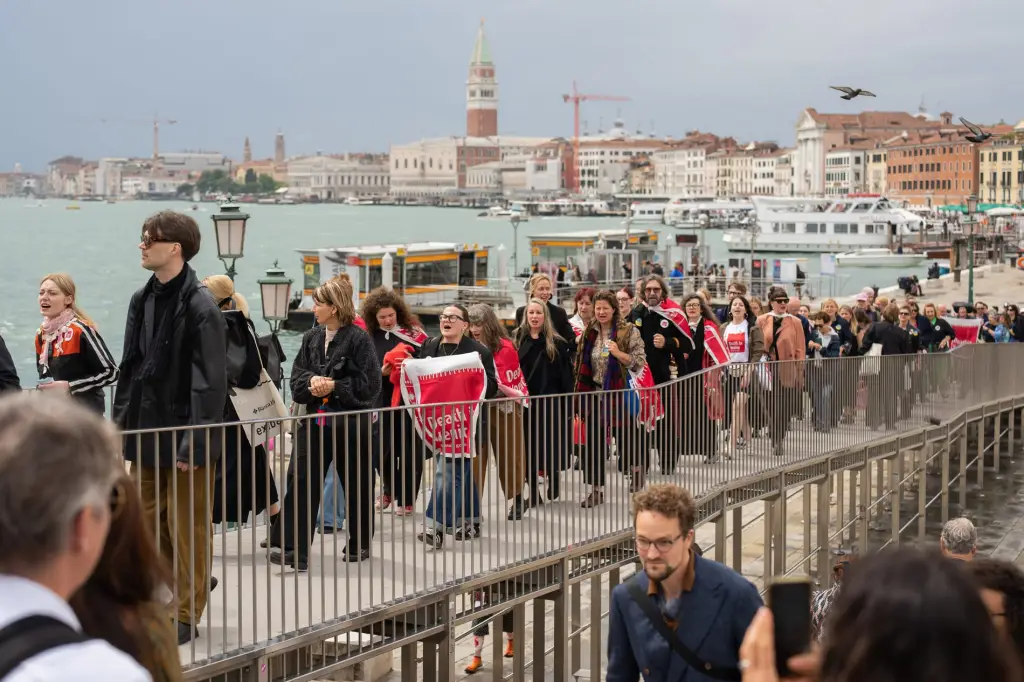
Three Baltic pavilions at the 2026 Venice Biennale—Lithuania, Latvia, and Estonia—organized a walk in solidarity with Ukraine on May 6, one of the exhibition’s preview days.
A statement from the Lithuanian Pavilion explains that the procession was dedicated to cultural workers from Ukraine “who continue to create and represent their country in conditions of war, as well as to those who have lost their lives because of ongoing violence.” Ukraine has its own pavilion at the Biennale, and this year’s show, “Security Guarantees,” features work by Zhanna Kadyrova.
The walk began at the Lithuanian Pavilion in the Fucina del Futuro, progressed to the Latvian Pavilion in the Arsenale, and ended at the Estonian pavilion at Patronato Salesiano Leone XIII, a church–turned–community center. The total distance was about a mile and a half.
The action is one of many political statements that have already taken place at the highly contentious 2026 Biennale, which doesn’t open to the public until May 9.
On Wednesday morning, Pussy Riot and FEMEN protested at the Russian pavilion, and on Tuesday, dozens of artists gathered at the entrance to the Giardini in opposition to Israel’s inclusion in a collective action titled “Solidarity Drone Chorus.” Tomorrow, the Art Not Genocide Alliance has organized a rally to kick of a 24-hour strike, also in protest of the Israeli pavilion. And mere days before the art world descended on Venice for the preview week, the entire jury resigned, presumably related to their prior decision to exclude countries charged with crimes against humanity by the International Criminal Court, which would include both Israel and Russia.
Solvita Krese, the director of the Latvian Centre for Contemporary Art in Riga and commissioner of the Latvian pavilion, made clear what is at stake: “In today’s geopolitical reality, we are reminded that freedom is never self-evident—it must be defended. The Venice Biennale’s decision to allow Russia’s participation raises urgent questions about the responsibility of cultural institutions.”


