






Editor’s Note: This story originally appeared in On Balance, the ARTnews newsletter about the art market and beyond. Sign up here to receive it every Wednesday.
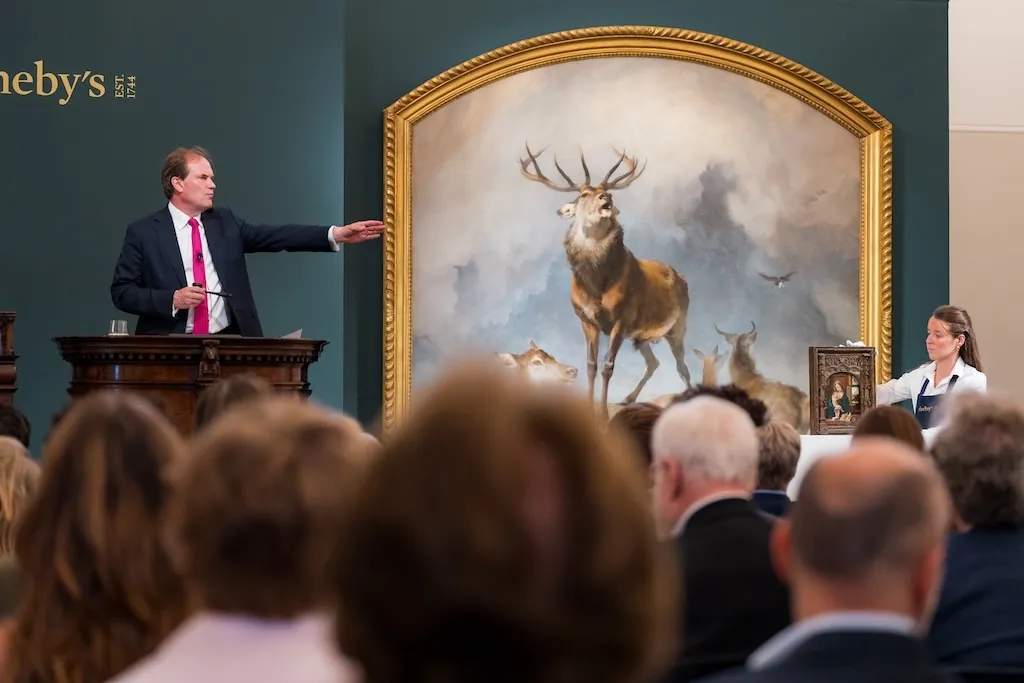
In London on Wednesday, Sotheby’s Old Master & 19th Century Paintings and Sculpture sale brought in £37.8 million ($50.2 million), a solid result that masked a sharply divided market. Record prices, a flurry of bidding for museum-quality works, and a £13.6 million sculpture suggested demand for trophy property remains strong. At the same time, 10 lots failed to sell, exposing a market that has become increasingly unforgiving for more ordinary material. (All reported prices include the buyer’s premium.)
Coming less than 24 hours after Christie’s equivalent sale topped its high estimate, Sotheby’s reinforced what is quickly becoming the defining story of London’s summer auctions. Collectors are still willing to compete fiercely for exceptional Old Masters. They’re just becoming far more discerning about everything else.
The evening’s top lot was the Hamilton Laocoön, a monumental Neoclassical marble by Auguste-Jean-Marie Carbonneaux after the celebrated ancient sculpture. After a 15-minute bidding battle involving four collectors from Asia and Europe, the work sold for £13.62 million ($18 million), becoming the second-highest price ever paid for a pre-modern sculpture at auction.
Alex Bell, chairman emeritus of Sotheby’s UK and Old Masters worldwide, said the work succeeded because it combined scale, rarity, impeccable provenance, and immediate visual impact. “You had all the elements there of different types of collectors finding this object,” he said.
Among the paintings, Rembrandt’s Let the Little Children Come Unto Me realized £8 million ($10.6 million), squarely within its estimate. That result may have been less dramatic than some of the evening’s records, but it was revealing in its own way. The picture was nearly three-quarters finished when the artist died in 1669, leaving passages that expose his working process. Rather than igniting a speculative bidding war, it sold at exactly the level specialists had anticipated—a reminder that the market’s consensus around great masterpieces remains remarkably disciplined.
Elsewhere, buyers showed they were perfectly willing to abandon discipline when the right picture appeared.
Hans Memling’s intimate Virgin Mary Nursing the Christ Child, one of the last important devotional panels by the artist still in private hands, climbed to £3.51 million ($4.66 million), setting a new auction record. Bernard van Orley’s Virgin and Children reached £2.04 million ($2.71 million), while Cosimo Rosselli’s Christ as the Man of Sorrows more than doubled its high estimate to sell for £960,000 ($1.3 million). A set of seven early 17th-century Flemish copper paintings illustrating the Seven Days of Creation soared to £768,000 ($1.02 million), nearly six times its high estimate, while Palma il Vecchio and Michiel van Musscher also established new auction records. Gainsborough’s Portrait of Mrs. Sloper, estimated at just £40,000 to £60,000, brought £230,400 ($305,000), nearly four times its high estimate.
What united many of the night’s strongest performers wasn’t a single school or subject. It was that they offered collectors something memorable. “I do think the works that visually resonate with new collectors—and the works that tell stories—are the ones that perform,” said Elisabeth Lobkowicz, a director and specialist in Sotheby’s Old Master Paintings department. Bell agreed, arguing that no single ingredient explains success. Sometimes it’s extraordinary condition. Sometimes it’s a celebrated provenance. Sometimes it’s sheer visual impact. More often, it’s some combination of all three.
That helps explain why the sale’s final tally tells two stories at once.
Ten lots failed to sell, a considerably higher number than Christie’s posted the previous evening. Yet collectors weren’t simply avoiding lower-priced works. Twelve pictures carrying high estimates of £200,000 or less found buyers, while five in that same price bracket failed to sell. Four additional buy-ins were estimated between £300,000 and £500,000.
The contrast with Christie’s was instructive. Tuesday’s sale produced just three buy-ins and set six artist auction records, led by Sir Thomas Lawrence’s Portrait of the Duke of Wellington and a pair of Jan van Huysum still lifes. Sotheby’s generated another flurry of records—including Memling, Van Orley, and Rosselli—but it also produced more than three times as many unsold lots.
The two evenings suggest collectors remain eager to compete for museum-quality pictures, even as they become increasingly demanding elsewhere in the market.
Bell cautioned against drawing too broad a conclusion from the buy-ins. “Sometimes you’ve got a very good picture where collectors weren’t there on that particular day,” he said. “And then sometimes … the discount on the estimate needs to be greater than we had applied.” Estimating an Old Master, he added with a laugh, is equal parts “psychology and economics.”
If the buyer pool is changing, advisors say that’s no accident.
“Ten million can’t get you much as far as significant contemporary works go, but for that same price you can walk away with a small Rembrandt or a Titian,” said Mari-Claudia Jiménez, a partner and head of Withers Art and Advisory. Before joining the firm, Jiménez served as chairman and president of Sotheby’s Americas, where she oversaw the auction house’s Old Masters department. “Young collectors find the value proposition in Old Masters quite seductive. They can buy a 500-year-old work by a blue-chip master for the same price they would pay for a recently painted work that hasn’t stood the test of time.”
Philip Hoffman, chairman and founder of The Fine Art Group, said many of today’s buyers are crossing over from other collecting categories. Contemporary collectors, private equity executives furnishing country houses, and even artists such as David Hockney and Jeff Koons have all helped broaden interest in the field. Rumor has it that other prominent Old Master collectors include Blackstone co-founder Stephen Schwarzman and Law & Order creator Dick Wolf, though neither has been linked to this week’s London sales. Even so, Hoffman argues the market remains highly concentrated.
“There are serious collectors of Old Masters, but very few of them,” he said. “It’s a downhill struggle for the middle and lower end of the market.”
Christie’s and Sotheby’s summer buffet of Old Master pictures offered a useful snapshot of where that market stands today. Across two evenings, collectors chased Van Huysums, a Lawrence, a Memling, a Rembrandt, and the Hamilton Laocoön, producing record prices and spirited bidding for works that combined rarity, scholarship, and visual appeal. But the auctions also showed that demand has become increasingly object-driven. In Old Masters today, the category itself is no longer enough. The picture has to give collectors a reason to fall in love.


