
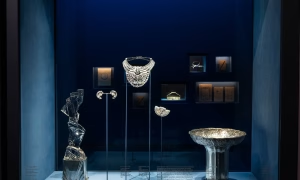
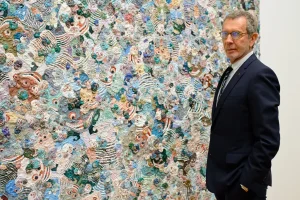





For Dior’s fall/winter 2026–27 haute couture show in Paris, creative director Jonathan Anderson took inspiration from the materially inventive sculptures of American artist Lynda Benglis. Over more than 50 years, Benglis has redefined the boundaries between painting and sculpture, transforming industrial materials like plaster and latex into viscous, amorphous forms.
Presented during Paris Haute Couture Week, the collection—which was Anderson’s second couture collection for the French fashion house—translated many of Benglis’s signature gestures, including knotting, pleating, and draping, into sculptural garments. “I think she’s one of the most important living sculptors in America—in the world,” Anderson told the New York Times.
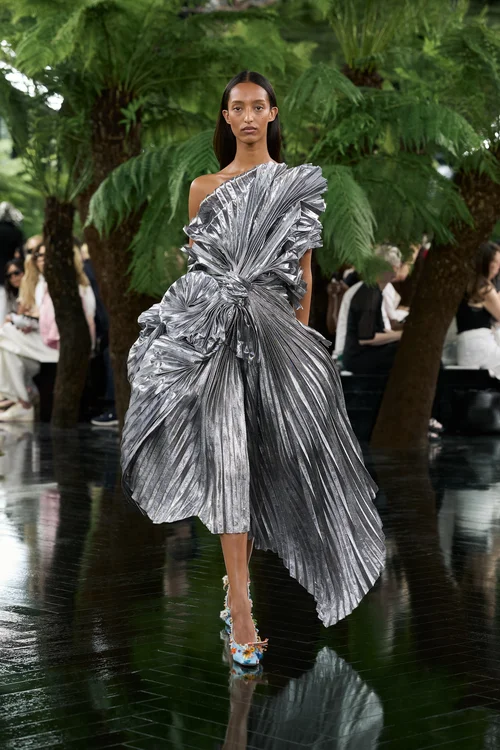

Many of Benglis’s sculptures begin with materials that are folded, twisted, or molded into three-dimensional forms—a process that Anderson has likened to haute couture, in which fabric is transformed into sculptural silhouettes through handwork. Dior’s ateliers echoed the artist’s practice in metallic textiles, iridescent finishes, richly embroidered surfaces, and soft silver netting designed to evoke the appearance of chicken wire.
The collection also draws on places that have shaped Benglis’s artistic practice. Bright floral embellishments and beadwork reference her “Peacock” series, inspired by time the artist spent in Ahmedabad, India, beginning in the late 1970s. The collection’s palette also evokes the desert landscape of Santa Fe, New Mexico, where Benglis maintains a home and studio. Antique fragments of 18th-century Indian chintz and indienne textiles were incorporated into miniature Lady Dior and Petit Dîner handbags.
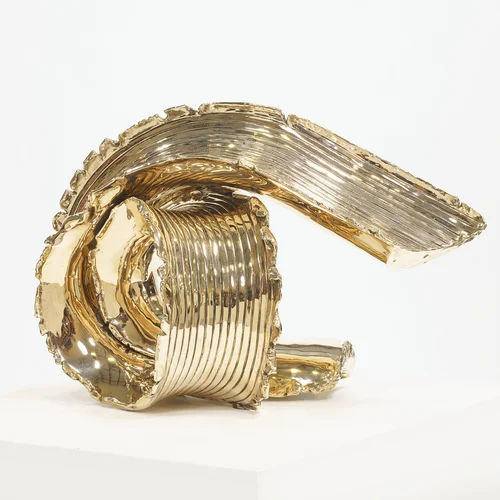

Lucky Strike, 2024
Lynda Benglis
Pace Gallery
Coinciding with the collection, Dior presented “Grammar of Forms,” a temporary installation in the sculpture garden of the Musée Rodin that explored the dialogue between Benglis’s sculpture and couture. The collaboration builds on Anderson’s longstanding admiration for Benglis. He first encountered her work at the Hepworth Wakefield in 2015 and later included her sculptures in the 2017 exhibition he curated there, “Disobedient Bodies.” During his tenure at Loewe, he featured Benglis’s work in runway presentations and collaborated with the artist on a jewelry collection in 2024.
The fashion collaboration arrives as Benglis receives renewed institutional attention. Pace Gallery will present a survey of sculptures spanning more than five decades of her career this fall, while a major 2027 retrospective organized by the Kunstmuseum Basel will travel to Tate Modern in London and the Louisiana Museum of Modern Art in Denmark. Together, the exhibitions underscore the growing recognition of Benglis as one of the most influential post-war American sculptors, whose experimental practice continues to shape conversations across both contemporary art and fashion.


